
Beijing’s RobotEra is scaling into thousands of units with substantial financial backing as its humanoids take over human jobs for some of the world’s largest logistics companies.
Born from one of China’s most elite institutions, the startup has made rapid progress priming its autonomous machines for real-world work in just a few years. The following is everything you need to know about its origin, its technologies, and its plans for a robot-run future.
RobotEra started as a research project at Beijing’s Tsinghua University, a top engineering school often called China’s MIT. The work began in 2022 inside a lab led by Chen Jianyu. The engineer and researcher studied robotics as an undergraduate at the university in its Precision Instrument program. He went on to earn a doctorate in mechanical engineering at UC Berkeley under the renowned robotics professor Masayoshi Tomizuka.
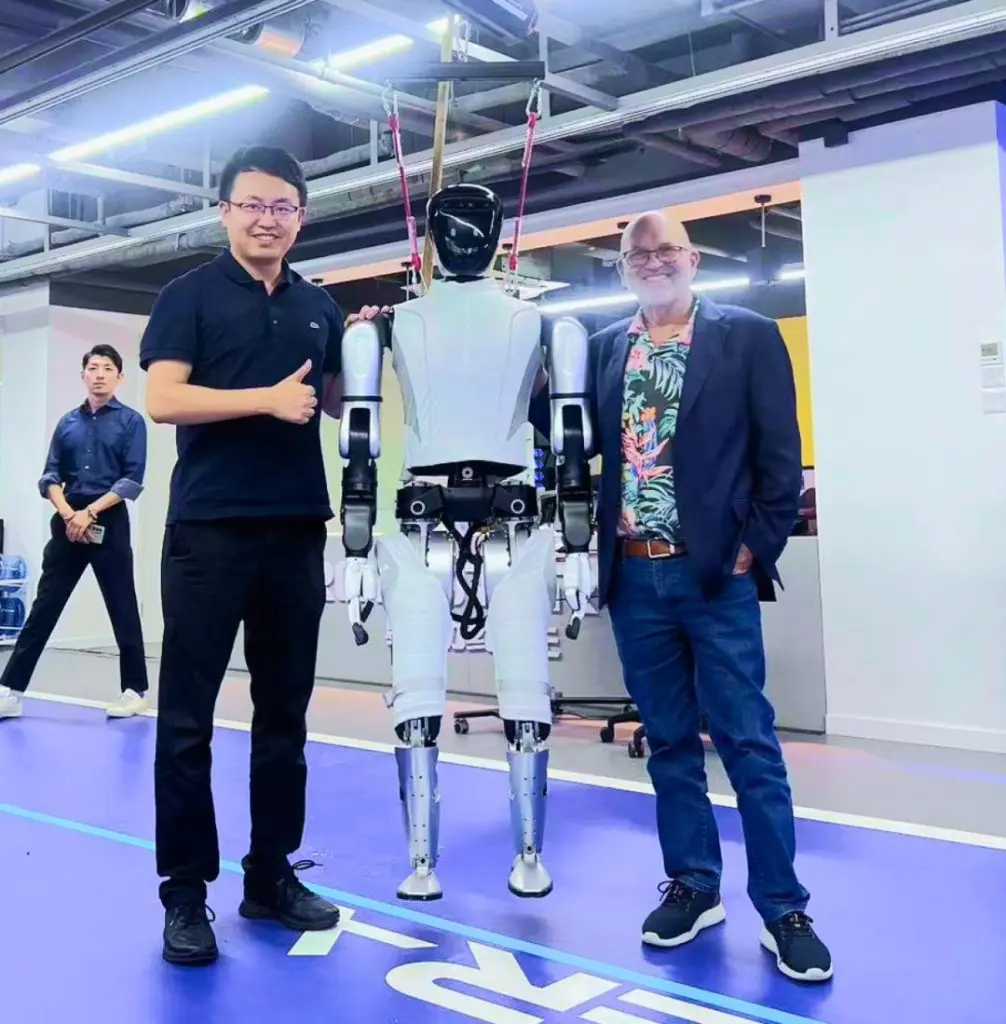
Tsinghua recruited him back in 2020 to lead robotics research. By 2022, his lab was already building early humanoid robot prototypes and experimenting with ways to combine artificial intelligence with robot hardware.
The research-to-company transfer structure gave Tsinghua an ownership stake in RobotEra. It reportedly holds over 6 percent equity indirectly via a university-affiliated entity. It’s the only humanoid company in which the institution has a vested interest. Tsinghua transferred a core leg structure patent into the startup at launch as a technology contribution valued at around $250,000.
With the setup, RobotEra had a strong headstart at a time when there were only a handful of serious players in the humanoid market. The startup’s launch was just a few months before the Chinese government set a national goal to mass manufacture humanoids by 2025 and to own the emerging market by 2027.

Beijing’s policy flooded China’s tech hubs with billions of dollars in funding to rapidly develop next-gen machines. A truly staggering number of startups started popping up throughout the republic, while established firms like Pudu Robotics and KEENON added humanoids to their portfolios.
Perceived leaders in China’s humanoid sector at the time included Shanghai’s Fourier Intelligence, Shenzhen’s UBTECH Robotics, and Hangzhou-based Unitree Robotics, which introduced its first commercial biped, the H1, in August 2023.
RobotEra started unveiling its first prototypes just months following its founding. They started with Starbot, a compact humanoid developed to research autonomous navigation and bipedal locomotion. The startup shared footage of the robot tackling snowy terrain and demonstrating its resistance to interference.
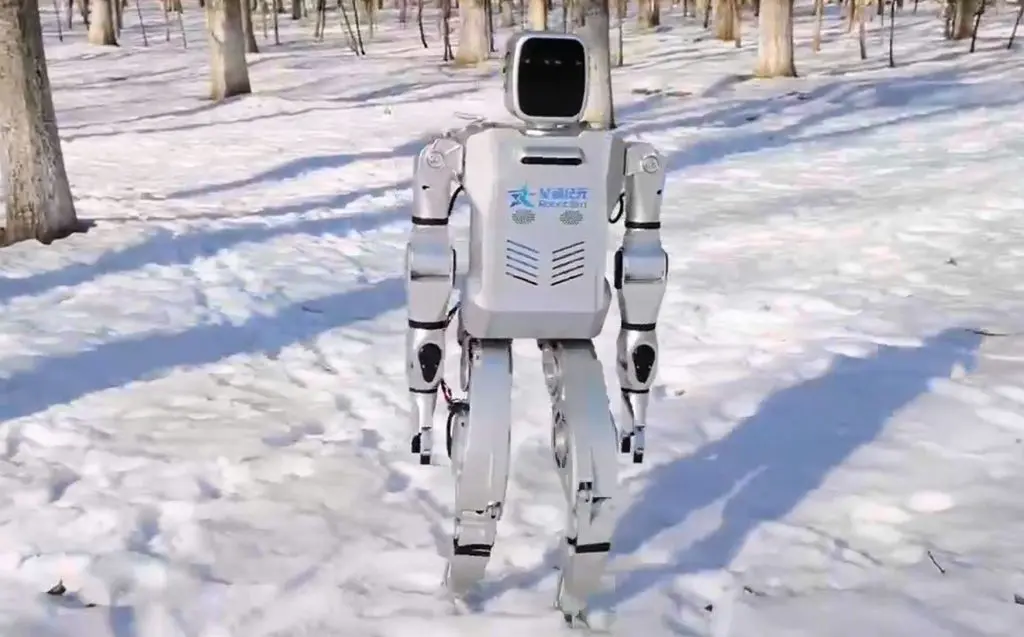
Starbot’s AI was trained in simulation using a digital twin of the robot. It practiced millions of moves in a virtual world to master walking, balancing, and recovering from disturbances. The learned behaviors were then transferred to the physical robot through a process called Sim2Real, short for Simulation to Reality.
Another early prototype was called XBot-L, which gained attention in the summer of 2024 for walking along the Great Wall of China. Standing 165 cm (5 feet 5 inches), the humanoid successfully trekked uneven stone paths, steep steps, and low-light conditions. The achievement was considered substantial at the time, but it was primitive in comparison to what would come.

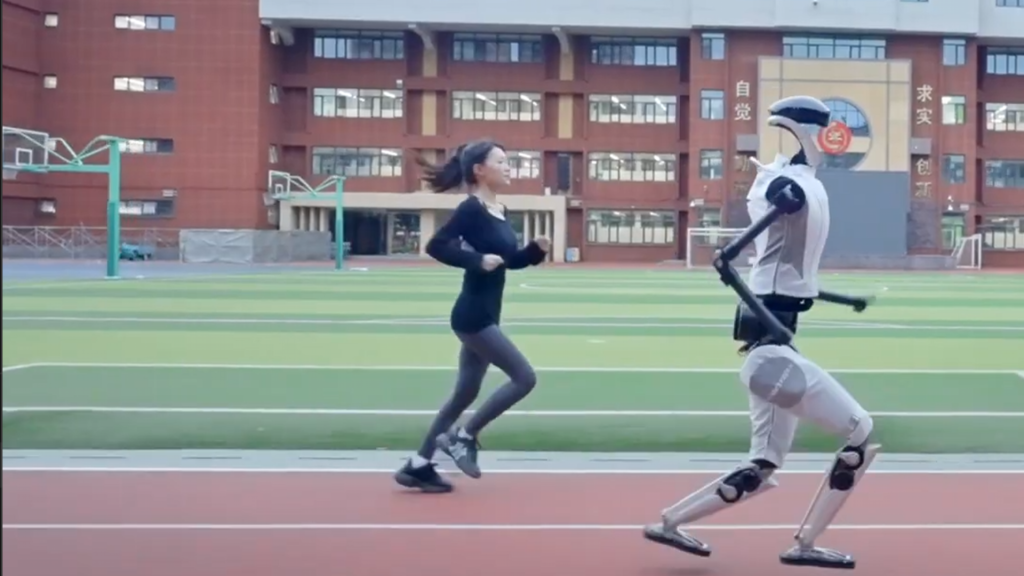
In Fall 2024, RobotEra’s second-generation full-sized humanoid, the Star1, claimed the title of world’s fastest humanoid robot on two feet. The robot achieved a reported top speed of nearly 13 km/h (8 mph) during a 34-minute run in the Gobi Desert’s Hexi Corridor. The former fastest humanoid was the H1 from Unitree, which set the prior record earlier in 2024, clocking in at just under 12 km/h (7.5 mph).
RobotEra also developed a wheeled service humanoid with a thin frame to get around constrained spaces like retail stores and tourist spots. The Q5 humanoid is essentially a more agile and intelligent version of SoftBank’s Pepper robots that proliferated in the 2010s. It navigates autonomously using its LiDAR and stereo vision, while its AI-powered dialogue system understands 37 languages.

The startup hasn’t revealed pricing for the Q5 publicly but third-party reports indicate it typically falls between $20,000 and $90,000 depending on the configuration.
The team also developed a dexterous end effector called the XHand. The AI-powered robotic hand boasts a reported 12 active degrees of freedom (DoF) and tactile sensing for delicate tasks like using beginner chopsticks and serving drinks.
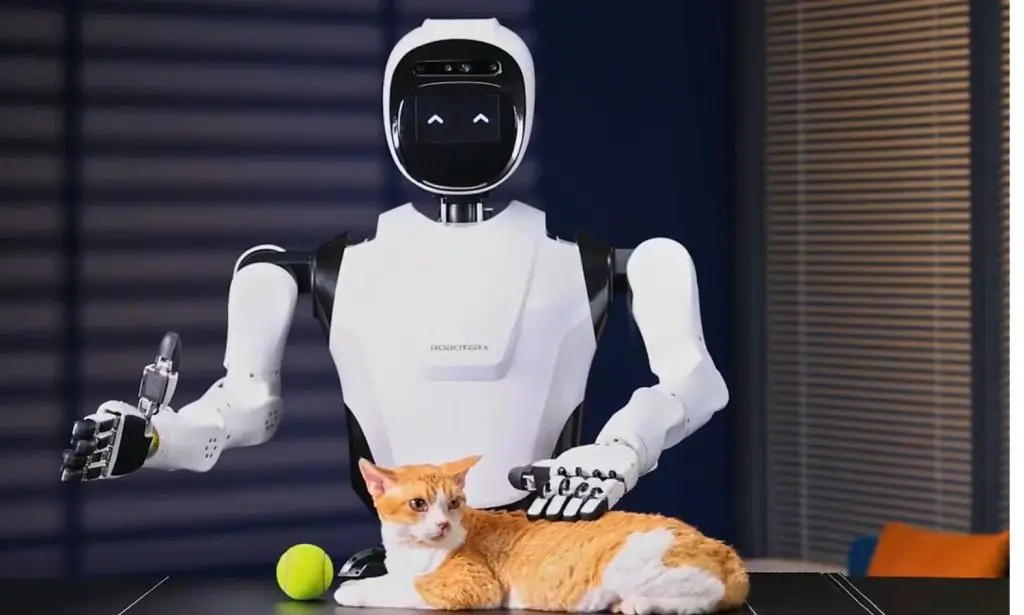
RobotEra’s humanoids run on its self-developed ERA-42 vision-language-action (VLA) model. According to the startup, the system learns from large-scale data, human demonstrations, simulations, and data collected from cameras and sensors.
RobotEra credited the AI with unlocking the real-time coordination and adaptation needed for a viral sword-dance memo produced to commemorate the Year of the Horse. The robot performing alongside a brave human martial artist in the demo is RobotEra’s next-generation two-legged humanoid, the L7. It builds on the Star1’s bipedal agility, adding advanced upper limb dexterity. It’s also faster than the Star1, maxing out at 14.4 km/h (9 mph).

Standing 175 cm (5 feet 7 inches), the L7 features a reported 55 DoF across its body and joints that deliver 400 Nm of torque. It maintains 360-degree spatial awareness with its multi-sensor fusion system that combines panoramic vision, depth sensing, and real-time positional feedback. Its hot-swappable battery system supports an estimated 6 hours per charge.
An upper-body-only variant called the M7 is intended for applications that don’t require mobility as well as data collection and research. Third-party listings for the L7 start around $100,000, while the M7 is roughly half that. RobotEra’s website suggests an easy upgrade path from the half humanoid to the full-bodied L7.
The startup, with a staff of more than 100 people, is scaling production of its robots with a substantial war chest. RobotEra has raised well over $600 million, starting with an early angel round of more than $14 million led by Lenovo Capital. Its investor base includes a mix of industrial and venture players including Geely, Alibaba, and the home appliance giant Haier, which is developing a custom version of RobotEra’s Q5 for households.
RobotEra announced several blockbuster fundraising rounds in 2026, including $143 million in March from investors like Samsung and Porche, and another $200 million the following month in a round led by SF Group (parent company of SF Express).
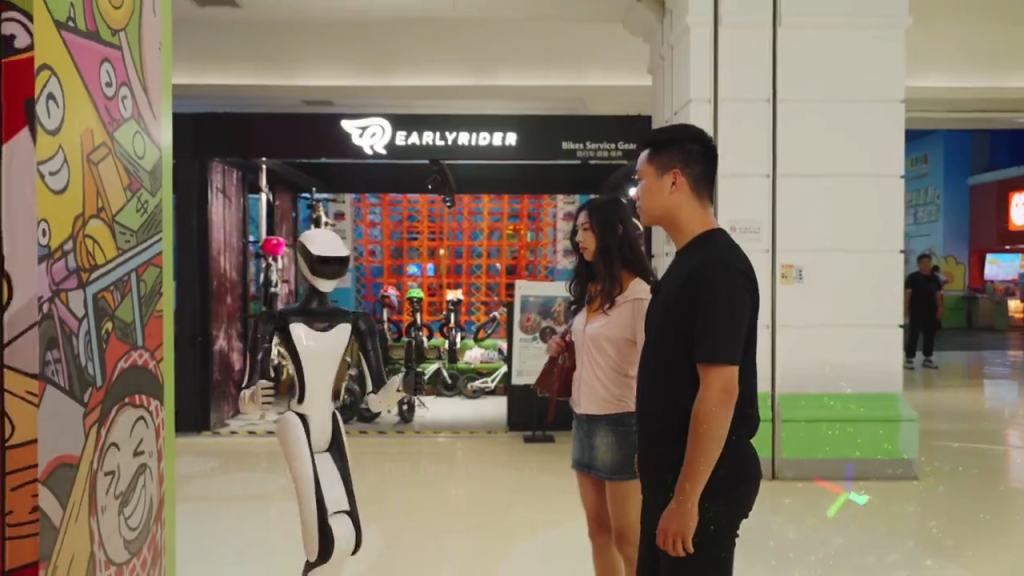
RobotEra hasn’t shipped nearly as many humanoids as Chinese competitors like Unitree, UBTECH, Shanghai’s Agibot, and fellow Beijing startup NOETIX Robotics, but it appears to have found footing in the logistics sector.
According to RobotEra, its flagship humanoids are already operating in more than 10 logistics hubs across the mainland through partnerships with major delivery operators like SF Express and China Post. They’re doing the same jobs normally done by human workers on conveyor lines. They pick packages off moving belts, identify them using their cameras, and use their onboard AI to sort and place each parcel into the correct destination lane.
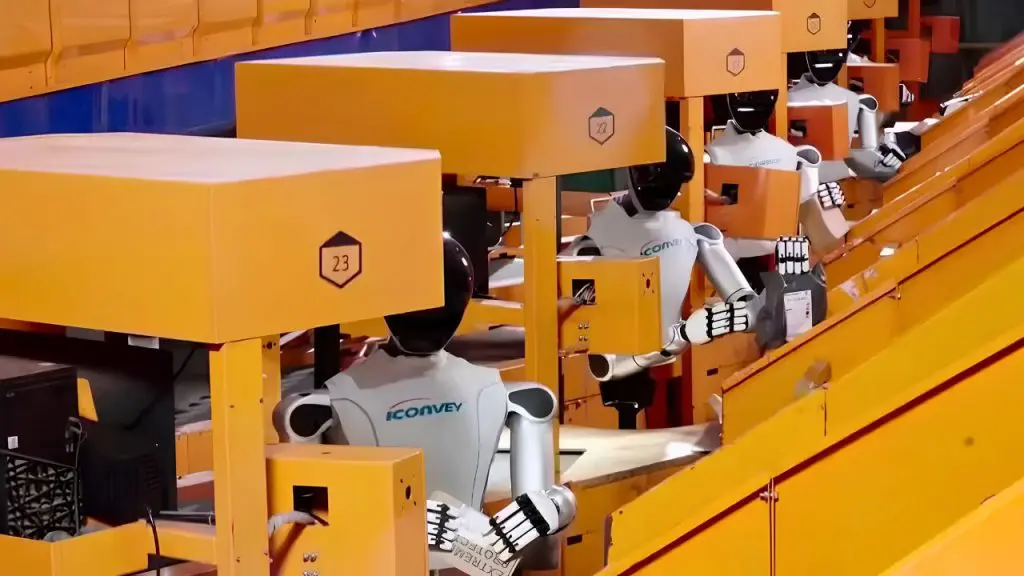
RobotEra reports that the autonomous machines have already reached around 85 percent human-level efficiency in some facilities while running continuously. The company plans to scale to thousands of units throughout 2026.
The logistics sector is turning into one of the most competitive battlegrounds for humanoid makers. They say since warehouses are built for humans to operate in, robots with their form factor can theoretically use the same equipment, navigate existing layouts, and pick up highly repetitive tasks without expensive infrastructure changes.
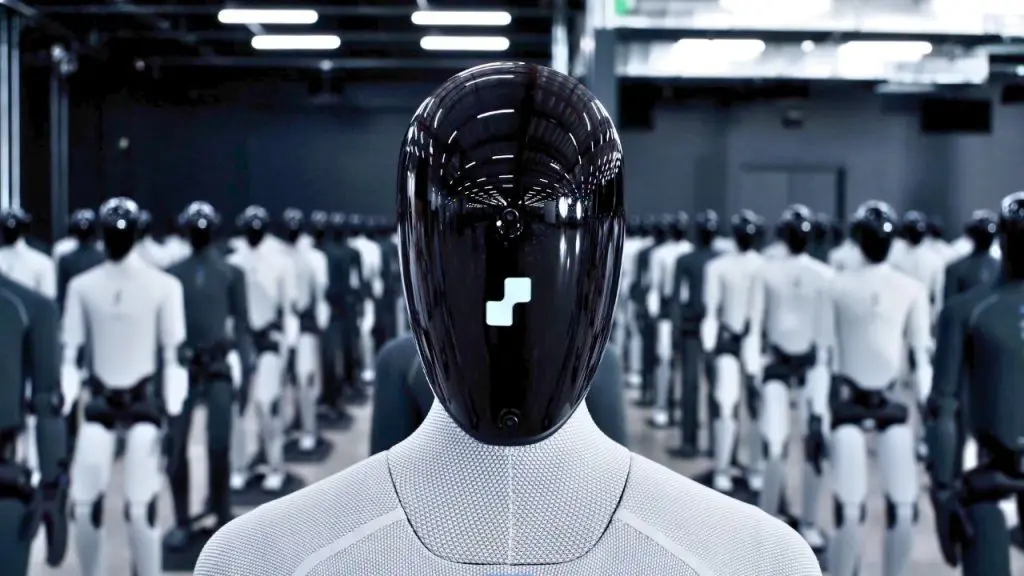
In Silicon Valley, the startup Figure AI says it’s building one robot per hour amid reports it’s about to close a major deal with UPS. The $39 billion offered a rare glimpse into its BotQ humanoid factory in San Jose with footage paying homage to the 2004 movie I, Robot, which was initially intended as a cautionary tale. The robots they’re making are the same model as the Figure 03 humanoid that recently appeared with First Lady Melania Trump at the White House.
Also in Silicon Valley, one of Figure’s biggest competitors, 1X Technologies, just offered a peak into its new humanoid robot factory in Hayward, California. The startup says it built the manufacturing facility in just a few months after it got more than 10,000 preorders for its NEO humanoids in fall 2025. Though the robot is mostly marketed as a household helper, 1X has also committed to making up to 10,000 additional humanoids available to Stockholm-based EQT between 2026 and 2030. The key 1X investor is heavily vested into logistics infrastructure.