
The rising startup RobotEra, maker of the world’s fastest bipedal humanoid robot, is pushing a suite of AI-powered humanoids to market with significant financial backing.
The Beijing-based robotics firm, which was spun from Tsinghua University in 2023, recently secured nearly $70 million in a Series A round led by CDH Investments and Haier Capital. Its total publicized funding for 2024 and 2025 exceeds $125 million.
Record Holder
RobotEra gained significant attention in October 2024 when its Star1 bipedal humanoid achieved a top speed of nearly 13 km/h (8 mph) during a 34-minute run in the Gobi Desert. It made the robot the world’s fastest biped humanoid. The former fastest humanoid, the H1 from Hangzhou-based Unitree Robotics, set the previous record earlier in 2024, topping out at just under 12 km/h (7.5 mph).

Another one of RobotEra’s two-legged humanoids, the XBot-L, became the first biped to successfully walk the Great Wall of China. The way the robot walked on weathered stone, climbed uneven stairs, and performed Tai Chi moves was seen as shocking just a year ago. But today, the demonstration would barely be noteworthy, showing how fast things are progressing amid the international race toward fake humans.
Humanoid robots today are performing elaborate dance routines, competing in long-distance races, fighting each in the ring, learning to enter unfamiliar places and get to work right away. They’re also entering mass production and becoming increasingly normal in the real world, a trend analysts expect to continue until the world’s is like that Fresh Prince movie.
RobotEra L7
RobotEra’s latest humanoid, the L7, builds on the STar1’s bipedal agility, adding advanced upper-limb dexterity. It’s also faster than the Star1, maxing out at 14.4 km/h (9 mph). The robot, standing 175 cm (5 feet 7 inches), danced, ran, and performed a range of domestic and industrial tasks in its intro video.
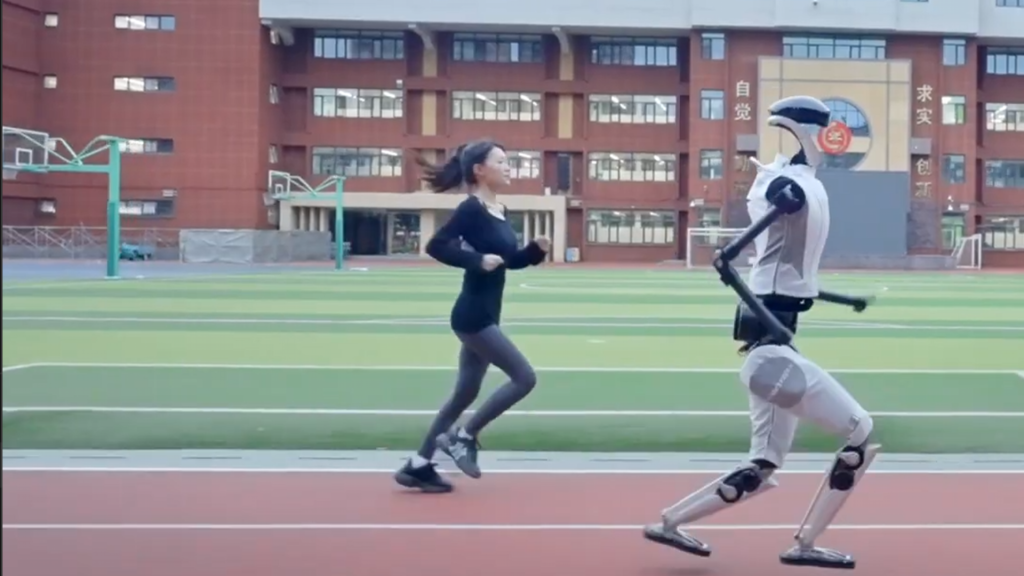
The L7 boasts 55 degrees of freedom (DoF) across its body and joints that deliver a reported 400 Nm of torque for fast and powerful limb movements. The robot can lift and carry up to 20 kg using both arms. It maintains 360° spatial awareness with its multi-sensor fusion system that combines panoramic vision, depth sensing, and real-time positional feedback. The L7 features a swappable battery system, but its battery life has not been disclosed.
Humanoid Robotics Suite
RobotEra also offers an upper-body-only variant called the M7. Mounted on a vertical pillar stand, it’s intended for applications that don’t require mobility as well as data collection and research. RobotEra’s website suggests an easy upgrade path from the M7 to the full-bodied L7.
Both humanoids run on the startup’s in-house ERA-42 vision-language-action (VLA) model that equips them to understand and perform multi-step jobs without special programming. According to RobotEra, the AI model has been upgraded to make its humanoid smarter at handling complex perception to action tasks.
RobotEra also recently wheeled service humanoid robot with a compact waist design that’s narrower than an iPhone. Standing 165 cm, the Q5 boasts 44 DoF for tasks requiring humanlike dexterity.
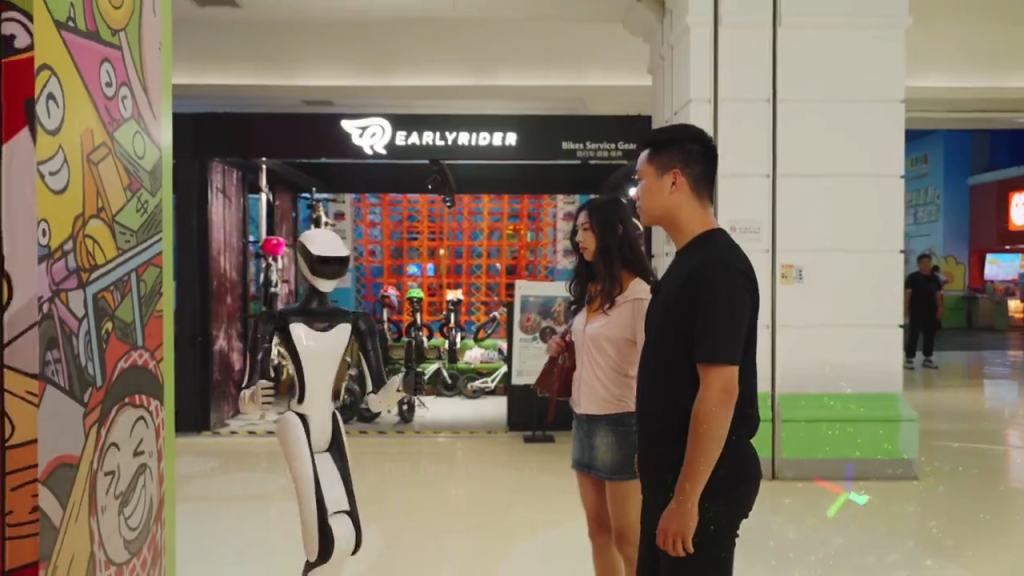
RobotEra’s humanoids integrate with the firm’s XHand, which has 12 DoF and tactile sensors for high-precision manipulation. The modular robotic hand uses a standard quick-release interface for use with other robots. RobotEra has reportedly already shipped more than 200 robots, serving clients like Haier, Lenovo, and BZS Technology.
DexForce Debuts W1 Pro
Meanwhile in Shenzhen, the booming Chinese tech hub, DexForce just unveiled its second-generation humanoid robot.
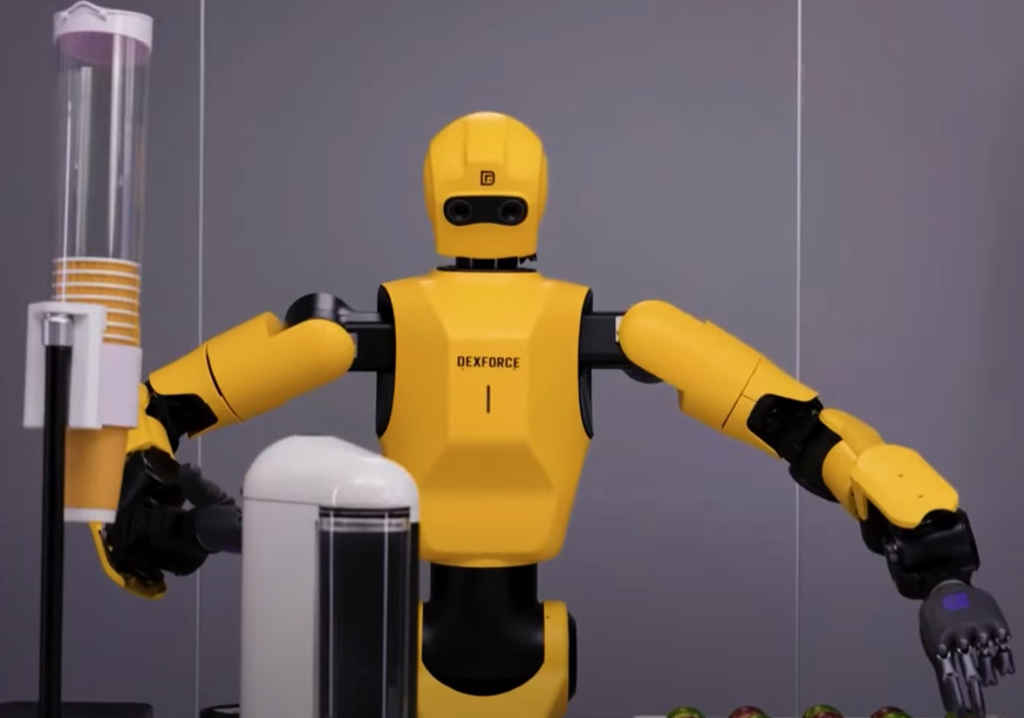
The startup calls its W1 Pro humanoid a high-performance platform with its 34 powered joints. The wheeled humanoid’s dual arms have 7 DoF each and can lift up to 10 kg. Its AI system, called DexSense, handles-real-time perception. Its control system is called DexCore, which handles motor control, perception, and task planning. According to DexForce, the W1 Pro operates for up to 8 hours per battery charge.
Launched in 2021, DexForce says it’s developing a full-stack solution for embodied intelligence, including intelligent sensors, 3D vision foundation models, and robotics software platforms. Its core offering, the DexVerse, handles simulation, physics-based control, and synthetic data integration.
DexForce is headquartered in Shenzhen and has offices in Shanghai, Beijing, and Zhengzhou. It’s also registered as a US entity in Seattle to support international operations.
DexForce is expected to showcase its flagship robotic humanoid at the upcoming 2025 World Robot Conference in Beijing. Another Shenzhen firm, EngineAI, plans to highlight its next-generation humanoid robot that builds on the freakishly lifelike capabilities of its SE01 and PM01 humanoids.