
The world has a new fastest humanoid robot.
That’s according to Robot Era, a China-based startup that just released this footage of its Star1 humanoid running in the Gobi Desert’s Hexi Corridor.
The robot can run up to 3.6 meters per second. At that pace, which equates to 8 miles per hour, the robot can finish a 5K race in about 23 minutes. That’s way above average compared to human runners who typically take between 26 and 35 minutes.
Robot Era also tested whether the Star1 is faster with sneakers or barefoot. In the test, the sneakered robot started late but still beat out the competing robot. According to Robot Era, the Star1 can run for 34 minutes, navigating tough terrains like grassland, gravel, and mountain trails.

The Star1 robot’s speed surpasses the previous fastest humanoid, Unitree’s H1, which set a record at 3.3 meters per second. The leading Chinese robotics company announced the world record in March 2024.
Another robot known for its speed is Cassie by Agility Robotics. Though the robot lacked a full humanoid body, its legged design suited it for running. Cassie set a record in 2022, averaging a speed of 4 meters per second or about 9 miles per hour.

Atlas by Boston Dynamics, known for its agility and balance, also has impressive running abilities, though its top reported speed is slower at 1.5 meters per second or 3.4 mph.
1X Technologies says its humanoid robot, NEO, has a running speed of 3.3 meters per second or 7.5 mph. At that speed it would finish a 5K race in just under 25 minutes, still above average compared to human runners.
Earlier this year, Robot Era’s XBot-L became the first humanoid robot to climb the Great Wall of China. Climbing sections of the Great Wall, the robot handled uneven terrain, winding stairs, and dark archways.
Possible applications for the robot are in construction and disaster relief. Robot Era, also known as Beijing Xingdong Era Technology, develops and commercializes humanoid robots and embedded intelligence technologies.
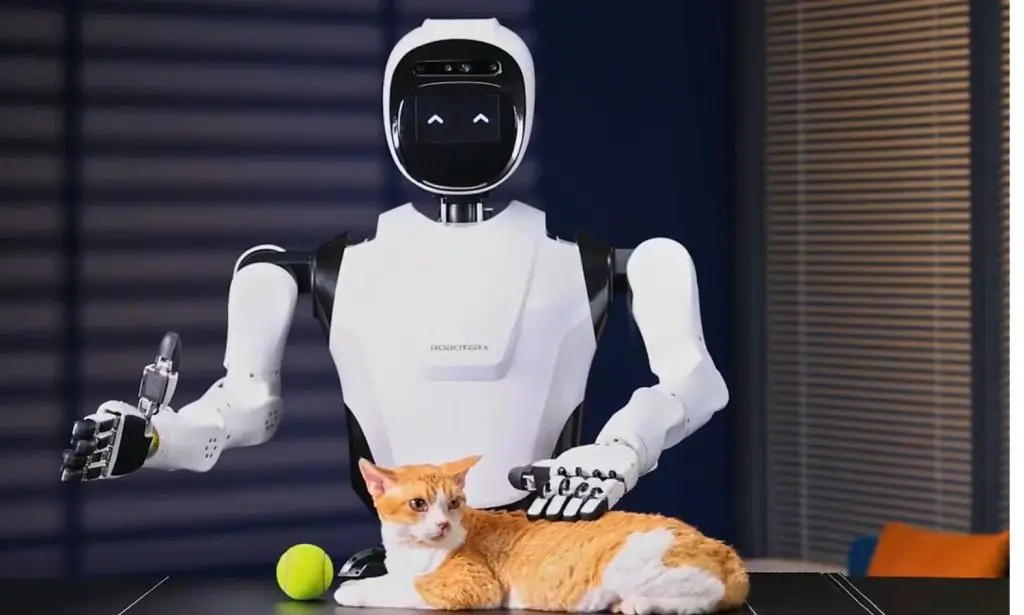
Robot Era also recently unveiled its Xhand technology for robotic hands.
The hand design features 12 active degrees of freedom and tactile sensors for tasks ranging from petting a cat to holding scissors precisely to handling eggs without breaking them.