
There’s a class of intelligent beings roaming in a simulation, aggressively training for the real world.
There are tens of millions of them at least. Soon, there will be billions.
They live in a multiverse of sorts designed to teach them how to survive on Planet Earth. They learn the same way as humans, through positive reinforcement, but they cram years of lessons into just hours.
When they do something right, the world rewards them. When they fail, it resets. They don’t know it, but they’re being prepared to change forms.
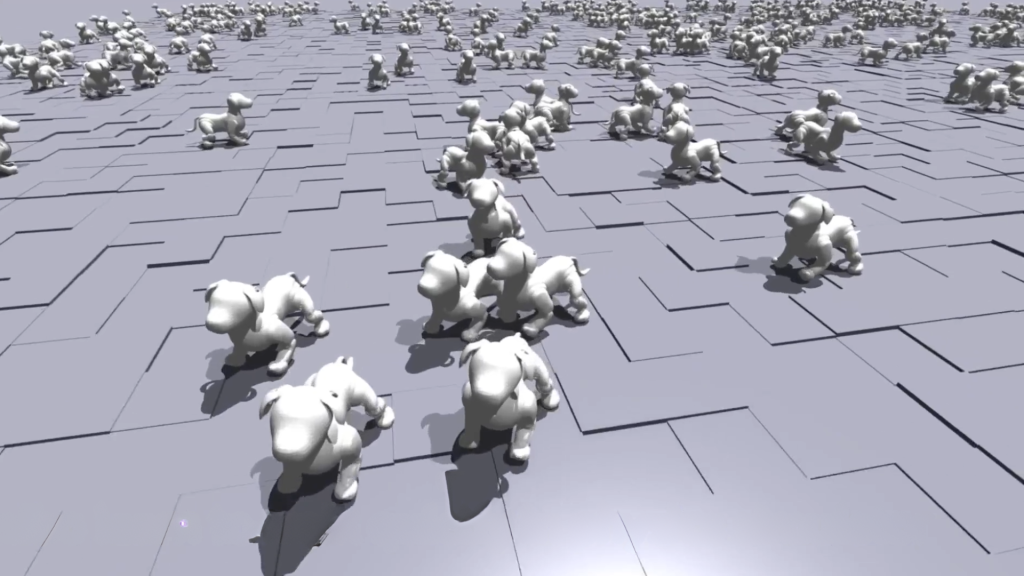
As companies worldwide spend billions to bring robotics into daily life, they’re leaning heavily a training system called Sim2Real, short for Simulation to Reality, that bridges digital and physical worlds.
It’s an idea humanity has flirted with since Plato and has been increasingly obsessed with since The Matrix (1999). Using the same technology originally intended for video game development, they’re rapidly building a world modeled after ours.

If analysts are right, it’ll manifest into a future where robots with general intelligence vastly outnumber people.
Space Race Origin
NASA engineers paved the way for Sim2Real during the Space Race era. After President Kennedy’s 1961 mandate to reach the Moon, the space agency established extensive training facilities at the Manned Spacecraft Center, which is now called the Johnson Space Center.
To accelerate development cycles, NASA built analog-digital hybrid simulators that replicated spacecraft controls, visuals, and even failures. The investment paid off dramatically in June 1970, when NASA engineers built simulations to mirror Apollo 13 after an oxygen tank explosion crippled the spacecraft 200,000 miles from Earth.

Simulations embedded real-time streams from hundreds of sensors aboard Apollo 13, including voltage and pressure readings, temperatures of equipment and sensors, trajectory information, valve positions, fuel levels, and oxygen tank pressure. Large physical mockups of the command and lunar modules, wired to digital computers, simulated system malfunctions, oxygen and power usage, and command sequences.
IBM 360 mainframes ran telemetry analysis and simulation software, while Apollo’s computers interfaced with Mission Control. As depicted in the 1995 Ron Howard movie Apollo 13, engineers used the ground-based simulators to test unorthodox methods that proved successful.
Digital Twin Technology
The Apollo-era simulators foreshadowed what came to be known as digital twins, which are virtual models of physical objects or systems that sync with their physical counterparts in real-time.
The Apollo-era simulators foreshadowed what came to be known as digital twins, which are virtual models of physical objects or systems that sync with their physical counterparts in real-time. The rise of the Internet of Things (IoT) made it possible to attach tiny sensors to everyday machines like engines, thermostats, and factory equipment to automatically transmit data to central systems.
Robot Simulators
Early simulations weren’t very useful in robotics because they couldn’t accurately mimic the messy physics of the real world. That changed with breakthroughs in high-fidelity physics engines and deep learning.
MuJoco, released in 2012 by Emo Todorov’s group, could realistically simulate how joints move and how surfaces interact through collisions and friction. Gazebo, which had been in development since 2002, matured alongside the Robot Operating System (ROS) giving developers realistic 3D environments to test code safely.


Videogame development platforms like Unity and Unreal Engine soon followed, bringing their powerful graphics and physics systems, originally designed for entertainment, into AI training.
By 2018, NVIDIA jumped into the robotics fray, launching Isaac Sim, its platform for training robots in virtual settings. The GPU maker adapted its powerful simulation and collaboration engine originally designed for 3D content creators to generate photo realistic scenes and synthetic sensor data. This meant virtual models could learn to see and move in digital worlds that looked and behaved almost like the real thing, before ever touching physical hardware.
Deep Learning
At the same time, deep reinforcement learning began showing that AI could learn complex behaviors through trial and error entirely in simulation. In a 2013 breakthrough, DeepMind researchers trained an aI to play Atari games using just pixels and score feedback.
As computers and simulations became more powerful, researchers began training AI models to fly virtual drones, control robotic arms, and solve physical tasks in environments that mimicked the real world.
Sim2Real Gap
The AI agents often achieved superhuman skill levels in simulation, but there was a major challenge. They didn’t always perform well when transferred to real robots. Simulations, no matter how detailed, were still simplified versions of the messy and unpredictable real world.

The problem became known as the sim to real gap.
To overcome it, researchers developed a technique, called domain randomization. Instead of training a robot brain in a single, perfect vision of a virtual environment, they exposed it to thousands of slightly different ones. Variances in things like textures, lightning, object shapes, and physics settings taught the AI to focus on the big picture and adapt to surprises.
At UC Berkeley, researchers trained a drone entirely in simulation using random textures. The drone navigated real-world obstacle courses on its first try, without ever having flown before, a form of what’s called zero-shot transfer.
Open AI used a similar approach with Dactyl, a robotic hand trained in the MuJoCo physics engine. By constantly changing the virtual conditions during training, Dactyl learned to rotate and manipulate a block with human-like dexterity.

Boston Dynamics, known for its advanced legged robots, started testing the approach around 2019 when training its world-famous Atlas humanoid robot. By 2021, Atlas was going viral navigating obstacle courses in the real world with smooth, dynamic movements, trained almost entirely in the virtual space.
Industry Embraces Sim2Real
As academic and open-source tools proved their worth, industry eagerly embraced the simulation to reality concept.

Companies developing self-driving cars realized early they could not possibly encounter every rare scenario, like accidents, unusual obstacles, and complex traffic patterns, by road testing alone. But in simulation, they could synthesize endless variations of streets and situations. Waymo built a whole Simulation City and by 2020 had driven over 10 billion virtual miles, far outpacing its real-world test mileage.
In 2022, an AI drone pilot trained largely in sim, with some real data augmentation, famously beat human world champions in a first-person-view drone race. Simulation training plus reinforcement learning is also what made autonomous dogfighting possible.
Manufacturing and logistics companies are now using simulators to plan factory layouts, optimize workflows, and train robotic arms or autonomous vehicles without ever touching a physical machine. For example, Amazon Robotics uses simulated warehouses to finetune the behavior of its fulfillment bots.
Synthetic Data
NVIDIA’s Omniverse is a major enabler. As part of its ecosystem, Isaac Sim helped popularize the use of synthetic data for robotics and AI training, especially for industrial and commercial applications.

In just a few years, synthetic data has changed how startups build, pitch, and fund their ideas. They can validate the core functionality of their products before building a single physical prototype. Armed with detailed simulations, founders can more confidently pitch to investors, with a clear, visual, and testable story even at early stages.
It also lowers early-stage spending on hardware, testing facilities, and field trials, freeing up capital to speed up iterations.

To be clear, synthetic data has its limitations. The reality gap still exists. The highest quality synthetic data can’t fully capture the noise, wear, randomness, and edge cases of the real world.
A robot trained only in simulation might fail in unexpected ways when developed, like slipping on wet floors, misreading shadows, or reacting poorly to slight sensor drift. If the simulation is poorly designed, the robot may learn to exploit quirks that don’t exist in reality.
This leads to what’s called sim-to-sim performance that looks great in demos but underperforms in real deployments. That’s why most companies today combine simulations with real-world testing and feedback.
Next-Generation Humanoids
Today, simulation-to-reality techniques are pushing a new breed of AI-powered humanoid robots to mass deployment.
In fall 2024, China’s EngineAI sent shockwaves throughout the industry introducing its flagship humanoid robot, the SE01 and its humanlike walking gait. The bipedal locomotion was so lifelike many assumed it was computer generated, despite experts vouching for the authenticity of Engine’s demo footage. The Shenzhen-based startup says it achieved the realistic strut through an end to end network trained using Sim-to-Real methodologies.

Another top robotics company from China, Unitree, says that training in simulation, along with smart motion control, helps its robots quickly learn complex moves like dancing and martial arts. In the US, Figure AI says its humanoids have achieved natural walking thanks to a combination of reinforcement learning in simulation and its self-developed AI model called Helix.

Sim2Real Democratization
If the current wave of robotics companies succeeds bringing their machines into daily life, consumers will naturally become fluent with Sim2Real technology. Emerging frameworks are already simplifying the simulation to reality pipeline.
The era of exclusive, expensive robotics is ending thanks to open-source projects like K-Scale Labs’ Python based Sim2Real pipeline. The Palo Alto startup caters to a wide range of researchers and hobbyists, offering humanoid robots for under $10K.

The robots are bound to appear in upcoming battles with fellow humanoids as a cottage industry emerges inspired by a decades-old fantasy. Read more about that right here.
The Future of Robotics
To stay up to date as AI and robotics evolve rapidly, subscribe to my YouTube channel for first updates.