
Several Massachusetts startups are generating global buzz as the state aims to reclaim its position as a leader in physical AI.
The commonwealth has long been considered a global leader in robotics, with elite institutions like MIT and Harvard laying down decades of foundational work. However, while Massachusetts has historically led in research and early-stage innovation, it has been less dominant in scaling and commercial deployments during the current wave of physical automation. A new breed of startups is rapidly emerging challenging that narrative.
Roomba Creator’s Robot Pets
Among them is Familiar Machines & Magic, which just emerged from stealth with a next-generation robotic pet for the consumer market. Its founder is Colin Angle, the creator of the Roomba robot vacuum.
Angle co-founded iRobot in 1990 to build machines for military and government use. He led the MIT spinout as it pivoted to consumer robotics in the 2000s and stepped down in 2024. Since his departure, iRobot has declared bankruptcy and is now Chinese-owned.

His new Boston area startup says it’s bringing a new class of consumer robots to market. Its first product is a dog-sized companion. It’s designed to look approachable and cuddly, but underneath its soft exterior is serious hardware.
The four-legged robot, known as a Familiar, has 23 moving joints, which is about double the degrees of freedom that fellow quadrupeds from Boston Dynamics and Unitree Robotics have. They give the robot the ability to move in subtle, lifelike ways to build an emotional connection with the people it interacts with.
An NVIDIA Jetson Orin computer powers its onboard AI, processing vision, audio, and behavior patterns in real time. It perceives its surroundings with its cameras, microphones, and other sensors. It’s expected to become available around 2027, with pricing similar to owning a pet.
Eka’s ChatGPT-1 Moment
In Cambridge, Eka Robotics just emerged from stealth with a new kind of AI model that helps robots handle objects more like humans. Its so-called Vision-Force-Action (VFA) model combines input from cameras and real-time force feedback to make adjustments based on how objects physically respond. The early-stage startup says it’s ushering in “The Era of Superhuman Robotics.”
WIRED Magazine reporter Will Knight, who’s been covering robotics for over a decade, described it as early potential “ChatGPT moment” for physical AI. The former MIT Technology Review author visited Eka’s lab and said he watched a robot claw perform tasks that most machines still struggle with like picking up small, irregular objects and screwing in a lightbulb. He said he’s never seen a robot move so naturally, especially how it adjusts mid-action to react to the physical behavior of what it’s handling.
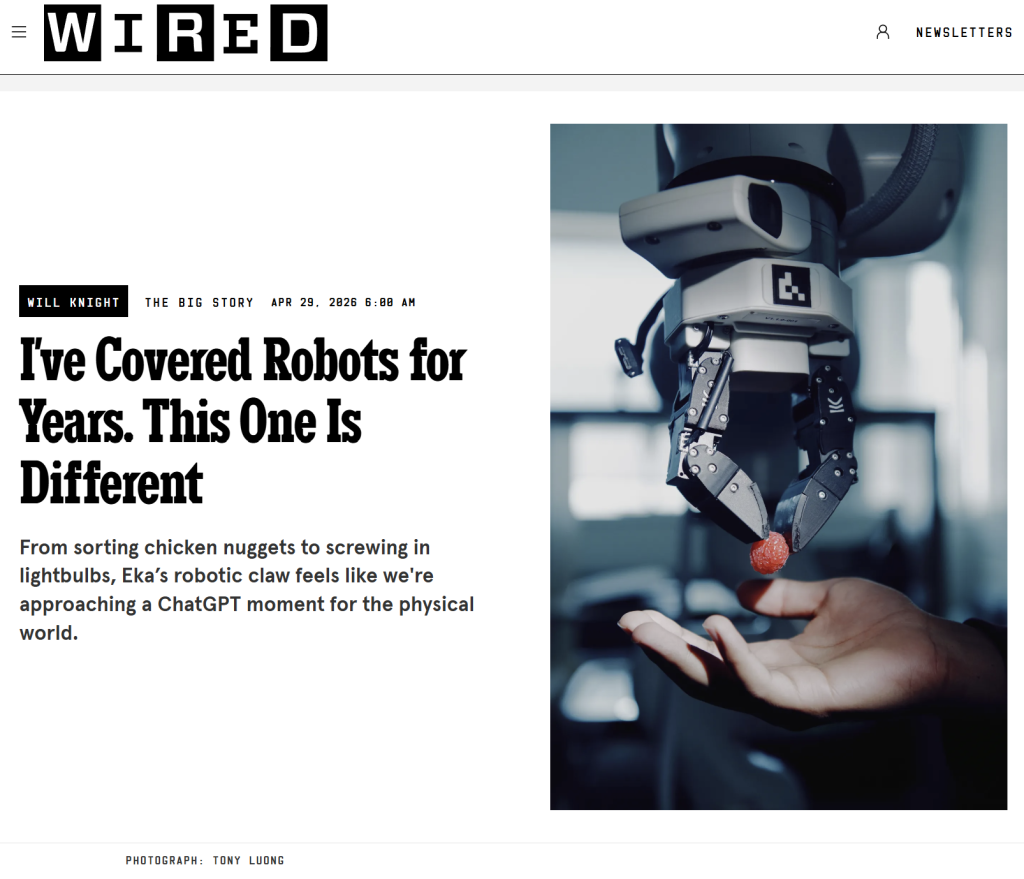
“Unlike with any other robot I can think of, it’s almost possible to imagine what the world is like for the robot,” he wrote. “Its sensors seem to feel the weight of its arm, the inertia as it sweeps toward the keys and slows down. Once it has the keys in its grasp, it seems to sense the weight of them dangling from its claws.”
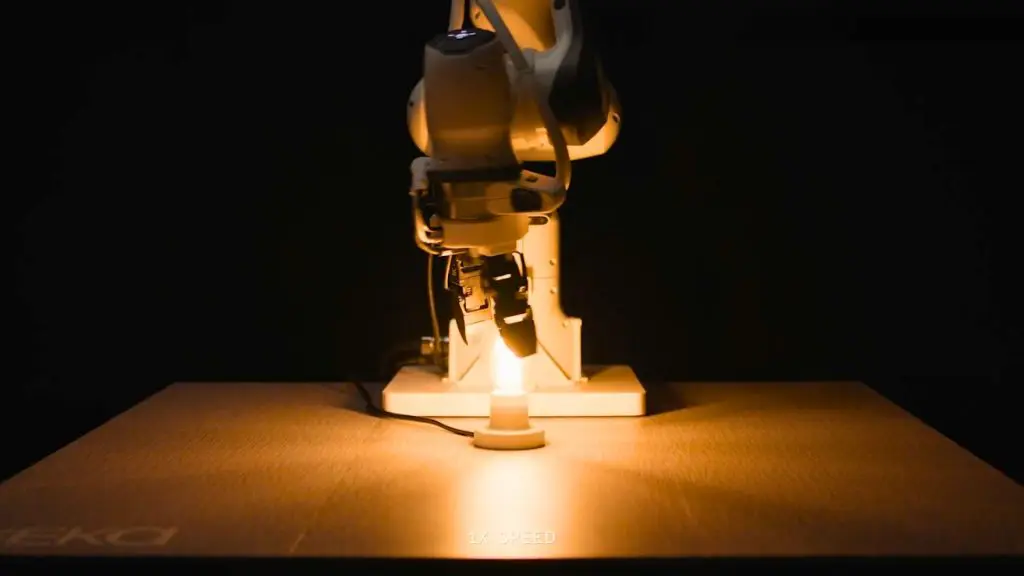
According to Eka, the VFA model is trained primarily through self-practice in a high-fidelity simulation that models real-world physics. It gradually improves how it manipulates objects through reinforcement learning. The model differentiates itself by including feedback on force interactions so the robot’s digital twin understands objects how push back, slip, or shift when grabbed. After the learned behaviors are transferred to the physical robot, Eka says the combination of vision and force feedback allows it to adapt on the fly.
Eka Robotics was founded by two well-known AI researchers: Pulkit Agrawal, an associate professor at MIT who leads the Improbable AI Lab; and Tuomas Haarnoja, a former Google DeepMind robotics researcher known for his work in reinforcement learning. The startup has 21 associated members on LinkedIn. It has not publicly disclosed detailed funding rounds or valuation yet.
Tutor’s Robot Data Factory
Another startup launched by MIT researchers, Tutor Intelligence, recently opened what it calls the largest robot training center in the United States.
Based in the Boston suburb of Watertown, Tutor is developing next-gen robot workers with $42 million in funding. While Eka relies on simulation training, Tutor emphasizes large-scale real-world data collection using fleets of robots that learn through repetition and human-guided correction. The startup says its Vision-Language Action (VLA) model, Ti0, is already being trained and tested on real-world tasks inside factories and warehouse environments.
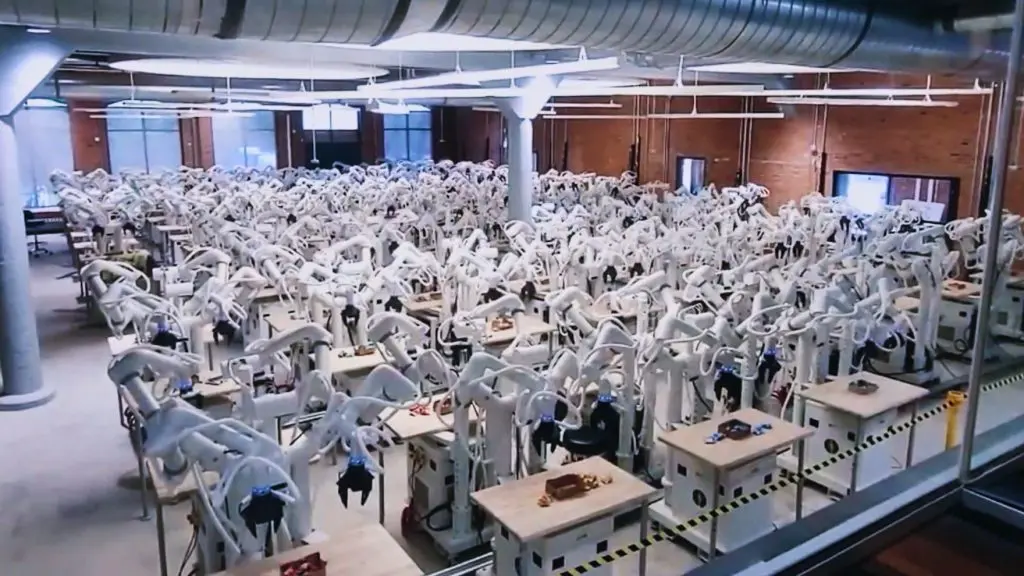
Its new robot training center, called Data Factory 1, spans about 3,300 square meters (35,000 square feet) and houses 100 “semi-humanoid” robots that produce up to 10,000 of robot training data per week. They continuously practice basic human tasks like picking, packing, and folding items under the supervision of human “tutors” who remotely step in to correct mistakes.
Tutor says it’s developing robots to take on repetitive tasks at factories and warehouses. They’re priced through a robots-as-a-service (RaaS) model, with listed rates between $14 and $18 per hour.
SIMPL Acquired by Home Depot
Another Massachusetts firm focused on warehouse automation, SIMPL Automation, was recently acquired by The Home Depot. The retail giant plans to deploy SIMPL’s automated storage and retrieval systems after a successful pilot at its Locust Grove, Georgia distribution center. Financial terms of the deal were not disclosed.
Turmoil at Boston Dynamics
SIMPL Automation was launched in 2023 by a team of engineers and supply chain experts. It’s based in Waltham, also the home of the leading Massachusetts robotics firm Boston Dynamics.
A new report from Semafor Technology suggests there’s a bloodbath going on at the company as it struggles to keep up with humanoid rivals. Quoting former employees, Semafor reported that “executives were pushed out by a board of directors critical of the company’s narrowing lead against its competitors.”
The report said BD is under pressure to delivery tens of thousands of working Atlas humanoid robots to its parent company, the South Korean automaker Hyundai. As of this year, Semafor reported, “the company was making roughly four of its Atlas humanoid robots per month, as it prepares to open a new manufacturing facility in the coming months.”
MIT’s Labububot
Looking to the future, MIT researchers continue to advance next-gen technologies that the public at times finds unsettling.
The MIT Media Lab just teased a spherical robot called Labububot, calling it “one of the rarest monsters” on Earth. A team led by Miranda Li built the robot from twelve interconnected Labubu toy heads to explore how people emotionally react to machines that are simultaneously cute, disturbing, familiar, and alien.

Each head has its own small electronics that help control the whole system’s movements. By shifting and coordinating the different parts, the robot moves like a strange living ball or swarm creature.
Labububot will make its public debut this summer at the 2026 International Conference on Social Robotics (ICSR) in London.