
Unitree Robotics is plotting an aggressive expansion following its viral showing during China’s 2026 spring festival gala.
Launched a decade ago, the Hangzhou-based robotics firm already leads the world in humanoid and quadruped robot deliveries. The increasingly autonomous machines are soaring in popularity as their prices trend downward. And now unitree has set up shop on Amazon to take things to the next level.
The heightened visibility brings greater scrutiny about the safety of the robots in public settings, the potential implications for national security, whether Unitree can keep its momentum going with stiffening competition, and if so, is the world really ready for their robot uprising?
Wang Xingxing and Unitree’s Origin
Hardware engineer Wang Xingxing founded Unitree in Hangzhou in 2016 at age 26 after a brief stint working for the leading drone manufacturer DJI. Wang, who calls Boston Dynamics founder Marc Raibert his idol, had attracted attention after developing a quadriped robot named XDog and jumped at the opportunity to commercialize it when an angel investor offered $275,000 to get started.

Wang credits Unitree’s participation in China’s 2021 Spring Festival Gala with accelerating the company’s ascent. The company sent shockwaves through the robotics world later that year with its Go1 quadruped. Priced under $3,000, the robodog was marketed as an affordable alternative to research-grade units like Boston Dynamics’s $75,000 Spot.
Unitree’s Humanoids
Unitree unveiled its first bipedal prototype, the H1, in 2023 as the Chinese government set a national goal to mass produce humanoids by 2025 and to own the market by 2027. A fleet of the humanoids went viral in early 2025, performing a synchronized folk dance alongside humans at the spring festival gala.

But Unitree’s shorter robot, the G1, has gotten the most attention. Its initial entry price of $16,000 was about a tenth of the cost of bipedal humanoids available at the time. The G1 quickly became the default humanoid research platform at pretty much every university with a robotics program. Elite labs have open-sourced research that’s given the robot eerily humanlike and often superhuman capabilities.
It wasn’t long before Unitree’s short king started popping up in unexpected places beyond labs and well outside the mainland.
2026 Spring Festival Gala
Those same robots captivated the world during the 2026 Spring Festival Gala in a showcase that paired dozens of them with some rather young performers from the Henan Tagou Martial Arts School.

Their moves were much more acrobatic and fluid than the prior year’s robotic ensemble. They did aerial tricks, vertical wall runs, and showcased iconic wushu techniques. The Drunken Fist, playful in appearance but explosive in power, came alive through staggering steps and sudden bursts of energy. They handled wooden staffs and swung nunchakus with tight rhythm and sharp control. Unitree’s next-generation full-size humanoid, the H2, came out for the sword dance segment, but kept a safe distance.
According to CCTV’s reporting, Unitree’s technical team brought the humanoids to the Beijing studio more than a month before the gala. They performed data collection and 3D modeling of the 600 square meter stage. Engineers equipped the robots with LiDAR-based navigation interfaces so they could understand their position in the scan space.
Fully Autonomous Cluster Control
The multi-root choreography relied on a concept called “fully autonomous cluster control.” That means the robots were not being controlled by someone off stage. Nor were they using external tracking systems like cameras or motion capture markers. Using their embedded sensors, the robots plan their own paths across the stage and move together in coordinated formations without bumping into each other. The system, which was specifically engineered for large stage performances, can reportedly execute complex actions across dozens of robots with one click.
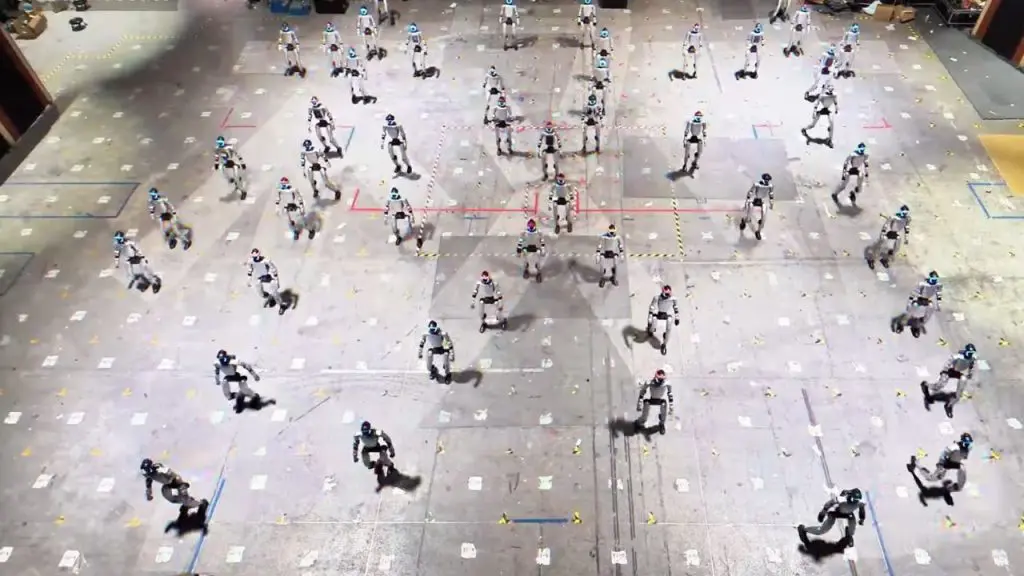
Unitree upgraded the robot’s hardware to boost joint motor power, reinforced body structure, and improve dexterity. Engineers also added soft padding to protect nearby performers.
Safety Concerns
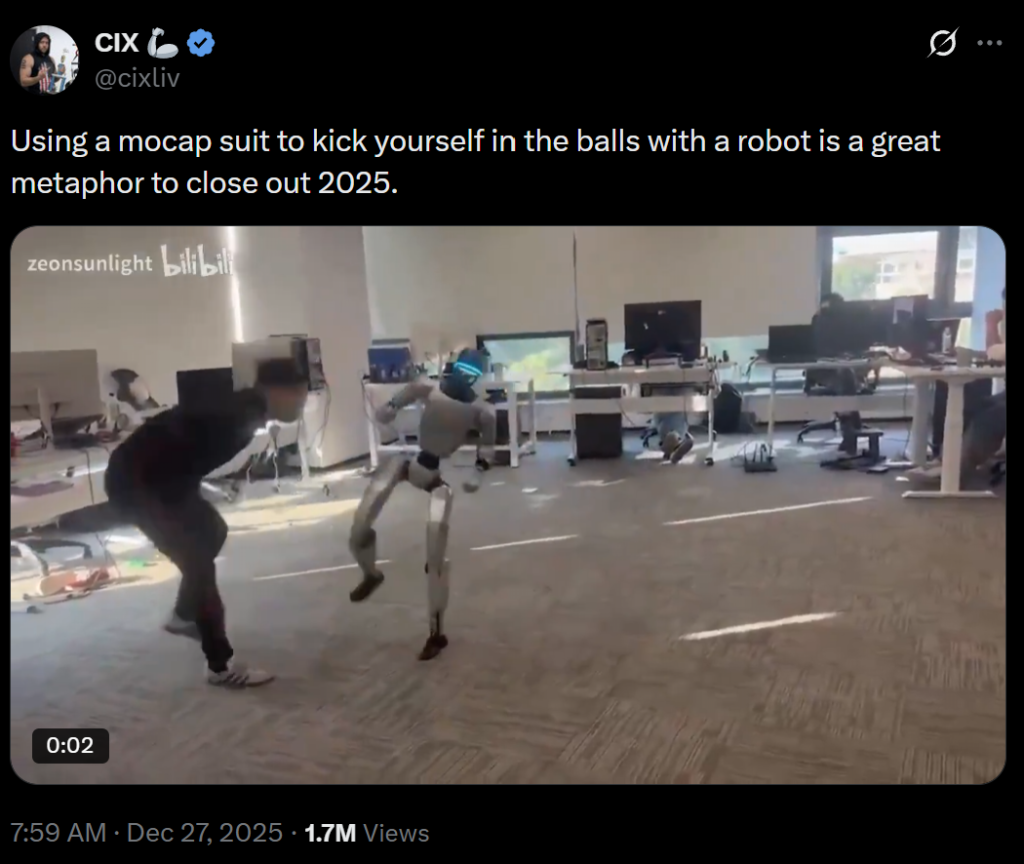
Unitree emphasizes that their robots can be very dangerous and increasingly frequent viral videos show what can happen when you don’t give them space.
Until now, robots were mostly confined to industrial settings or research labs where engineers and technicians understood their power and accepted the inherent risks of operating heavy machinery. We’re entering uncharted territory as the robotic sector pushes their next-gen machines into the consumer market.
The children who performed with the robots at the gala are highly trained martial artists who could hold their own against a G1. But a toddler chasing and hugging one at home is a different story.
2026 Production Plans
Unitree reported shipping more than 5,500 bipod humanoids in 2025. Its total mass production output exceeded 6,500 units.
In 2026, Unitree is preparing a major scale up as it heads toward an initial public offering on the tech heavy Shanghai star market, reportedly seeking evaluation of $7 billion. In interviews, Unitree CEO Wang has said the company aims to deliver up to 20,000 humanoid robots in 2026, a more than 250 percent increase compared to last year.
Unitree opened a new factory in Hangzhou in 2025 to keep up with surging demand. Covering more than 10,000 square meters, the plant is intended to support the company’s growth over the next several years and improve output efficiency.
Wang has said he expects Unitree’s next-generation compact humanoid, the R1, to be the best-selling humanoid of the year thanks to its relatively low price point starting at $4,900 and its design intended for mass production. Unitree is also lowering the barrier of entry for full-size humanoids with its H2, which is priced starting just under $30,000; its predecessor’s pricing started around $90,000.
Robots on the Battlefield?
The growing ubiquity of Unitree’s robots is ratcheting up fears about a Terminator-like future in which humanoids like the G1 are mass produced as robotic soldiers or hacked to cause harm by adversaries.

Following the gala spectacle, AI-generated video of Unitree’s humanoids in military drills went viral across social media. Though many quickly recognized the footage is fake. Others said it was only a matter of time before it becomes a reality.
Unitree’s quadrupedal robots have been modified for military exercises by the People’s Liberation Army, the US Marines, Ukraine, and others. The company stresses it does not support lethal use cases. In October 2022, Unitree joined Boston Dynamics, Agility Robotics, ANYbotics, and others in signing an open letter pledging to not weaponize their machines. The pledge also included reviewing customer applications and exploring techbased safeguards.
Other robotics firms, however, are eager to deploy their machines on the battlefield, including San Francisco-based Foundation, which aims to manufacture 10,000 of its industrial humanoids in 2026, and is developing a foundational model literally called Skynet.
Growing Competition
In the West, Unitree faces competition from well-funded companies like:
- 1X Technologies which plans to start shipping its NEO humanoids for households later this year
- Tesla, which is expected to unveil its highly anticipated Optimus Gen 3 imminently
- Boston Dynamics, which is preparing to begin mass producing its flagship humanoid Atlas for industrial work
- Agility Robotics, which just secured a robots-as-a-service contract with Toyota Motor Manufacturing Canada (TMMC) to deploy seven of its Digit humanoids
- Apptronik, which has raised almost $1 billion, led by Google
- Figure AI, whose founder Brett Adcock calls China’s humanoid revolution overhyped
This year’s Chinese New Year festivities made clear that Unitree is also just one of many companies in the mainland aggressively pushing its humanlike robots into the real world. Other robotics firms participating included:
- Wuxi-based MagicLab, which is positioning its Z1 humanoid as an alternative to Unitree’s G1
- Beijing’s Galbot, whose flagship humanoid robot, also called the G1, demonstrated its autonomous storekeeping capabilities
- and NOETIX Robotics, which developed a hyper-realistic replica of the Chinese veteran actress Cai Ming for a comedic skit
Following the Humanoid Race
To stay up to date on the constantly evolving race toward general-purpose robotics, subscribe here.