
The leading Chinese robotics firm Unitree just launched its new full-sized fake human that looks straight out of the future that Will Smith warned us all about.

Hangzhou-based Unitree Robotics introduced its new H2 humanoid robot with a cinematic 50-second video showcasing its lifelike dancing and martial arts movements. On social media, the company described the H2 as a “bionic humanoid” that’s “born to serve everyone safely and friendly.”
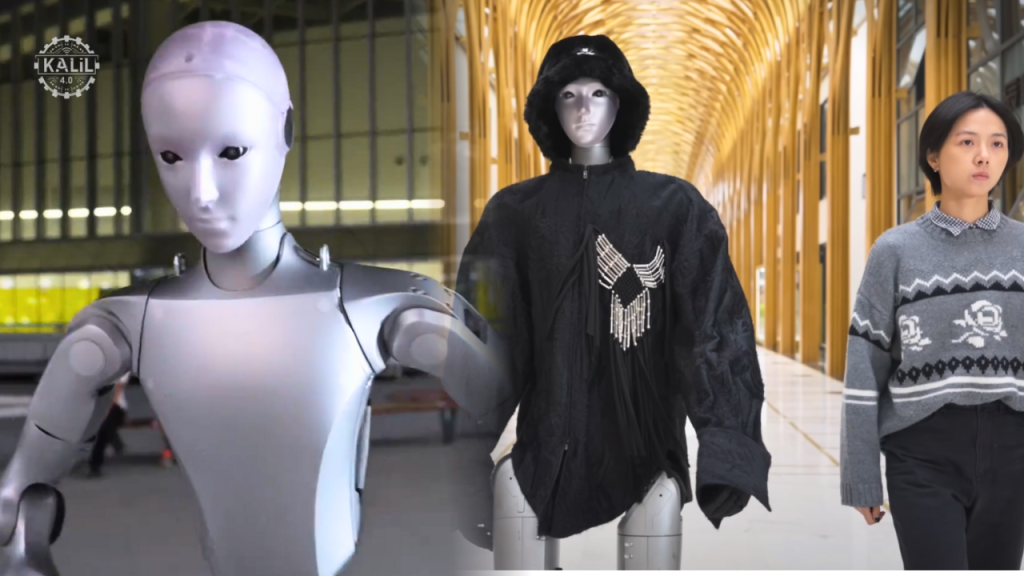
Standing 180 cm (5 feet 9 inches), the H2 robotic humanoid builds on the foundation laid by Unitree’s first-generation full-sized humanoid, the H1, which debuted almost two years ago in November 2023. Unitree introduced that robot as the Chinese government set a national goal to mass produce humanoids by 2025 and lead the emerging market by 2027.
The H2’s reported weight of 70 kg (154 lbs) is heavier than the H1, which weighs 47 kg (103 lbs). According to Unitree, the new robot boasts 31 degrees of freedom (DoF) for more fluidity in motion than its predecessor’s 23 joints allowed. Unitree hasn’t released detailed specs and hasn’t updated its website but its also expected to inherit H1 features like its 3D LiDAR and depth cameras.
Much of the initial reaction to the H2 focused on its smooth and minimalist face, which is reminiscent of the problematic synthetic humans in the Will Smith action/sci-fi vehicle I, Robot (2004).

The robot’s head has an outer shell that appears to be smooth or soft to the eye, possibly made from plastic or composite material. The back of its skull shares similarities with the clear rear panels on the world-famous Ameca android from Engineered Arts. The legendary robotics firm, founded more than 20 years ago in the UK, says it chose to use the translucent panels to showcase the intricate mechanics beneath and avoid uneasiness due to the uncanny valley effect.
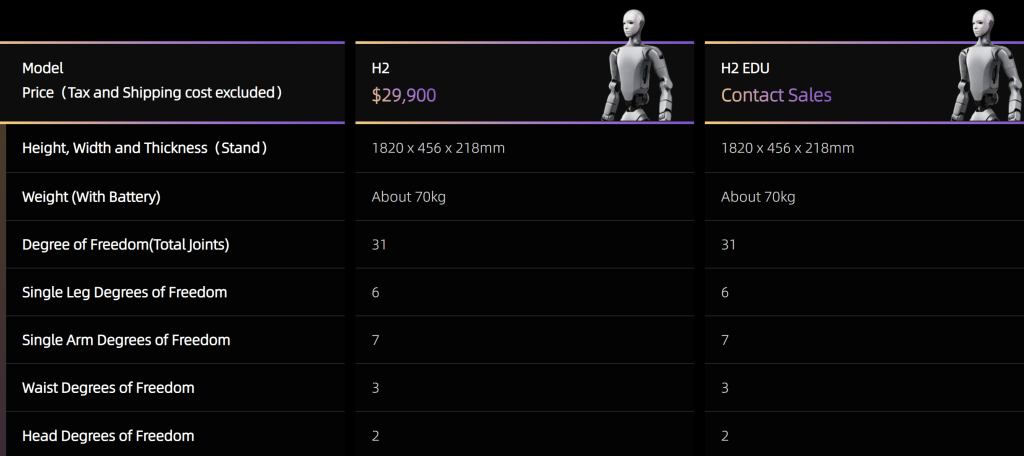
The humanoid’s base model is priced starting at $29,900 which is significantly lower than the H1’s $90K entry price. Other full-sized Chinese humanoids like Oli from LymX Dynamics and Atom by Shenzhen Dobot are priced in the $20,000s for base models.
A higher-end configuration with more computing power, dexterous hands, and custom development options requires contacting Unitree for pricing. The entry model is powered by an Intel Core i5 processor, while the custom development variant upgrades to an i7 chip. An optional expansion allows for the integration of an NVIDIA Jetson AGX Thor module for two thousand and seventy TOPS of onboard compute.
The H2 uses a humanoid binocular camera to perceive its surroundings with a wide field of view. It’s equipped with an array microphone and high-power speaker for natural voice interaction.
Launched in 2016 by hardware engineer Wang Xingxing, Unitree’s quadrupedal and humanoid robots have surged in popularity in the past few years thanks to their relatively low starting prices.
Its compact humanoid, the G1, disrupted the humanoid market when it introduced itself to the world in May 2024 wielding a baton thanks to its $16K price tag, which was considered shockingly low at the time. Its robotic dogs range are priced starting under $2K, positioned as affordable alternatives to research-grade quadrupeds like Boston Dynamics’ $75K robodog, Spot.
Unitree expects its next-gen compact bot, the R1, to be the best-selling humanoid of 2026 with its entry price of $5,900. Beijing-based Booster Robotics, however, is challenging that with its new K1 humanoid, which stands 90 cm (under 3 feet).
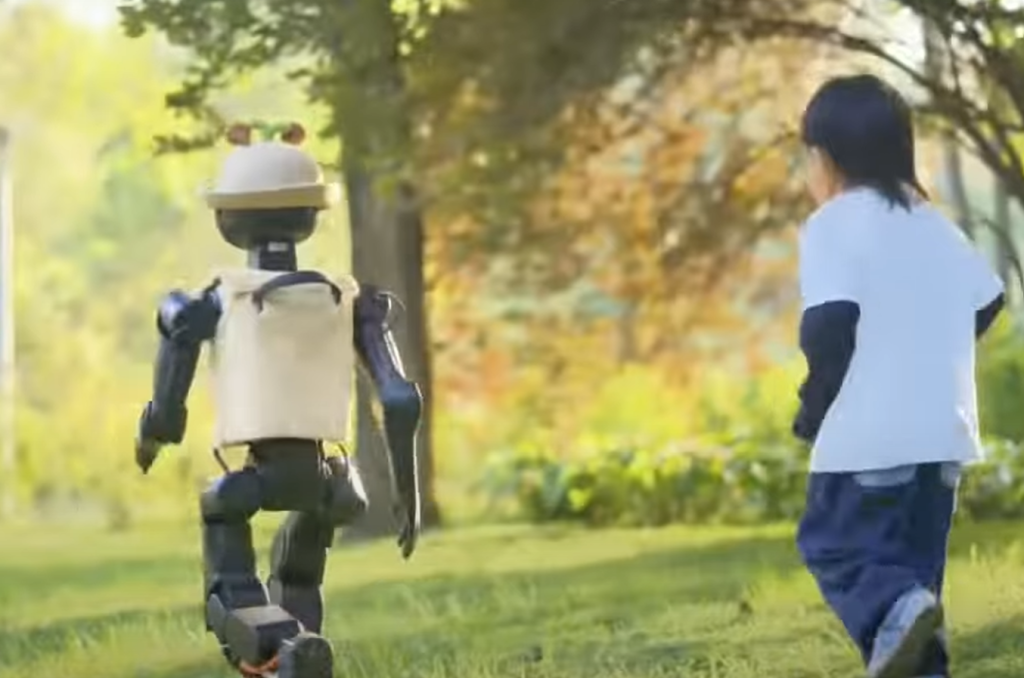
The startup says it scaled down its flagship developer-friendly robot, the T1, to lower the barrier entry into humanoid robotics. Booster is expected to announce official pricing imminently, but reports indicate it’s in the sub-$5K range.