
A fleet of AI-powered humanoid robots in China is working autonomously on a tablet assembly line in what’s being called a first-of-its-kind livestream.
The humanlike machines are doing quality inspection work alongside human coworkers as part of a historic multiday livestream. They were developed by a 3-year-old startup that’s giving top robotics companies around the world a run for their money.
It could be a glimpse of what’s to come at factories everywhere as investors pour billions into redefining the future of work. Amid the physical AI gold rush, robotics firms are making bold moves to prove their machines are ready for real-world labor.
They’re putting robots in charge of tasks that have long been considered too difficult, delicate, and unpredictable to automate. The robots are becoming better at collaborating across form factors on increasingly complex workflows. As they get more intelligent every day, they’re learning in increasingly humanlike ways, but at a scale no person or workforce could match.
Agibot’s 6-Day Livestream
In Shanghai, the rising robotics startup Agibot kicked off what it calls a first-of-its-kind livestream featuring a fleet of autonomous humanoids on a real tablet production line.
The robotics firm, launched in February 2023 by former Huawei Genius Youth Peng Zhihui, says it manufactured more than 10,000 humanoids in the first half of 2026. The company is aggressively scaling its global footprint as it reportedly heads toward an IPO on the Hong Kong Stock Exchange (HKEX) along with a slew of competitors like EngineAI and Pudu Robotics in Shenzhen and Beijing’s Galbot.
It’s becoming a serious thorn in the side of Hangzhou-based Unitree Robotics, which led the world in humanoid and quadruped in 2025, as well as Western firms like Figure AI.

Agibot started the 6-day livestream a few weeks after Silicon Valley-based Figure went viral for its own multiday livestream. Figure’s broadcast featured a small fleet of its bipedal Figure 03 humanoids taking turns sorting packages in a mock logistics setup. They worked 24/7 for 8 days straight in the controlled setting. When one robotic worker’s battery got low after about 4 hours, it walked itself to a charging station as another robot stepped in to keep things going.
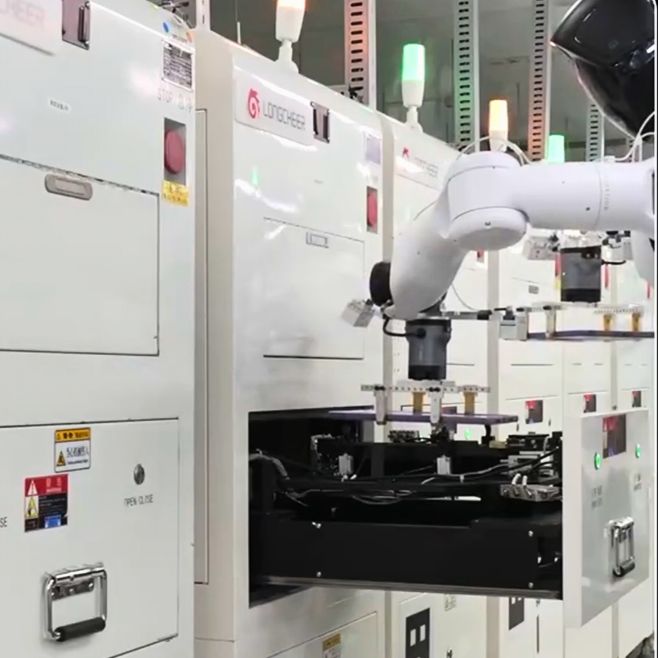
In contrast, Agibot’s stream had a larger fleet of humanoid-style wheeled dual-arm mobile manipulators working alongside people at Longcheer Technology’s tablet manufacturing plant in Nanchang. They worked a standard factory shift from around 8:00 AM to 6:00 PM, with lunchbreaks, doing quality inspection.
The robots on the tablet assembly line are Agibot’s G2 model, which is purpose-built for industrial deployments. Standing 1.7 meters (5 feet 7 inches), the G2 weighs up to 100 kg (220 lbs), depending on the configuration. It boasts a reported 26 degrees of freedom (DoF) across its body and integrates with optional dexterous hands.
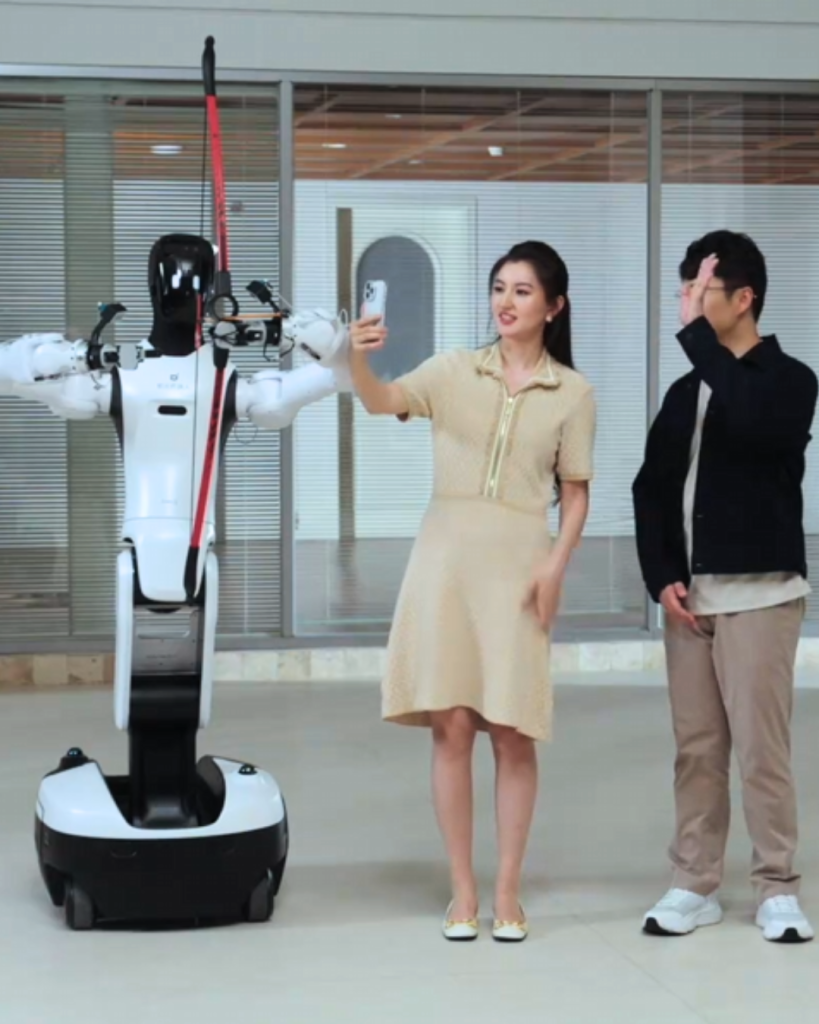
The humanoid runs on Agibot’s self-developed AI, which combines locomotion, interaction, and manipulation intelligence into a unified architecture. According to Agibot, the G2 improves with real-world reinforcement learning and large-scale datasets from its world model, Agibot World.
It’s designed for around-the-clock operation with hot-swappable batteries in its wheeled base. They support between 4 to 8 hours of active use per charge, depending on the payload and movement intensity. The battery can be changed in minutes without shutting the robot down, though it can’t yet do that itself like UBTECH’s Walker S2, Hexagon’s AEON, and Atlas from Boston Dynamics.
The robots working on Longcheer’s assembly line use specialized grippers to pick up tablets, inspect them with their sensors, and place them into trays as part of the automated process. The ODM makes electronics for giants like Xiaomi, Samsung, and Lenovo.
Agibot’s G2 is reportedly priced starting around $138,000, which is actually one of the more affordable options for factory deployments today.
The startup, also known as Zhiyuan Robotics, has gotten the most attention for its Lingxi X2 robots that start around $13,000. Higher-end pricing starts closer to $50,000.
The X2, which stands 1.3 meters (4 feet 3 inches) and weighs 34 kg (75 lbs), is designed for light manipulation and entertainment applications rather than heavy-duty industrial work. However, Agibot recently shared footage of a higher-end variant moving a minifridge in a controlled setup.
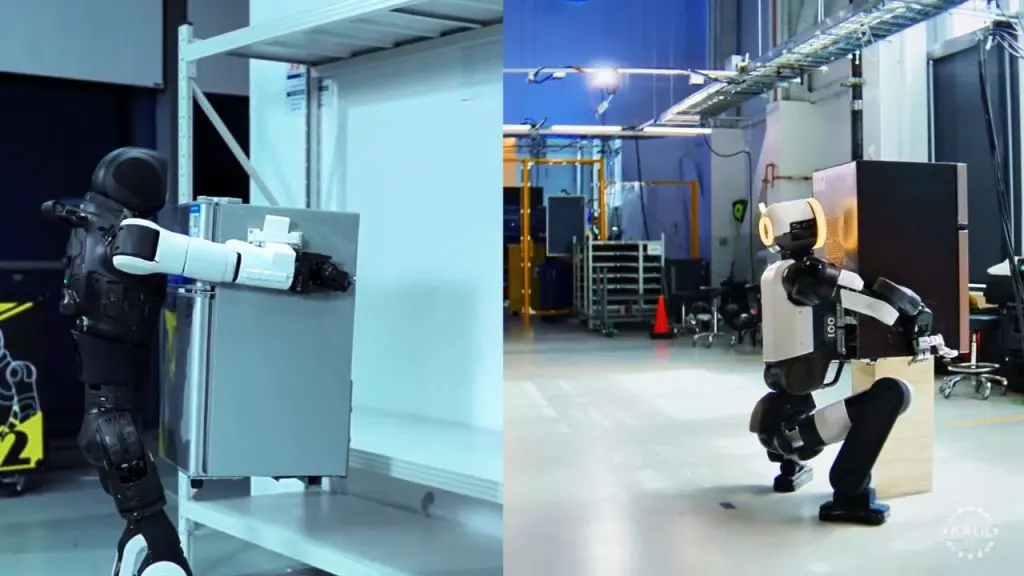
It was an obvious message toward Boston Dynamics. The Massachusetts robotics leader had showcased the whole-body dexterity of its world-famous Atlas humanoid the week before performing a similar task.
The demos had the same general idea, but with key differences. In BD’s demo, Atlas grabs a minifridge using its dexterous grippers, causing visible damage in the process, while Agibot’s X2 uses custom handles on the appliance to lift it with its arms. The unit Atlas carries also appears larger than the one from Agibot’s lab.

However, Atlas is also more than double the weight of the X2 at 90 kg (198 lbs). It also towers over the smaller humanoid at nearly 2 meters (6 feet 3 inches). Both robots use their onboard AI with extensive training in simulation and real-time sensor feedback to pull the task off, though Atlas has the benefit of superhuman rotating joints.
For now, you’re more likely to see Agibot’s humanoids in public as the startup scales toward 20,000 units in 2026. Boston Dynamics is also aggressively pushing Atas, its other famous robot Spot, and its logistics solution Stretch into the workforce. Its parent company, Hyundai, is reportedly seeking full ownership of the firm as it builds capacity for 30,000 robots.
Sanctuary AI Claims Wire Harness Breakthrough
To the North, the Canadian startup Sanctuary AI says it trained a Universal Robots dual-arm cobot setup to crush one of the hardest tasks to automate in automotive manufacturing.
Sanctuary AI is best known for its general-purpose humanoid robot, Phoenix, but it’s now expanding its focus to all industrial robots. It’s developing a physical AI model called Carbon for use across form factors.

The Vancouver-based robotics firm shared footage of the UR robots doing wire harness and connector insertion for a Tier 1 automotive supplier. Plugging the connectors into place over and over is simple for humans but difficult for robots because they struggle with flexibility.
Sanctuary says the system completed the job with a more than 99.5 percent success rate and a 2.5-second cycle time. That means it performed fast and reliable enough to match the unnamed customer’s production line.
MindOn’s Universal AI Robot Brain
Another startup developing a universal AI robot brain, China’s MindOn Tech, just shared demo footage showing a team of humanoid and collaborative robots completing a logistics workflow.
The Shenzhen-based firm, launched in 2025 by former Tencent researchers, says the robots are operating fully autonomously. A Unitree G1 humanoid retrieves items from bins and places them onto a conveyor for a pair of dual-armed cobots to prepare for shipment. Once packaged, a second Unitree biped picks up the item to be taken away for shipping. The packaging features Amazon Prime branding, though there’s no evidence of an official partnership.
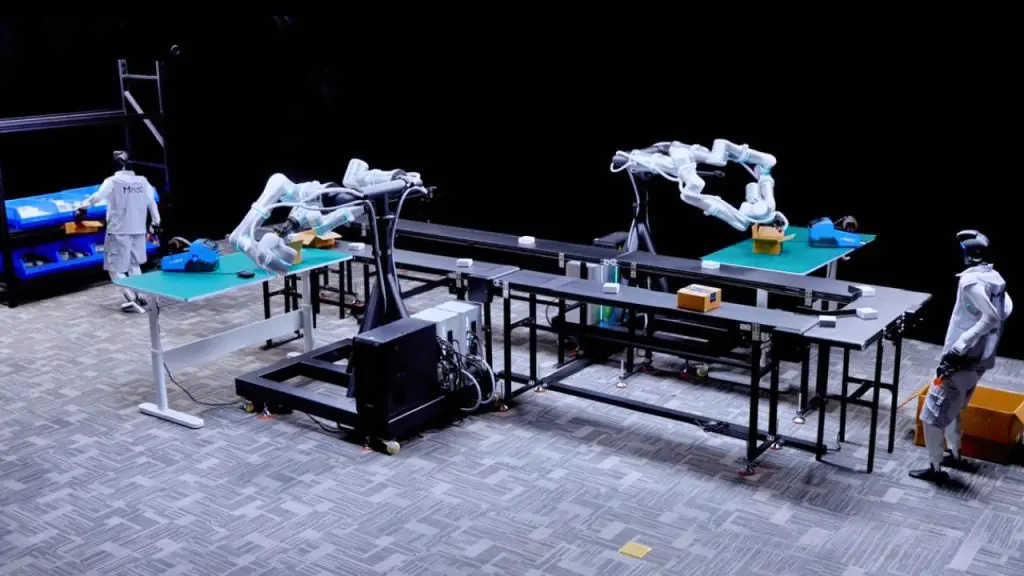
MindOn says its Mind0 model is trained on human-centered data. It includes egocentric video recorded with head cameras, manipulation data from handheld gripping devices, and whole-body movements captured with MoCap suits. It’s combined with a small amoutn of physical robot testing data to help correct gaps between simulation and real-world behavior.
The startup says Mind0 is an early version of the system. It plans to make the AI robot brain bigger, smarter, and more universal so robotic teams can take on longer, more complex jobs in factories, warehouses, and eventually households.
EgoEngine Makes Videos Useful for Robots
MindOn is one of a growing number of firms hoarding egocentric video to train its next-gen robot workers.
Meanwhile, labs are coming up with solutions to leverage the enormous amount of footage all over the Internet. Researchers from Georgia Tech, for example, just introduced an AI system called EgoEgine to teach robots manipulation skills from existing first-person video clips.
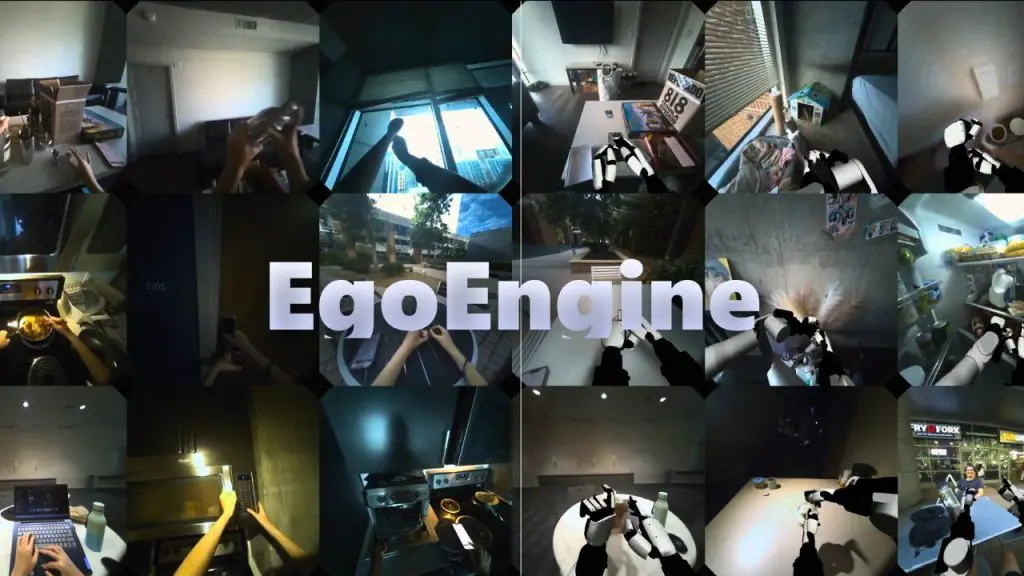
The scale is potentially massive, with more than 20 million daily uploads to YouTube alone. Just a tiny fraction of those being egocentric could mean tens of millions of videos for teaching robots everything from cooking to electronics assembly.
The EgoEngine first identifies and removes human arms and hands from each video frame. It then reconstructs the scene inside a digital twin, generating a new video of the robot doing the same task. The human movements are converted into robot motion data and refined so the robot can safely execute them.
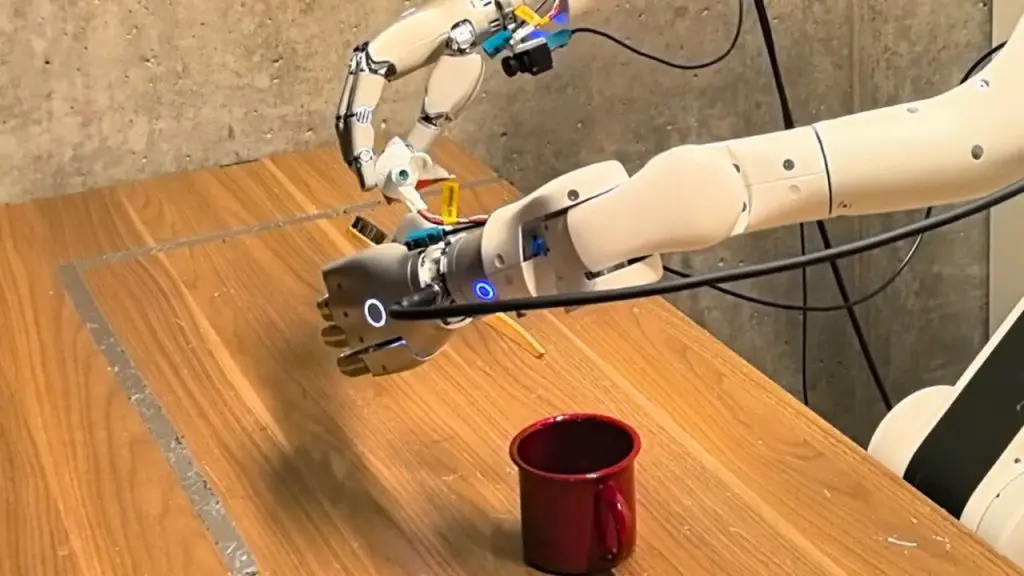
The researchers tested the system on a Rainbow Robotics dual-arm manipulator equipped with two five-fingered hands. They said it performed nearly as well as robots trained by teleoperation.
UC Berkeley and NVIDIA’s T-Rex
A new AI system that uses egocentric recordings, developed by UC Berkeley and NVIDIA researchers, brings robotic eye-hand-touch coordination closer to human levels.
They tested the system, called T-Rex, on a Dexmate Vega-1 integrated with the Singaporean company Sharpa’s Wave hands. They’re among the most advanced end effectors on the market, with a reported 22 DoF each.
According to the researchers, T-Rex completed 12 touch-heavy tasks like applying toothpaste to a brush and screwing in a lightbulb. It worked autonomously with an AI brain trained on more than 22,000 hours of first-person video and a 100-hour tactile dataset.
Following natural-language instructions, the robot used its head camera to understand the scene and wrists cameras to monitor what each hand was doing. At the same time, tactile sensors in its hands continuously measured changing forces.
T-Rex tracked how those signals changed from moment to moment as its so-called Mixture of Transformers architecture worked like a team of specialized AI agents. One planned the humanoid’s movements while another used touch to make fast corrections.
T-Rex achieved a 65 percent average success rate, which is about 30 points higher than the strongest comparison system. However, the team said the technology still needs better sensors and more precise control for general autonomy.
Researchers from Stanford University, Panasonic, Sapienza University of Rome, and ItalAI also contributed to the study.
Meanwhile, in South Korea, a long-standing company that develops actuators used in [music] robots like Disney’s Walking Olaf Biped is developing what many consider a credible challenger to Unitree’s Viral G1. Read all about it here.