
South Korea’s newest AI robot is emerging as one of the country’s most credible threats to China’s viral Unitree G1 humanoid.
The open-source humanoid, powered by the technology that Disney’s walking Olaf biped uses, may be the country’s best hope of becoming a humanoid powerhouse in the robot-run future that analysts predict. It’s just one of several Korean humanoids advancing rapidly under South Korea’s so-called K-Humanoid initiative.
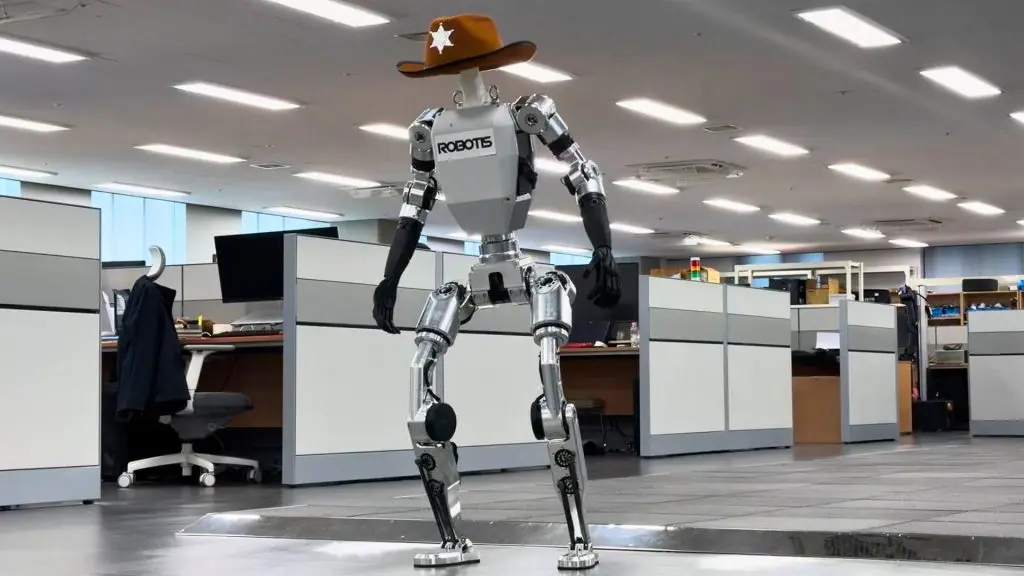
The government-led alliance, launched by the Ministry of Trade in April 2025, brings together more than 40 entities from universities, robotics labs, and industrial giants like Hyundai, LG, and Samsung. They’re developing a foundational AI robot brain for Korean-developed machines to run on by 2028.
South Korea already has many of the ingredients needed to manufacture humanoids at scale, but its robotics expertise has historically been spread across different private and public groups. The K-Humanoid Alliance hopes connecting those capabilities will give Korean firms a coordinated way to compete China and the US.
“Robotics is going to be the next major sector here in Korea,” NVIDIA CEO Jensen Huang said during a recent visit to Seoul.
South Korea’s Humanoid Evolution
South Korea established itself as a leading force in humanoid robotics in the early 2000s.
That’s when Professor Jun-ho Oh’s team at the Korea Advanced Institute of Science and Technology, more commonly called KAIST, developed HUBO as the country’s answer to Honda’s ASIMO. They even took the biped for a stroll outside the automotive giant’s headquarters in Japan, which was considered the undisputed world leader in humanoids at the time.
HUBO wasn’t quite as advanced as Honda’s legendary humanoid, but it showed that South Korea was within striking distance and could achieve impressive results with a fraction of its budget.
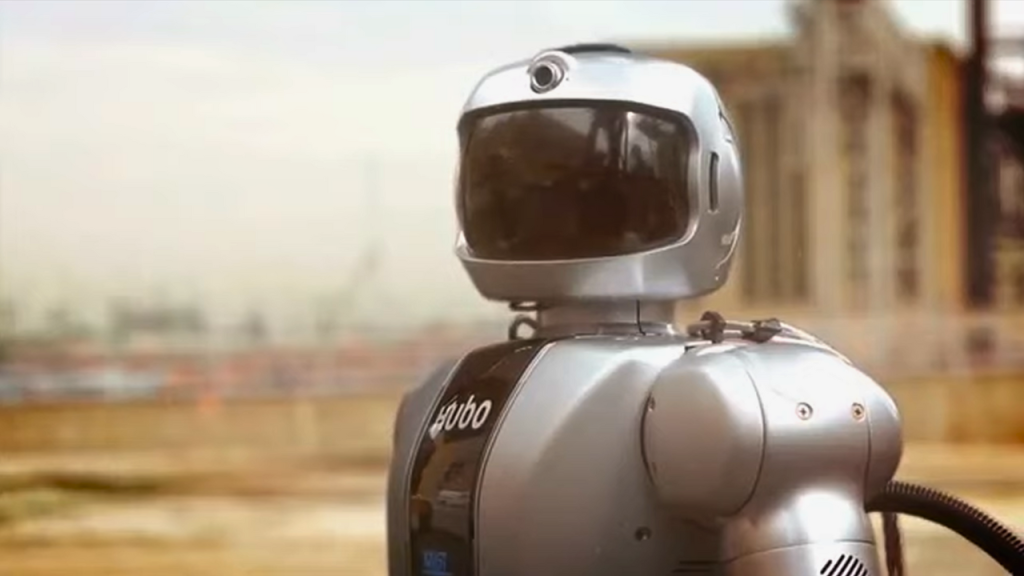
An upgraded version, developed in collaboration with then-US-based Hanson Robotics, featured an expressive android head modeled after Albert Einstein. The HUBO platform peaked in 2015 when a more advanced version won the DARPA Robotics Challenge finals, beating out teams using an early version of Atlas by Boston Dynamics.
Professor Oh spun Rainbow Robotics out of the lab in 2011 to commercialize HUBO. They sold second-generation units to MIT, Google, the US Navy, and others as a research platform and incorporated the underlying tech into its collaborative robots for industrial use cases. Samsung became the robotics firm’s largest stakeholder in early 2015 when it invested in $181 million into it to accelerate humanoid development.
The New KAIST Humanoid
KAIST’s work toward general-purpose humanoids also never stopped.
The elite KAIST DRCD robotics lab recently shared footage of the latest iteration of its research-grade biped. Standing 1.6 meters (5 feet 5 inches), the KAIST Humanoid weighs 75 kg (165 lbs). The KAIST team says it developed key parts inhouse, including actuators, motors, reducers, motor drivers, and control hardware.
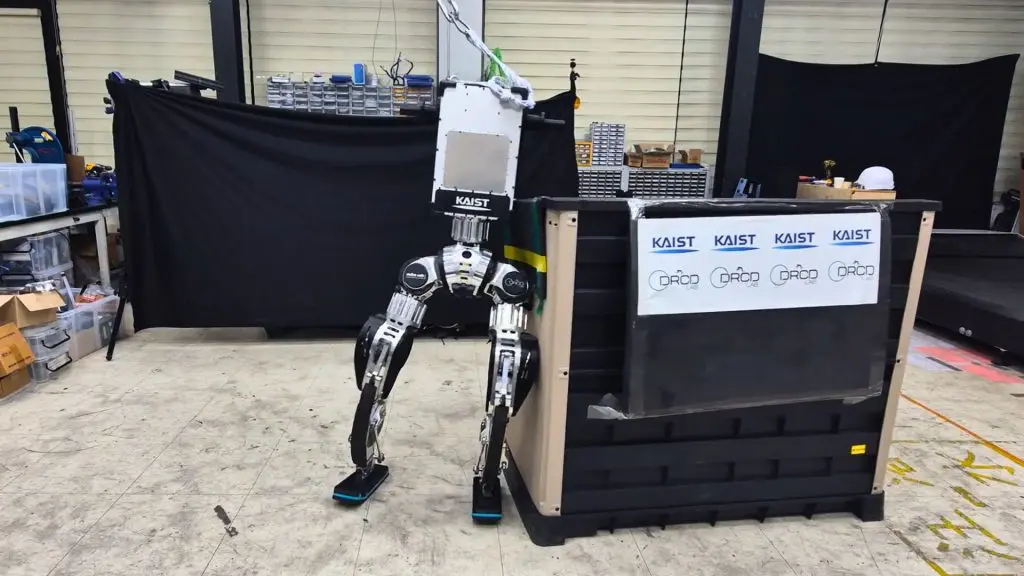
It reaches speeds up to 13 km/h (8 mph) and, for whatever reason, can moonwalk across uneven ground. The robot learned the movements with deep reinforcement learning in simulation, where it tried different variations over and over and improved through trial and error.
ROBOTIS’ Open-Source Play
KAIST is a key member of South Korea’s Humanoid Alliance alongside around 40 other entities. Another member, ROBOTIS, is developing what many consider a true challenger to Unitree’s viral G1 humanoid robot.
The company launched in 1999 to build modular parts and software for developing next-generation robots. It’s known for its DYNAMIXEL actuators that combine motor, gearbox, controller, sensors, and communication systems into one compact module.
The technology powers robots of all form factors across sectors, including ultra-realistic humanoids from Hanson Robotics and Realbotix, and Disney creations like its new Olaf biped. ROBOTIS also develops its own platforms like its popular Darwin OP open-source humanoid for research and STEM.
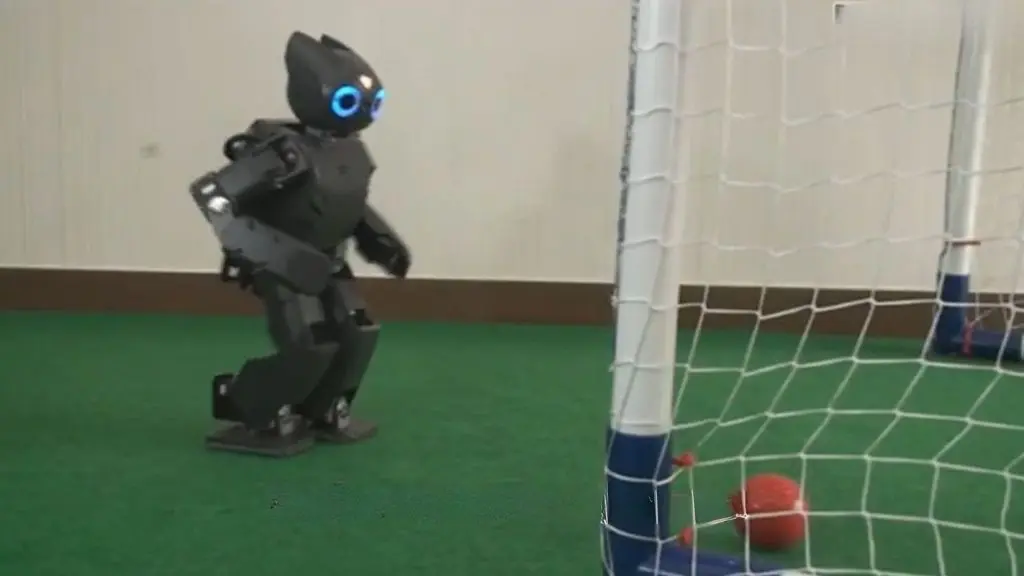
As of late, the Seoul-based firm has been generating buzz with its new open-source AI Sapiens line.
It’s anchored by its compact K0 humanoid robot. It stands 1.3 meters (4 feet 3 inches), weighs 34 kg (75 lbs), and boasts a reported 23 degrees of freedom (DoF) across its body. Its onboard artificial intelligence runs on an 8-core ARM processor with a Malli GPU and a dedicated neural processing unit.
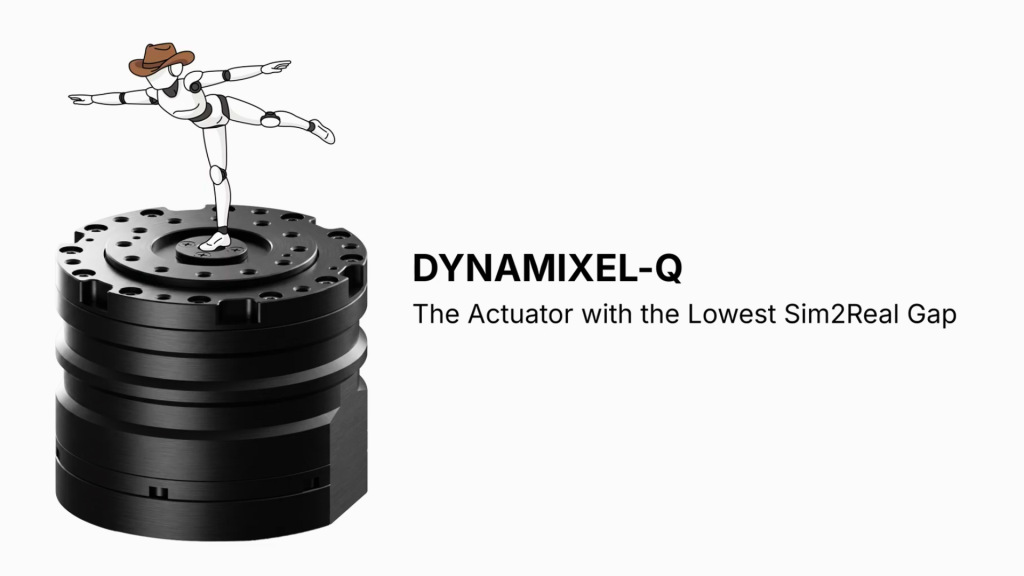
ROBOTIS says its DYNAMIXEL-Q actuators, which power the robot’s joints, help close the so-called Sim2Real gap. The servo has a quasi-direct-drive (QDD) design that uses a low-gear ratio so joints can respond faster, sense forces more precisely, and move more fluidly compared to high-gear actuators.
They’re designed specifically for humanoids, though they can also be used in other form factors. The K0 appears to be the first humanoid to use the actuators, whose pricing has not yet been announced.
On paper, the K0’s technical specs are similar to Unitree’s G1, which has soared in popularity among researchers, developers, and increasingly, content creators thanks to its relatively low entry price. However, the AI Sapiens platform is fully open-sourced, while only higher-end G1 configurations offer the same level of customizability. ROBOTIS has not shared pricing, but Korean reports indicate it’ll be below $10,000.
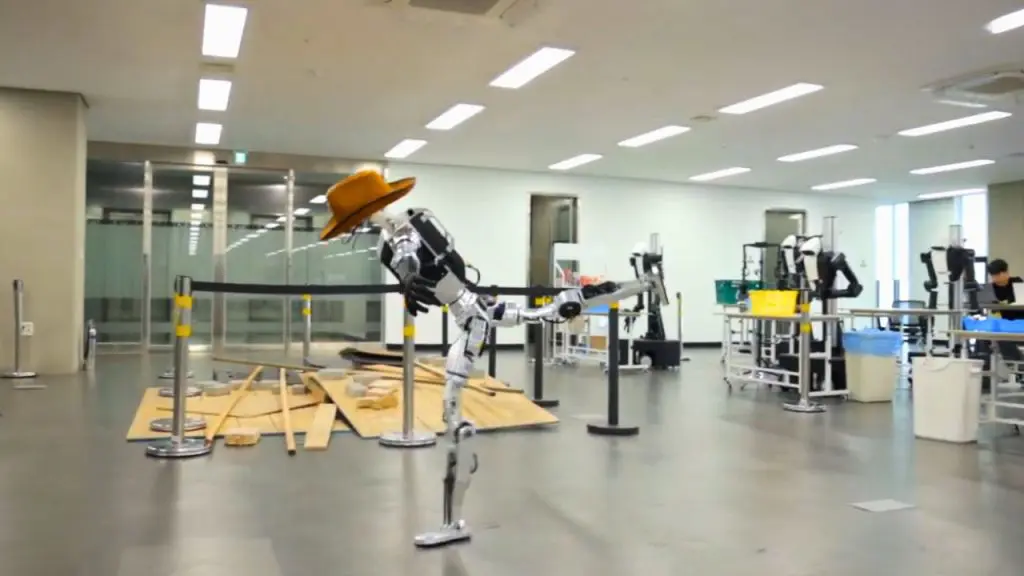
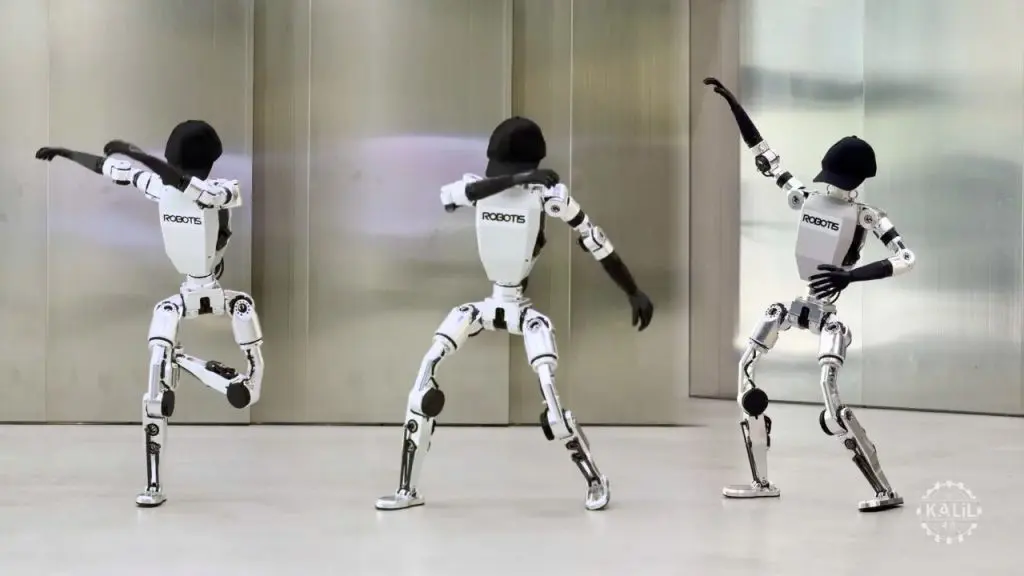
In the latest AI Sapiens demo, the K0 humanoid performs the REDRED dance challenge by the K-Pop group CORTIS using a training pipeline the team says empowers it to learn full-body movements in days instead of months.

According to ROBOTIS, the robot learned the routine with just smartphone footage and no specialized motion-capture setup. The team used NVIDIA software to convert the recording into motion data for the robot’s digital twin to train on with reinforcement learning in simulation. In the virtual world, the robot practiced the movements over and over to find the best ways to balance and move safely.
Possible Reference Humanoid
ROBOTIS says it’s building AI Sapiens as an open-source physical AI platform for researchers and developers to move the field away from one-off demos and toward reusable humanoid skills that can be trained, shared, and improved like software.
The close relationship between ROBOTIS and NVIDIA makes the K0 a logical choice for a future South Korean reference humanoid. NVIDIA recently selected China’s Unitree H2 Plus as its first reference humanoid for its Isaac GR00T robotics platform, but CEO Jensen Huang later said the tech giant will collaborate with US, European, and South Korean firms on other reference models. It would give researchers and developers a standardized robot for training, testing, and transferring NVIDIA’s humanoid AI to physical reality.
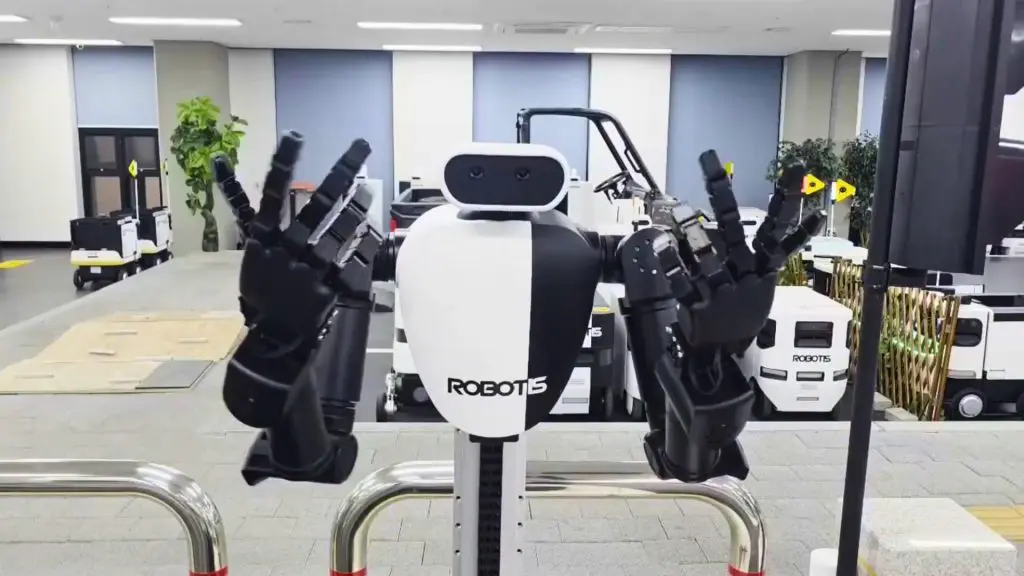
ROBOTIS is also developing a semi-humanoid robot for factory and warehouse use cases called the AI Worker. It has two 7-axis arms and moves on an omnidirectional base that can travel sideways and turn in tight spaces.
ROBROS’ Ingris Humanoid
Meanwhile, a newer Korean firm, ROBROS, is developing a full-sized humanoid robot for real-world research and industrial use.
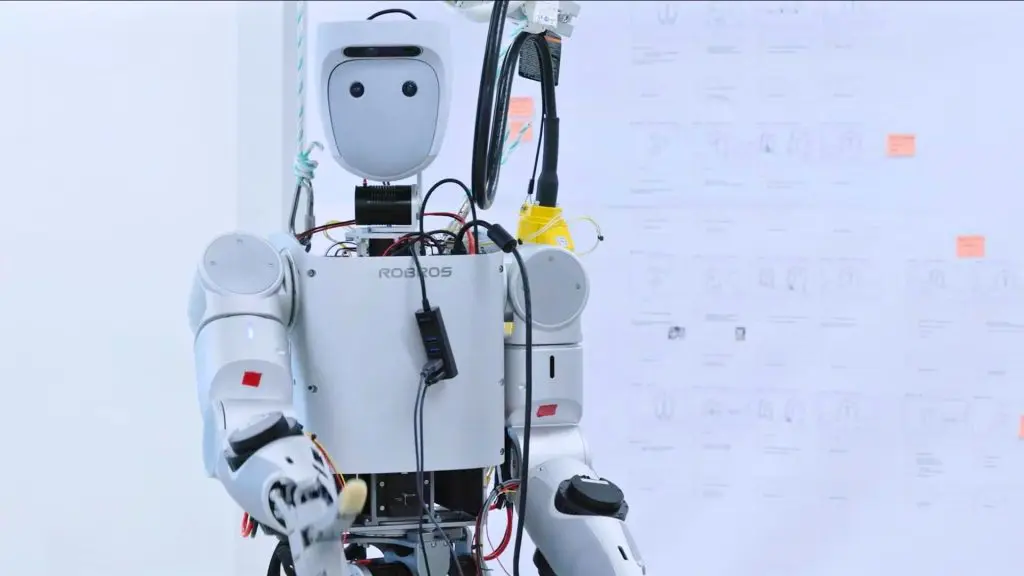
Established in September 2020, the Seoul-based firm describes itself as a full-stack humanoid robotics company. Its flagship is the IGRIS-C, which recently demonstrated the ability to navigate autonomously through obstacles in a demo.
Standing 1.5 meters (5 foot 1), the robot weighs 56 kg (123 lbs) and boasts a reported 43 DoF. It runs on an Intel NUC with an NVIDIA Jetson Nano computer. Its top speed of 3.5 km/h (2.2 mph) lags behind contemporaries from Unitree and Figure AI, but ROBROS says its focus is on reliability at real-world jobsites. The humanoid’s tendon-driven hands have six moving joints and each can handle payloads around 3 kg (6.6 lbs).
LG’s CLOiD for Homes
According to Korean reporting, IGRIS are being piloted by LG. The South Korean appliance manufacturing giant is developing its own humanoid robot for homes named CLOiD, which debuted at CES 2026 in Las Vegas.

LG says it’s the next step in its so-called Zero Labor Home initiative. It integrates with its ThinQ smart home ecosystem. The humanoid gets around on a wheeled base, perceiving its surroundings with its vision-based AI. It has two five-fingered hands for everyday chores like tidying up and folding laundry.
However, CLOiD still looks very early. A Tom’s Guide report from CES noted it moved slowly and left towels poorly folded.
WiRobotics’ ALLEX
Another company focused on dexterous manipulation is WiRobotics in Cheonan. Founded by former Samsung engineers in 2021, its name stands for We Innovate Robotics. Like Fourier in China and Wandercraft in France, it started out building exoskeletons and wearable robotics before expanding into humanoid development.

Its flagship robot is ALLEX, an upper-body-only platform. The humanoid integrates with the company’s dexterous end effector, which has 15 DoF across its fingers and wrist. ALLEX’s developers say the robot’s joints and mechanics are so finely tuned and back-drivable that can sense tiny forces through its own structure. The startup says the mix of extreme sensitivity and useful strength makes ALLEX safer and more natural to work alongside humans than traditional industrial robots.

WiRobotics reported raising around $68 million in a Series B round in May 2026. The company calls ALLEX its next major growth engine. It plans to launch a research-focused humanoid later in 2026 as it targets mass-production readiness for late 2027.
Meanwhile in the US, the leading robotics firm Boston Dynamics, which is tied to Korea through its parent company Hyundai, is going to great lengths to differentiate itself as the physical AI race heats up. Read all about it here.