
Which US robotics company is working with NVIDIA on humanoid research platforms?
At GTC Taipei 2026, NVIDIA Founder/CEO Jensen Huang unveiled the tech giant’s reference humanoid platform for its Isaac GR00T foundational model. The Chinese company Unitree Robotics developed the body based on its full sized H2 humanoid, while the Singaporean startup Sharpa Robotics supplied its five fingered hands. The announcement came a day after Hangzhou-based Unitree cleared a major hurdle as it heads toward an IPO on the Shanghai STAR Market.
During his keynote, NVIDIA Founder/CEO Jensen Huang said humanoids are part of the bigger shift toward agentic artificial intelligence. He called AI agents “digital robots” because they can understand, reason, plan, act, and use tools designed for humans.

Still, he said more breakthroughs are needed to unlock general-purpose robotics. Instead of building a robot from scratch, he said, universities and labs should have a standardized platform to teach a robot’s AI useful skills.
“The one thing that is missing is we need a reference platform for robotic systems,” he said. “These robotic systems are so complicated. So many motors, so many sensors, so fragile.”
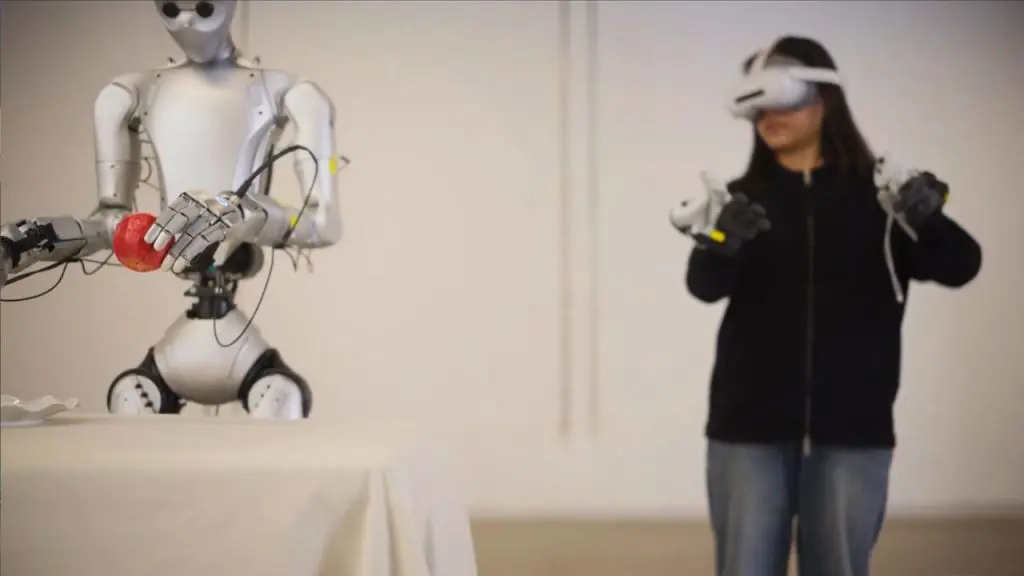
Until recently, research-grade humanoids have cost well into the six figures. That changed largely thanks to China’s aggressive push to lead the humanoid sector by 2027. Chinese robots, like Unitree’s G1 and Agibot’s X2, have surged in popularity among researchers and developers thanks to their relatively low entry prices.
Huang later told Reuters that NVIDIA is also working with humanoid makers in the US, Europe, and South Korea.
But who?
If NVIDIA builds a US version of this platform, it’s probably safe to start with the American humanoid companies already visible in Jensen’s keynote. That would be 1X Technologies, Agility, Fauna Robotics, Figure AI, Persona AI, Disney Research, Familiar Machines & Magic, and Noble Machines.
Of those, these are more likely:
- 1X Technologies (Palo Alto): They’re already scaling production of NEO, which is priced at $20,000 for consumers.
- Agility (Salem, OR): The Oregon State University spinout has previously built research-grade bipeds in small batches before commercializing Digit.
- Noble Machines (Sunnyvale): A newer startup that’s scaling its headless humanoid robot named Moby for factory work. The startup says it’s already shipped its first robots to a Fortune 500 customer.
The most likely, however, is Fauna Robotics. Amazon acquired the New York startup earlier this year after it started shipping its $50,000 Sprout humanoid. The compact humanoid is mostly marketed as a research platform. Boston Dynamics has even used Sprout to test next-gen capabilities for Atlas.

Figure seems unlikely just because no one can imagine it. Disney Research is focused on entertainment applications, while Familiar Machines & Magic is trying to replace pets. Persona AI, based in Houston, is focused on specific use cases in shipbuilding.
Unitree’s H2 Plus robot’s onboard AI is powered by an NVIDIA Jetson Thor computer, which uses a Blackwell GPU and a 14-core ARM CPU. According to Unitree, the H2 Plus robot perceives its surroundings with binocular vision, optional cameras, and array microphones. Its 15Ah battery is rated for 3 hours of active use per charge.
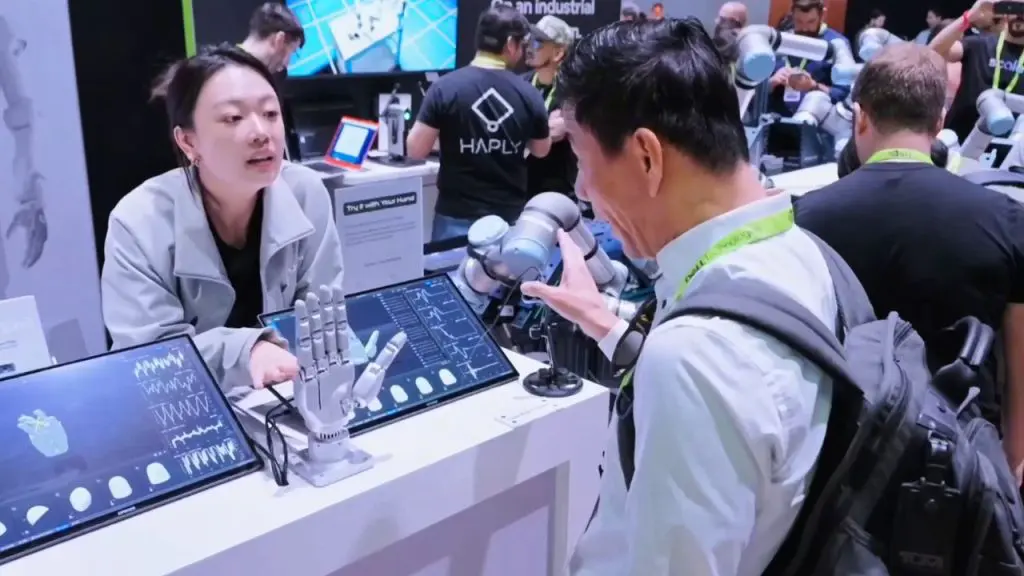
The humanoid stands 182 cm (6 feet), weighs 70 kg (154 lbs), and boasts 31 degrees of freedom (DoF) across its body. Its SharpaWave hands are among the most advanced dexterous end effectors on the market today. Each has 22 active DoF and tactile sensing in the fingertips for interacting with real world objects.
NVIDIA says the system includes Isaac TeleOp, Isaac Sim, Isaac Lab, Isaac ROS, and GR00T open foundation models. The goal is to give universities and robotics labs a common humanoid platform to accelerate development. It’s expected to be available for academic research in late 2026.
Pricing has not been released.