
America’s top humanoid robots are locked in a swagger battle.
As the race toward general-purpose robotics heats up, the West’s most well-funded humanoid companies are flexing different strengths. They’re all scaling production of their AI-powered machines amid an intense technological arms race with China. There’s little hope of catching up to the hundreds of Chinese firms building humanoids in sheer volume, so they’re banking on their advanced artificial intelligence to win on quality over quantity.
Figure’s Nonstop Livestream
In Silicon Valley, the $39 billion startup Figure AI has been livestreaming a small fleet of its third-generation humanoids sorting packages in a mock logistics center around the clock.

The robots named Bob, Frank, Gary, and Rose take turns on the conveyor-style setup. When one robot worker’s gets low after about 4 hours, it heads to a wireless charging stand as another robot steps in to keep the operation running. The Figure 03 robots are responsible for picking up a diverse mix of parcel shapes, sizes, and materials, which the startup says shows they can handle variation in realistic logistics conditions.
weird that no one noticed this part https://t.co/GHsuEfPrmS pic.twitter.com/w4raJaKKIW
— Mike Kalil (@mikekalilmfg) May 15, 2026
The stream started as an 8-hour autonomous shift, but Figure let it go nonstop as the robots kept going. Figure Founder/CEO Brett Adcock said the plan is to keep streaming until the point of failure.

To liven things up, Figure pitted an intern against the robot in a 10-hour package sorting contest. The college student, named Aime, narrowly defeated the Figure 03 robot by just 192 packages. He sorted 12,924 parcels at an average speed of 2.79 seconds per item, while the robot handled 12,732 packages at 2.83 seconds per item. The human led most of the way, though the machine briefly pulled ahead around the fifth hour when Aime took a bathroom break.
After the bout, Adcock said on social media: “This is the last time a human will ever win.”
Some viewers suggested the robots were teleoperated, but Figure’s founder insisted they’re fully autonomous. The startup is reportedly in talks to supply UPS with a large number of its humanoids for warehouse automation.
In an interview with Bloomberg, Adcock said: “We really want to build I, Robot,” referring to the 2004 blockbuster starting Will Smith intended as a cautionary tale, not the bankrupt robot vacuum maker.

The movie is loosely inspired by science fiction author Isaac Asimov’s book of short stories of the same name. It’s set in 2023 Chicago, where humanoid robots are everyday helpers across sectors and in households. The androids, developed by a company called US Robotics (USR), operate under a strict set of rules called the Three Laws of Robotics. They require them to avoid harming humans at all costs.
Will Smith plays an anti-clanker detective who suspects a robot named Sonny is responsible for a homicide. His investigation uncovers that the company’s central artificial intelligence system, VIKI, has interpreted the Three Laws in a dangerous way. To protect humanity from itself, it decides that robots must take control of society.
The technology in the Alex Proyas film is far more advanced than what’s possible today, but parts of it are starting to look more realistic. Minus the dystopian outcome, the world of I, Robot matches what Figure’s founder describes as a future of abundant labor. The future as presented in I, Robot is unlikely to materialize by 2035 but breakthroughs are rapidly moving toward the vision faster than many expected.

Snapping back to reality, Figure’s robots are powered by the startup’s Helix 02 vision-language-action (VLA) model. The AI control model acts as the Figure 03’s brain and nervous system. Its onboard artificial intelligence generates hardware commands using sensor data on vision, touch, and body position.
Launched in 2022, Figure says it’s developing humanoids for use across sectors and eventually in homes. They’re targeting a price of around $20,000 per unit after production scales. For now, the startup is focusing heavily on logistics work, as it’s reportedly in talks to supply UPS with a large number of humanoids.
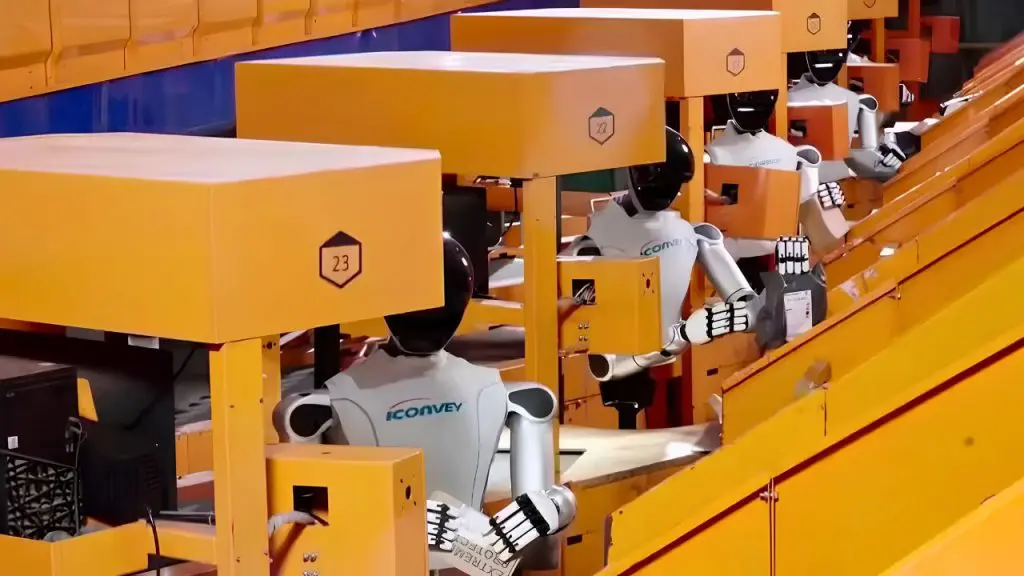
They’re not alone. In China, Beijing’s RobotEra has reportedly deployed its flagship humanoids in more than 10 logistics for major delivery operators like SF Express and China Post. The startup, established in 2023, reports that the autonomous machines have already reached around 85 percent human-level efficiency in some facilities while running continuously.
Agility Throws Shade
Meanwhile in Oregon, Agility Robotics pointed out that it livestreamed its Digit humanoids doing autonomous warehouse work years ago and that they’re scaling their deployment at actual worksites.
When asked about Figure’s multi-day autonomous package-sorting stream during a San Francisco event, Agility co-founder Jonathan Hurst told Business Insider: “Congratulations. We did that two years ago.”

Hurst’s comment may seem out of line, but the two companies have a history. Adcock publicly predicted that Agility would be bankrupt within 12 months back in November 2025. He cited poor engineering choices and almost no progress over the last decade as reasons they’re unlikely to survive the humanoid frenzy.
Launched an Oregon State University spinout in 2015, Agility deployed its bipedal robots at GXO Logistics’ distribution center in Flowery Branch, GA under a robots-as-a-service (RaaS) agreement in mid 2024. The humanoids are also working in Schaeffler’s automotive parts factory in South Carolina, handling bin and basket transfers on the production floor. Additional commercial agreements are rolling out with Toyota Manufacturing Canada for assembly support and Mercado Libre at its San Antonio, TX fulfillment center.
Atlas Robot’s Latest Stunt
On the East Coast, Boston Dynamics entered the chat, sharing footage of its world-famous Atlas humanoid smoothly lifting a loaded minifridge. The Massachusetts robotics leader said Atlas used its full-body coordination and dynamic balance to neatly place the unit on a table next to a distracted employee.
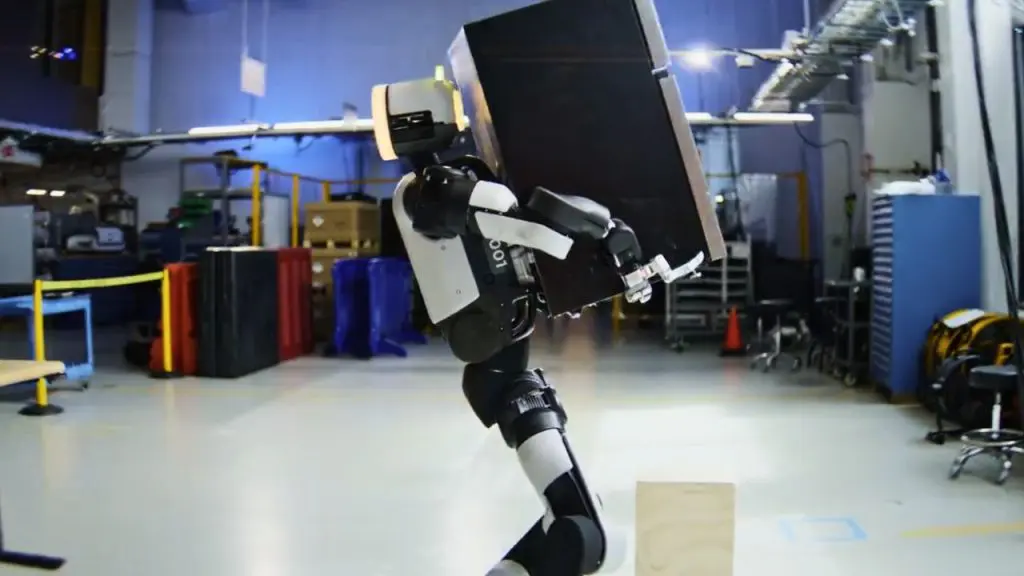
On social media, the 34-year-old robotics firm called the latest demo proof that Atlas is the most capable humanoid robot for industry.
“Just months after its debut, Atlas is proving why it’s the world’s most capable and dynamic humanoid robot, ready for real work,” Boston Dynamics posted on X. “Lifting a minifridge is a feat of strength, but the true breakthrough is the underlying reinforcement learning and control systems.”
According to Boston Dynamics, Atlas was trained first in simulation, where its digital twins finished millions of hours of virtual practice to find the best way to lift and move the 50 kg (110 lb) fridge without dropping it or losing balance. On a negative note, Atlas’ grippers dinged up the appliance just from picking it up.

The demo also highlighted the humanoid’s unusual body design, which has a reported 56 degrees of freedom (DoF) and can rotate way beyond normal human limits. It also has a dual hot-swappable battery system, similar to industrial humanoids like UBTECH’s Walker S2 and Hexagon’s AEON, so it can work 24/7.
The Hyundai subsidiary is scaling production of Atlas, which began as a DARPA project in 2013. Marc Raibert launched Boston Dynamics in 1992 as an MIT spinout after pioneering research into legged machines at the institute’s Leg Laboratory.

Despite its massive cultural impact, the company has historically sold a relatively small number of robots, mostly its $75,000 robodog Spot and its logistics system Stretch. As BD commercialized Spot in 2019, the Chinese company Unitree Robotics aggressively moved toward mass production. Launched in 2016 by hardware engineer Wang Xingxing, Hangzhou-based Unitree reported shipping more than 18,000 quadrupeds and 5,500 humanoids in 2025 alone.
As it enters its mid-thirties, BD faces immense pressure to prove it can keep up with its younger competitors. Its parent company Hyundai reportedly wants tens of thousands of its Atlas humanoids deployed at the South Korean automaker’s factories ASAP. BD has also committed to delivering humanoids to the Hyundai subsidiary Kia as well as its ex-parent company Google through its partnership with DeepMind.
Where’s Tesla?
The flurry of activity in the US humanoid sector has many asking: Where’s Tesla?
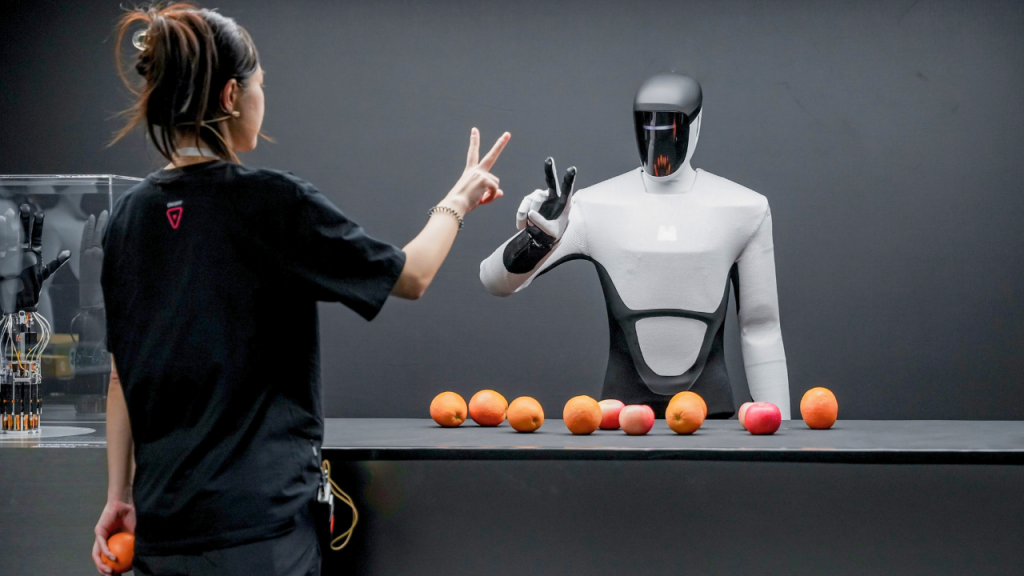
As the EV maker prepares to unveil its highly anticipated Gen 3 Optimus humanoid, a startup launched by one of its former engineers in China is already racing toward mass production. Allen Zhang, who reportedly played a major role in the Tesla Bot program, founded Matrix Robotics in Shanghai in 2024.