
Atlas, the world-famous humanoid robot by Boston Dynamics, is almost a teenager now.
Though young by people standards, Atlas is basically a senior citizen compared to the swarm of fake humans racing to market. It’s had a storied life so far, rising from a DARPA lab to scary robot notoriety to full-blown pop culture icon status.
Now it’s ready to start its first real job at its parent’s car company. Atlas is becoming uncannily human like in how it learns and perceives the world, and increasingly superhuman in physical capabilities. But will that be enough for the AI-powered humanoid to make it in today’s market as growing wave of robots like it angle for the same jobs?
Fukushima Origin
The need for robots that do things too dangerous for people became evident in the wake of the March 2011 Tōhoku earthquake and tsunami. The disaster crippled the Fukushima Daiichi nuclear power plant, located on Japan’s Pacific Coast, triggering meltdowns in multiple reactor cores, and releasing radioactive material into the environment.
Teams of engineers had been preparing for an event like it for decades. They developed machines to face extreme danger caused by high radiation, debris, and unstable structures for human responders.

Robots were sent into the plant, but many failed quickly. They overheated, got stuck, and struggled on harsh terrain. Even the robots that worked reliably, like iRobot’s PackBot and Warrior, were limited to simple reconnaissance and basic debris clearing.
It exposed a global gap in robotics for disaster response, directly motivating DARPA to create its robotics challenge that led to Atlas. The US Pentagon’s R&D wing said its goal was to create robots that could handle human-level tasks people couldn’t do at Fukushima, like driving vehicles, opening doors, climbing ladders, and using tools.
DARPA and Boston Dynamics
In 2012, DARPA picked Boston Dynamics to design and build the hardware for a human-like robot.
At the time, Boston Dynamics was already two decades old. Based in Waltham, Mass., professor Marc Raibert spun the robotics firm out of an MIT lab in 1992. The privately held engineering company was small, with under 100 employees, but very well known in the robotics and defense circles for pioneering legged robots, like its DARPA-funded BigDog quadruped.
It developed PETMAN, a humanoid for testing chemical protective suits for the US Army starting in 2009. That robot, introduced in 2011, was controlled by preprogrammed instructions and real-time feedback loops. It could adjust on the fly to keep its balance, but didn’t learn from experience or make decisions beyond its set tasks.
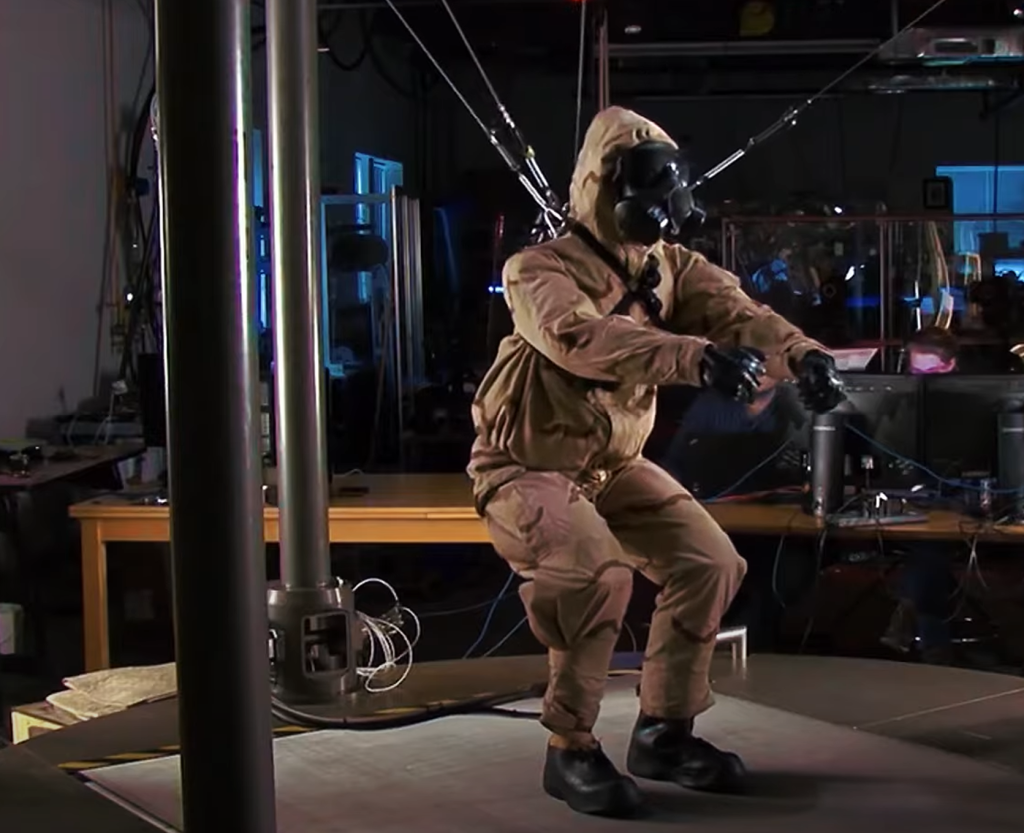
PETMAN was in a league of its own compared to the few two-legged humanoids of the era, with its hydraulic actuators and sensor feedback for natural and fluid movements. Footage of the robot walking, doing squats and pushups, and recovering from small pushes became a symbol of next-gen robotics.
Boston Dynamics was the obvious choice for the $11 million contract, as the only US-based firm with a working full-sized robotic humanoid prototype.
Atlas V1
Boston Dynamics and DARPA unveiled the first iteration of Atlas in July 2013. The name is a likely mythological reference to the Greek Titan who held up the heavens, symbolizing strength and load-bearing ability.
Standing 188 cm (6’2″), the original Atlas possessed 28 hydraulic joints, a sensor head from Carnegie Robotics with LiDAR and stereo cameras, and two interchangeable hands designed by Sandia National Labs and iRobot.

The humanoid was tethered to an off-board power supply and computer for hydraulic power and control. It could pull off rudimentary walking and climbing, but its abilities were very limited. DARPA’s program manager, Gill Pratt, likened the prototype’s skill level to a 1-year-old child. The New York Times called it “a striking example of how computers are beginning to grow legs and a giant, though shaky, step” toward synthetic humans operating in the real world.
Atlas Unplugged
The unveiling came amid surging investments in robotics that put humanoids, dexterous manipulation, and machine vision squarely on Silicon Valley’s roadmap.
Google went on a robotics buying spree, acquiring Boston Dynamics, Schaft and other firms in hopes of deploying intelligent machines at scale.
In 2015, Boston Dynamics released a major hardware revision nicknamed Atlas Unplugged. The redesign freed the humanoid from its tether by swapping the external power umbilical for an onboard battery pack.

An estimated 75 percent of the robot’s parts were replaced or modified. The revamp featured a new power distribution panel, improved arms and forearms with a wider range of motion, and a quieter hydraulic pump. Only the lower legs and feet remained from the OG model.
The changes also reduced Atlas’s reliance on a safety gantry. Its ability to balance on its own without a support line was a big step toward autonomy.
Post-DARPA Atlas
After the DARPA challenge, Boston Dynamics made clear it intended to continue its humanoid robotics program. A completely new iteration of Atlas, markedly smaller and lighter, debuted via a YouTube video, titled Atlas: The Next Generation, in February 2016.
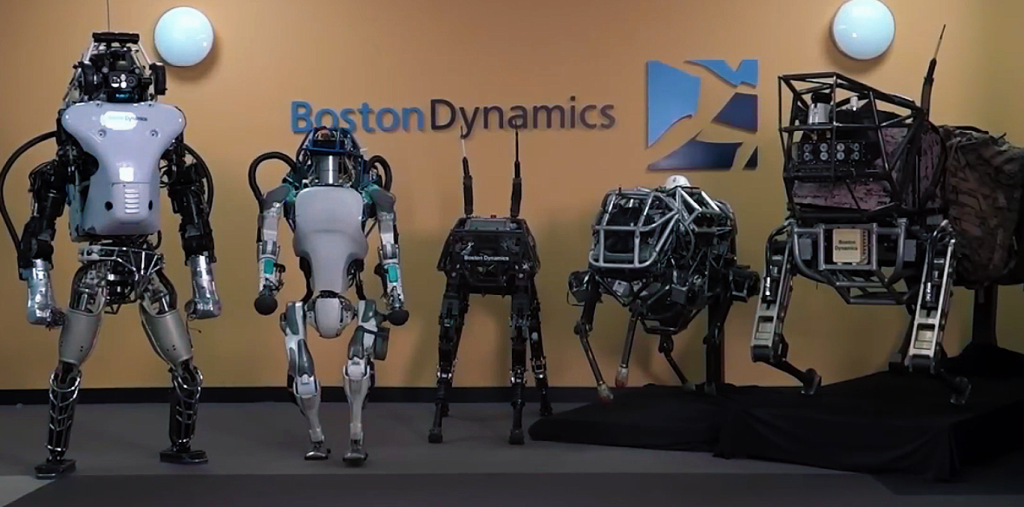
It stood a 1.5 meters (4’1″) and weighed just 82 kg (180 lbs). Despite the reduction in stature, the robot was even more capable than its predecessors.
The 2016 Atlas ran on battery power and a compact hydraulic system that empowered it to move both indoors and outdoors. With its upgraded sensors and onboard computing, the new Atlas could navigate uneven terrain including snow, right itself after being pushed over, lift and carry boxes, and even open doors.
SoftBank Era
Boston Dynamics changed ownership again in 2017 when SoftBank bought it from Google for an undisclosed amount. The Japanese tech giant sought to commercialize its recently introduced Spot robotic dogs as it also pushed its wheeled Pepper humanoids developed by the French startup it acquired, Aldebaran Robotics, into the service sector.
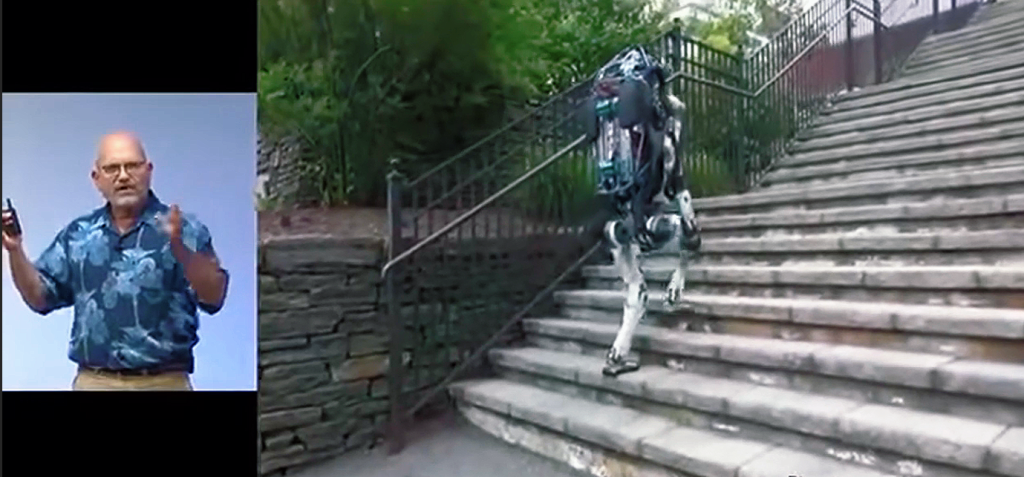
Atlas remained a research and development project, with continued improvements to its software and actuators achieving human-level, and even superhuman, agility. In November 2017, Atlas stunned the world with a demo video showing it doing backflips, jumping between platforms, and spinning 180 degrees midair.
Its athletic abilities continued to fascinate, and alarm, people at an accelerated rate. By 2018, the robot was seen jogging across outdoor terrain and effortlessly leaping over obstacles. In September 2019, an Atlas robot completed a gymnastics routine, including continuous somersaults, a handstand, and a 360-degree spinning jump, all executed in one fluid sequence.
By this time, the robot’s control system ran almost entirely onboard, processing inputs from RGB cameras and depth sensors to pull off moves in real-time. A model-predictive control algorithm helped string the complex moves together without the robot toppling over. When it did tumble, Atlas could roll on its back and spring up to standing in one motion, showing how its mechanical design protected its critical components.
The athletic feats went far beyond what most robotics experts thought was possible just a few years prior.
Hyundai Acquisition
Atlas’s direction shifted toward industrial use cases in 2020 when Hyundai acquired an 80 percent controlling stake in a deal valued at $1.1 billion.
The humanoid began learning useful tasks in addition to acrobatics. The robots also learned to collaborate, as shown in a 2021 demo with two Atlas humanoids performing synchronized parkour moves while rarely missing a step.
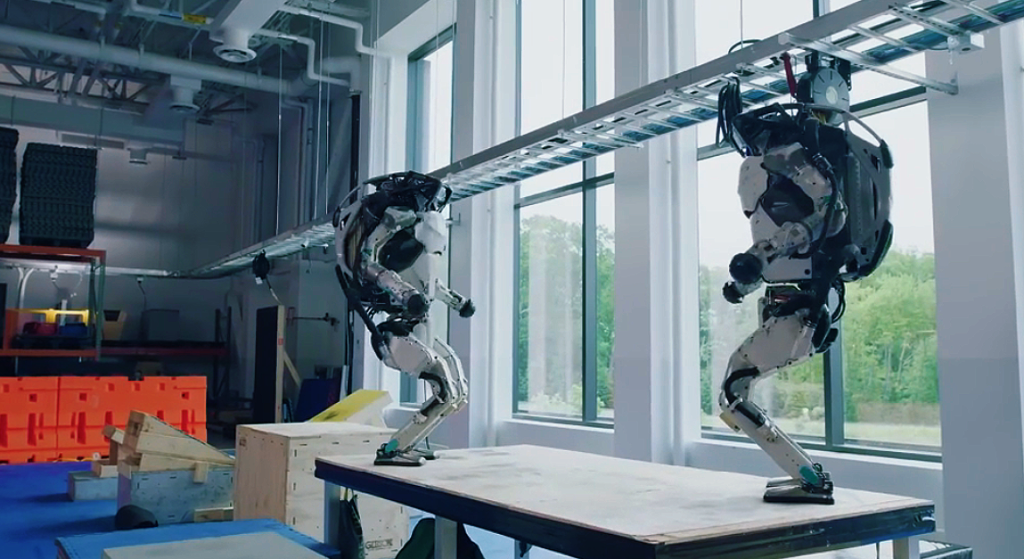
Engineers disclosed that Atlas’s software now handled perception, locomotion planning, and balance on the fly. All computations were done onboard thanks to three powerful computers in its torso.
Around this time, Boston Dynamics engineers began integrating more model-free artificial intelligence techniques. They experimented with reinforcement learning and motion capture to broaden its repertoire of movements.
By early 2023, its focus shifted toward manipulation tasks. In a demo, dubbed Atlas Gets a Grip, the robot was shown autonomously picking up a tool bag and tossing it to a human worker and moving wooden planks to create a bridge in a mock construction scenario.
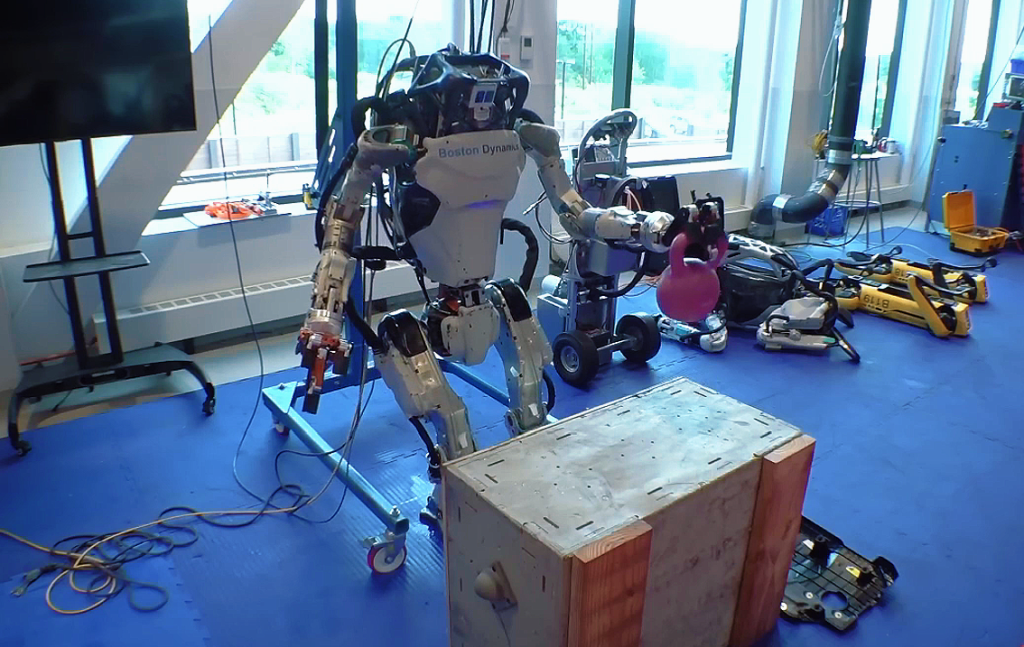
Internally, engineers started training Atlas with machine learning models to improve its handling of objects and navigation of complex settings in its push toward greater autonomy.
Fully Electric Atlas
After 11 years of refining the hydraulic Atlas, Boston Dynamics retired the original platform in April 2024.
and unveiled a next-generation fully electric Atlas the following day. The hardware was completely overhauled, built with a mix of titanium and aluminum 3D-printed parts.

Ditching hydraulics for electric actuation, Boston Dynamics described the all-new Atlas as stronger, with a broader range of motion that at times exceeds human capabilities.
Its form factor is more humanlike and upright with a distinctive ring-shaped LED light in its head. Fully rotating joints unlock shape shifting movements impossible for humans. Although Boston Dynamics has not released detailed specs, its hinted that it is more compact and efficient.
In a 2024 Halloween video, the electric Atlas donned a hot dog costume, showing it’s small enough to wear real clothes unlike its bulkier predecessor. By Christmas of that year, it could do floor to floor backflips.
Atlas Gets to Work
In 2025, Atlas is more human like and autonomous than ever, but there’s also more competition than anyone could’ve predicted.
In the race toward superintelligence, investors are pouring billions into accelerating the mass deployment of AI-powered humanoids. In the US, Boston Dynamics is scrambling to commercialize its flagship biped alongside Tesla, Agility Robotics, Apptronik, Figure AI, and others.

They’re stepping up efforts to compete with China, whose government has set out to own the fake humans market by 2027. Among the perceived leaders is Hangzhou-based Unitree Robotics, whose quadruped and biped robots have surged in popularity among researchers, developers, and hobbyists thanks to their relatively low entry prices. Unitree’s founder, Wang Xingxing, has said his idol is Marc Raibert, who now serves as chairman of the Boston Dynamics AI Institute, which operates as a separate entity focused on long-term research.

According to reports, Atlas robots have spent much of 2025 training for imminent deployment at Hyundai’s US manufacturing facilities. LG Innotek has developed next-generation camera and vision components for better perception on the factory floor.
Boston Dynamics and its parent company also announced a deeper collaboration to produce more robots. The year 2026 could make or break Atlas. Subscribe to my YouTube channel for first updates.