
It is remarkable how readily major news outlets repeat Foundation Future Industries’ claims about military contracts that are a matter of public record.
The San Francisco-based startup is in a crowding field of companies rushing to deploy autonomous humanoid robots at scale. Leaning into the robot-soldier narrative has become one of the few remaining ways to stand out and generate headlines. The media has largely played along because it’s easier to package Foundation as America’s killer robot company than to scrutinize whether its claims hold up.
Sankaet Pathak launched the robotics firm in 2024 just months after his fintech startup, Synapse, went bankrupt. The collapse left many customers unable to access their money. Between $60 million and $96 million remains unaccounted for, and the company reportedly remains the subject of a DOJ criminal investigation.
Pathak’s 10-year run at Synapse was turbulent. In 2019, three women sued, alleging harassment based on gender, pregnancy, and age. He denied the allegations, which do not appear to have resulted in a publicly reported verdict. Months earlier, Pathak sued anonymous Glassdoor reviewers for defamation and sought to compel the website to reveal the identities of reviewers who posted accusations about his treatment of employees.
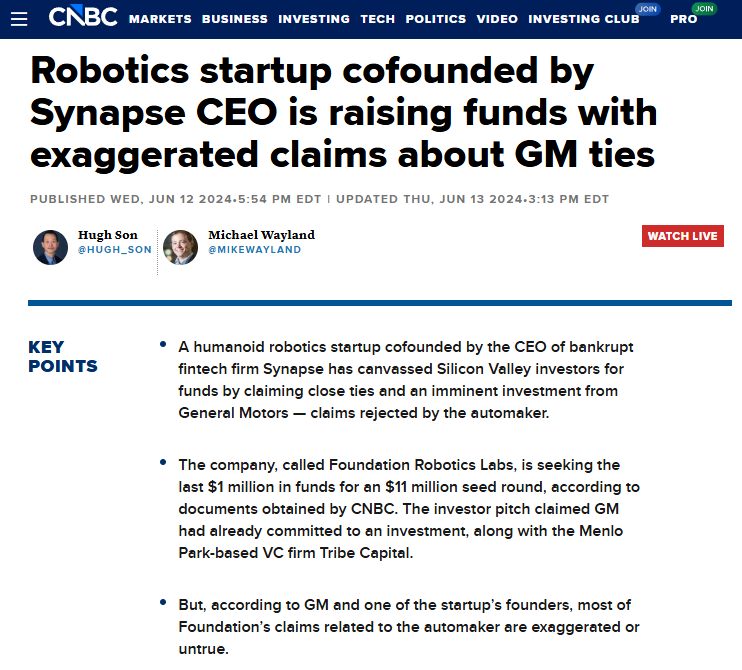
While raising funds for the humanoid venture, Pathak came under fire for circulating materials about a potential $300 million deal with General Motors. A document sent to potential investors said “GM agreed to let us collect the ground truth data” in its factories, starting in Mexico, and that “we would probably be the only company in this space with a dataset like this.” The automaker refuted the claim, and Foundation co-founder Mike LeBlanc told CNBC he was embarrassed that it had somehow made it into its marketing materials.
Despite the baggage, Pathak has managed to position himself as one of the perceived leaders in the US humanoid robotics scene. Since pivoting from fintech to robotics, he’s made a series of bold claims that the media has largely repeated without scrutiny.
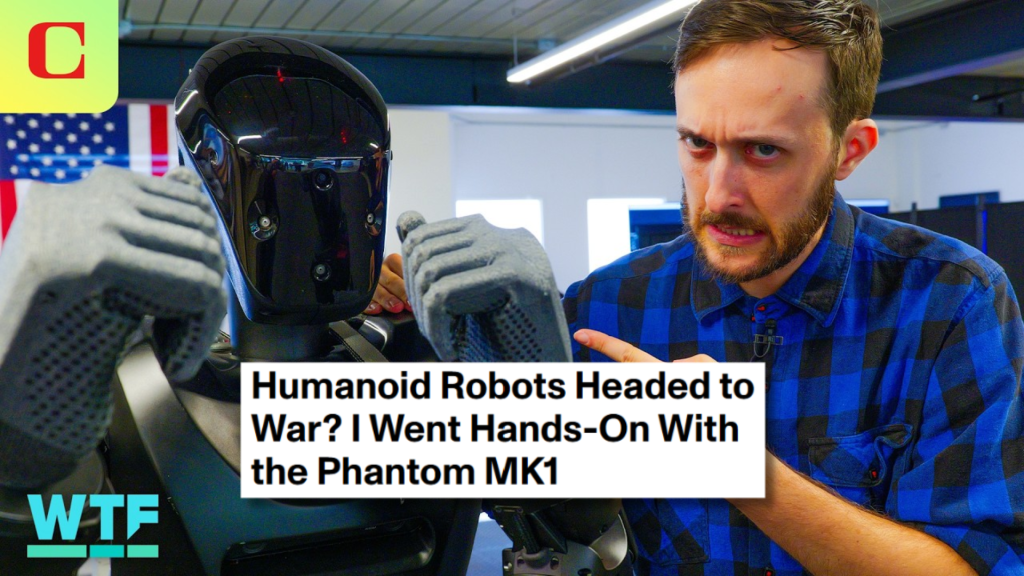
Foundation emerged from stealth in early 2025, immediately differentiating itself from fellow humanoid robot makers like Boston Dynamics, Agility Robotics, and Unitree with its eagerness to deploy its machines onto the battlefield. Its flagship humanoid, the Phantom MK-1, made its debut at a San Francisco nightclub as the newly inaugurated Trump Administration pushed to fast-track autonomous tech into defense.

Despite showing its robots performing little more than logistics work, Foundation quickly became known as America’s killer robot company. At one point, Foundation even named its AI system Skynet, after the problematic defense network from The Terminator series, before changing it to Cortex. The positioning landed them on the cover of Newsweek and earned it airtime across nearly every major news network.
The stories about Foundation’s work with the military grew increasingly larger than life after Eric Trump joined the startup as a chief advisor in early 2026. Foundation claimed to have delivered two Phantom MK-1 robots to Ukraine for evaluation in wartime conditions. There is no proof beyond Foundation’s word that the robots have done anything in Ukraine.
Shipping a robot to the Ukrainian military is not the same as securing an official battlefield deployment. Ukraine has become the world’s biggest testing ground for next-gen military robotics. Test in Ukraine is a state-backed program run by the country’s defense-technology cluster called Brave1. Launched in 2025, it allows foreign entities to submit drones, unmanned ground vehicles, AI systems, electronic-warfare gear, and other defense tech for evaluation.

It is intentionally accessible. The process is designed to pull as many relevant technologies as possible and to give developers structured feedback from people who would actually use in them in the field. Many companies get useful data and a marketing claim out of it. Few get large, recurring orders. There is no reason to believe Foundation falls into the latter category.
For something like a humanoid, which is still early-stage with clear limitations, the odds of adoption right now are slim. Even the most advanced humanoids on the market today would likely just get in the way during wartime conditions, especially bipeds. That said, Brave1 recently announced a grant competition specifically for humanoids. The technology they adopt today is more likely to be foundational systems to prepare for when humanoid technology matures.
In April 2026, Fox News’ Maria Bartiromo gave Pathak and Eric Trump a national platform to promote the company’s military ambitions. She took their word for it that they won a $24 million Department of War contract to train Foundation’s humanoids alongside the US Marines.

This would be easily verifiable if true, but federal government contract database searches come up empty. The only thing you’ll find is contracts that Foundation inherited when it acquired Boardwalk Robotics, a spinout of Florida’s Institute for Human and Machine Cognition (IHMC). That’s who developed the platform, Alex, that Foundation is building on today. Even then, those contracts are worth nowhere near $24 million or even $10 million.
To its credit, WIRED dug further and asked Foundation to clarify the discrepancy. When pressed, the company said it was referring to two contracts won by Boardwalk before the acquisition and three projects conducted through IHMC. WIRED concluded that Foundation did not appear to have independently secured new government funding implied in recent coverage describing the $24 million figure as “fuzzy.”

Just a few days ago, NBC News repeated the unverified claims without acknowledging the discrepancies. Reporter Gadi Schwartz also accepted Pathak’s account that two robots were sent to Ukraine. Although the segment challenged Foundation on the ethics of autonomous weapons and Eric Trump’s political influence, it did not apply the same scrutiny to the firm’s most basic factual claims about its contracts and deployments.
Foundation’s latest claim, unchallenged in a July 23 Forbes article, is that its robots “run 24 hours a day, five days a week in customer deployments, and contributed to more than 24,000 cars built in 2025, earning $100 million on contracted annual recurring revenue.” Forbes contributor John Koetsier noted that it “puts Foundation among a very short list of humanoid robot makers currently generating meaningful revenue from their robots.”
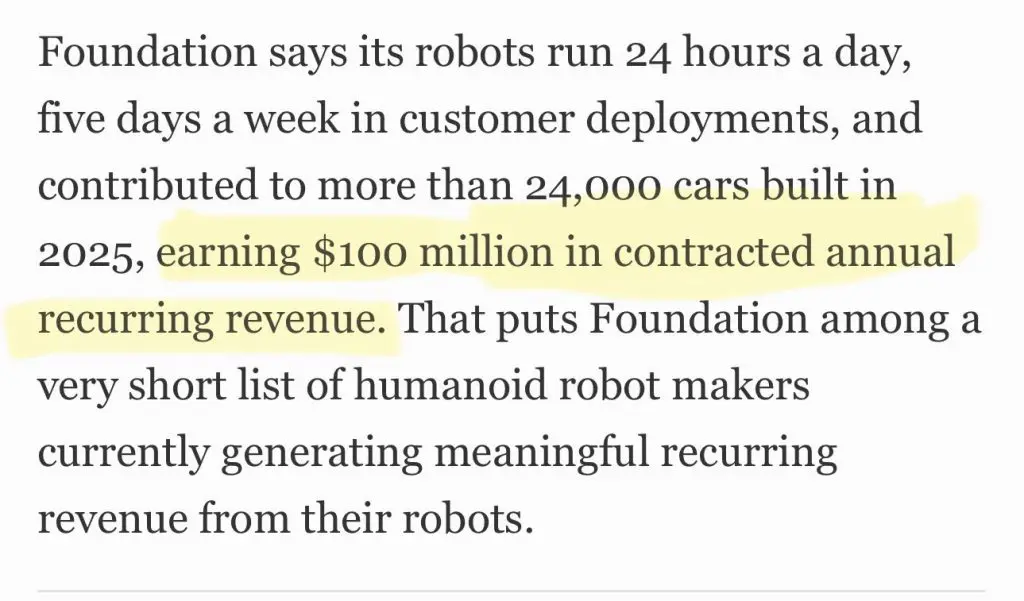
That’s actually an understatement. It would make them the world leader in humanoids. It would put them way ahead of Western competitors like Figure AI, Apptronik, Agility Robotics, 1X Technologies, and Tesla (only counting Optimus humanoids). Chinese companies like Unitree, Agibot, UBTECH, EngineAI, Galbot, and LimX Dynamics have them beat on production volume but none of them have reported anywhere near $100 million in contracted annual revenue.
Foundation has previously said it plans to lease its Phantom humanoids for $100,000 per year for industrial applications and $300,000 for military use. That would mean they have 1,000 industrial units under contract. If their $24 million contract was real, it could be a mix of about 80 defense units and 760 industrial robots. Regardless, it’s a very stunning accomplishment for a company with no known commercial customers that reported manufacturing just 40 units last year
Foundation says it plans to open a new factory in October 2026 with a targeted production capacity of 5,000 humanoids per year followed by a larger plant built for 50,000 units. However, Foundation has disclosed very little about its finances, so it’s unclear how it plans to fund such an aggressive expansion.
Given its track record, there is every reason to take its ambitious plans with a huge grain of salt.