
A humanoid robot built for war recently made its public debut at a San Francisco nightclub of all places.
In footage shared by SFGate, the Phantom MK1 is shown DJ’ing at the Temple Nightclub for the so-called Quarter of the Century Tech GigaParty.
Foundation Robotics Labs says it’s developing the robot specifically for military applications. The Frisco-based startup aims to make the robots faster and stronger than humans but without a nagging conscience.

“Defense is crucial for building and safeguarding the infrastructure necessary for making life self-sustaining,” founder Sankaet Pathak said on X. “Unlike most humanoid robot companies in the US, which have committed to non-weaponization, we believe it’s essential for our robots to master these tasks to support human expansion.”
As SFGate culture reporter Timothy Karoff put it, the MK1 is a “literal war machine.” Or is it? Let’s take a look.
According to Pitchbook, Foundation Robotics Labs was founded in 2024 with $11 million in seed funding. Foundation is led by Pathak, who founded the failed fintech startup Synapse, a banking-as-a-service platform that acted as an intermediary between startups and traditional banks.

Another co-founder is Mike LeBlanc, a former US Marine who helped found Cobalt AI, a security robotics company. LeBlanc told SFGate he believes humanoids like the Phantom MK1 will be critical during future warfare.
News reports from mid 2024 indicate Pathak started aggressively fundraising for the venture shortly after Synapse filed for bankruptcy. The company is marketing its robots as a solution for worker shortages in manufacturing. Pathak said the startup spent 9 months developing its first production robot.
“We think this is literally the first time in the history of humanity where you can automate the GDP,” the founder said in a pitch to investors posted on X. “If people actually stopped going to factories and everybody started working from home, we will essentially have the whole civilization collapse. So to be able to avoid something like that, you really need to be able to automate everything.”
Foundation acquired Boardwalk Robotics, a small Florida company that introduced its humanoid robot named Alex in August 2024. The Phantom military robot appears to build on the Alex robot. When Boardwalk introduced Alex, it operated from a stable base to perform tasks requiring advanced manipulation capabilities.

According to Foundation, the Phantom MK1 stands 1.75 meters (5 feet 9 inches) and weighs 80 kg (175 lbs). Its payload capacity is 20 kg (44 lbs). Demo videos on Foundation’s website show the MK1 robot performing tasks for beverage and glass manufacturing.
Phantom’s upper torso is its operational hub, housing its processors, cameras, batteries, and sensors. Foundation’s website also details MK1’s lower body, which Pathak said was under development while pitching to investors in 2024. Foundation says the robot features advanced actuators and balance systems for navigating rough terrain and confined spaces.
After the MK1’s nightclub debut, Pathak said robots like it are needed to deter near-peer adversaries.
“China is actively developing defense robots,” he wrote on X. “The US must keep pace to ensure that technological capabilities continue to expand.”
Phantom’s motions at the party were preprogrammed, and the music was selected by humans in advance, according to SFGate. The party was presented by Founders Bay, a 45,000-member networking group for Bay Area startups and venture capitalists.
Foundation has some pretty lofty goals. The startup aims to ship more than 40 robots in 2025, 10,000 in 2026, and more than 20,000 in 2027. They’re targeting more than $1 billion in annual recurring revenue (ARR).
Foundation says the profits will go toward building a base on Antartica. From there, the startup says it wants to help build bases on the moon, Mars and beyond.
Companies like Foundation are likely to become more common as the tech industry’s perceptions about defense tech has shifted dramatically in recent years. Tech giants including Meta, OpenAI, and now Google have reversed their policies on defense contracts.
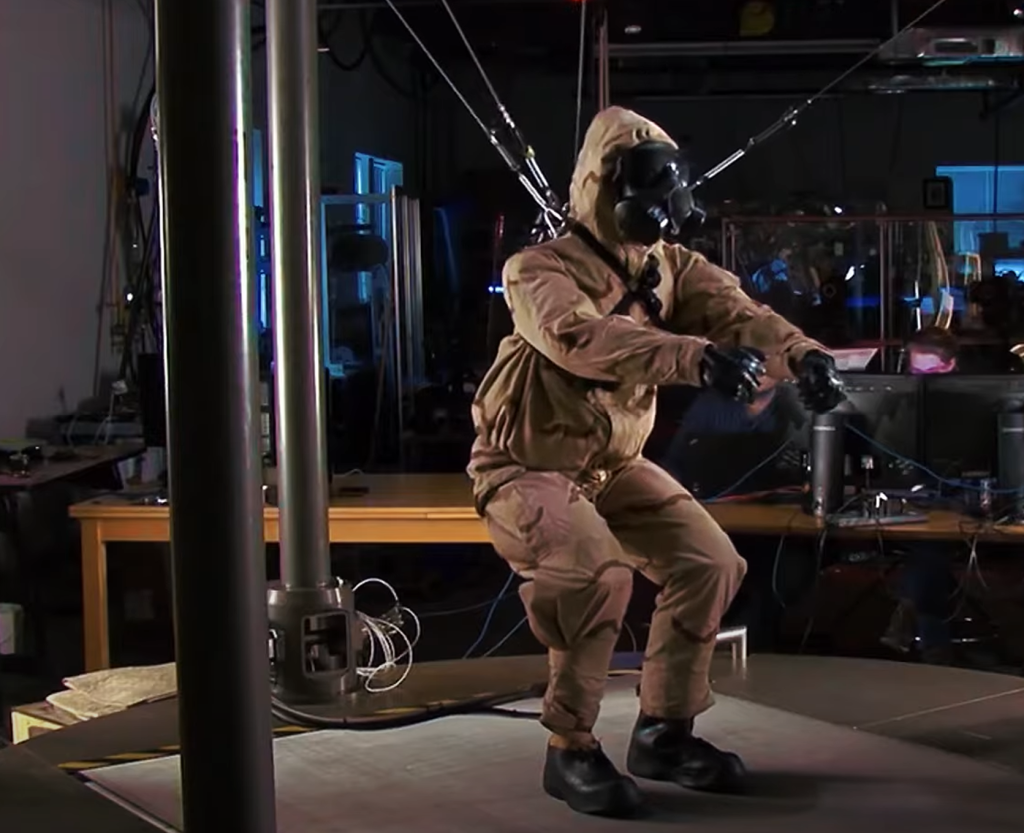
Boston Dynamics developed Petman for the US Army in 2011 to test chemical protective suits in realistic battlefield conditions. The project never passed the prototype stage.
DARPA initially funded and oversaw the development of Boston Dynamics’ more famous humanoid robot, Atlas, for disaster response and search and rescue operations. The Massachusetts-based robotics firm, now owned by Hyundai, has since pivoted toward industrial applications.
Russia introduced its gun-toting humanoid robot, Fedor, in 2016. The robot was designed for space travel, but Russian officials claimed it could also serve on the battlefield.
To keep as humanoid robots like the Phantom MK1 advance rapidly, subscribe to my YouTube channel for first updates.