
Chinese researchers just introduced a brutal new framework for preparing AI-powered humanoid robots for the harsh realities of the world.
The team, from the Shanghai-based startup RoboParty, shoved, kicked, dragged, and slammed a Unitree G1 robot to the ground like a nightmarish older sibling to demonstrate the system called UFO. The name is somehow short for A General Unsupervised Reinforcement Learning Framework for Humanoid Control.
According to the researchers, the harsh treatment is to identify weaknesses in the M3GAN-sized robot’s hardware and to improve its AI system that controls its balance and movements. They say it cuts training time from days to just a few hours while requiring less computing power compared to older AI-based training methods.
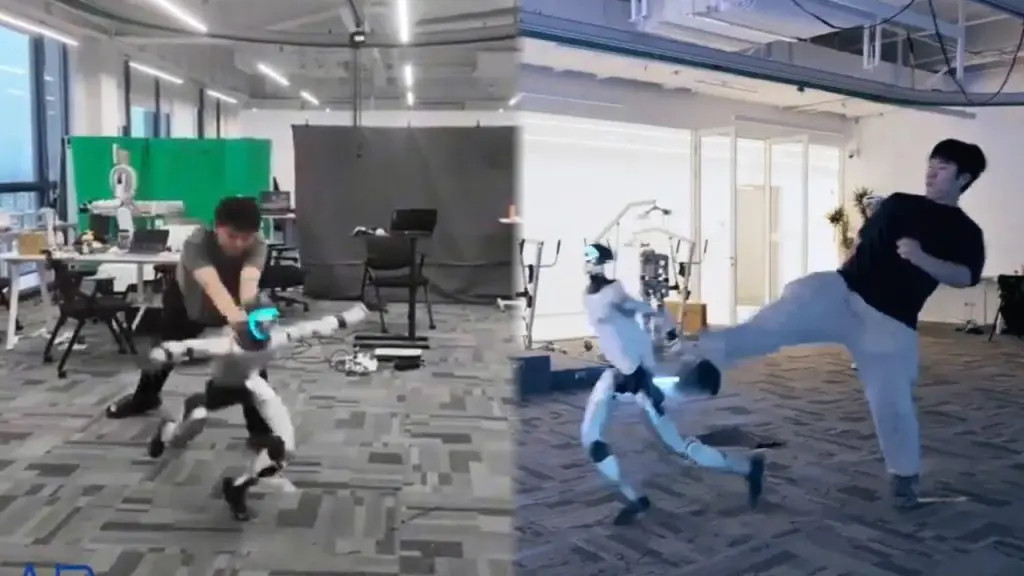
The UFO team says the testing prepares humanoids for the messy and unpredictable situations they’ll face in the real world. The system is intended for robotics developers who design, train, and test humanoids, similar to crash testing a car before it goes on sale. It works across different humanoid models so the AI can be adapted to new hardware with only a small amount of additional training.
The process begins in simulation, where a robot’s digital twin is given a goal without step-by-step instructions on how to achieve it. It learns through unsupervised learning by trying millions of different movements and receiving rewards when it’s successful. Accomplishments include staying balanced, walking efficiently, recovering after being shoved, or completing a given task.
As the AI improves, it develops a control policy, which is a decision-making system that determines how it should move in different scenarios. Once the policy becomes reliable in the virtual world, it’s transferred to the real humanoid so engineers can validate it through physical testing. The real-world test results are used to refine the AI further, creating an ongoing feedback loop.
RoboParty was launched in 2025 by a team of engineers affiliated with the Harbin Institute of Technology. It says its mission is to make lower the barrier of entry into humanoid robotics by openly sharing its hardware designs, electronics, control software, AI training tools, and deployment instructions. The startup’s main platform is called ROBOTO ORIGIN, which stands 125 cm (4 feet 1 inch), which is designed for dvelopers to study, modify, and assemble with commercially available parts.