
China is kicking into 2026 with major tailwinds in the humanoid race.
New Year festivities got a high-tech upgrade with robots like a synchronized dance troupe from Shanghai-based Agibot, which is aiming for the masses with its smallest and easiest-to-customize machine yet. Meanwhile, a much larger robot has already clinched an early victory for 2026. At the same time, fleets of industrial humanoids are gearing up to patrol China’s southern border with Vietnam, as a robotics firm with major financial backing introduces what it calls the country’s most advanced humanoid to date.
AgiBot’s New Year Blitz
The leading Chinese robotics startup Agibot is entering 2026 with a new backpack-ready robot meant to lower the barrier of entry into embodied artificial intelligence. The Shanghai-based firm, launched just three years ago, says its new Q1 humanoid delivers full-body force control with roughly one-eighth the mass of its adult-sized humanoids. The announcement capped off a blockbuster year for the startup, which is led by former Huawei “genius youth” Zhihui, an engineer with a growing cult following who recently said a new era of technologists has arrived.
Agibot reported shipping more than 5,000 humanoid robots throughout the year. That total represents roughly half of China’s national goal of manufacturing 10,000 humanoids in 2025, as Beijing aims to dominate the emerging market by 2027. The company is reportedly inching toward an initial public offering on the Hong Kong Stock Exchange (HKEX), where it would join fellow humanoid robot makers Shenzhen Dobot and UBTECH Robotics, both of which are aggressively scaling production of industrial humanoids.
Agibot is positioning itself as a broader alternative to Hangzhou-based Unitree Robotics, which is heading toward its own IPO on Shanghai’s tech-focused STAR Market and is reportedly seeking a valuation of around $7 billion. Agibot’s expanding portfolio spans industrial, service, entertainment, research, and consumer applications, with a focus on widening access. The startup has launched a rental program covering more than 16 scenarios, including business meetings, trade shows, weddings, and concerts. Pricing starts under $100 per day for entry-level quadruped robots, while high-end packages involving multiple robots can exceed $14,000 per day.
Demand is growing for compact humanoids like Agibot’s Lingxi series and Unitree’s G1, which have proven effective as marketing tools for early adopters.
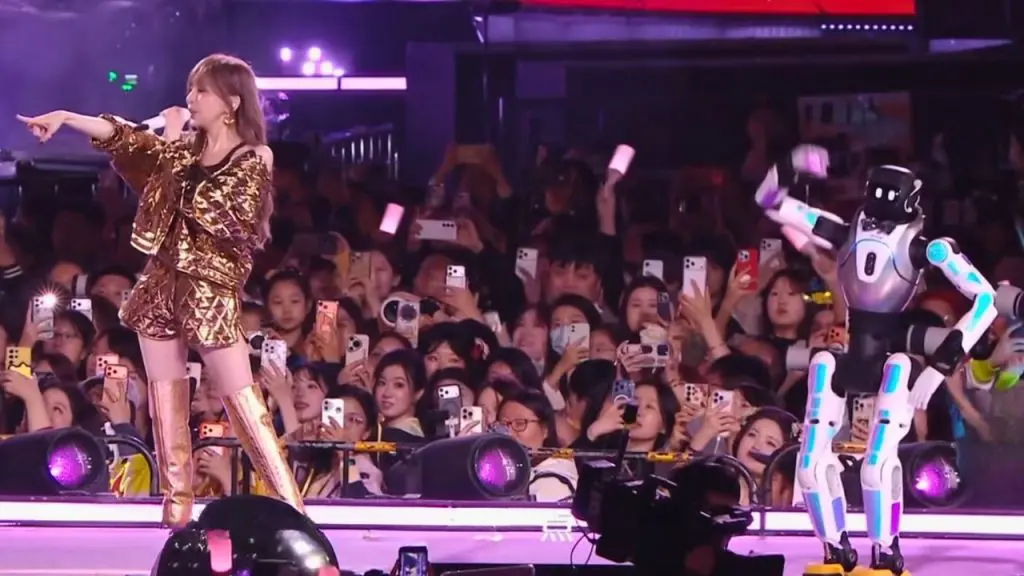
Unitree’s G1 humanoids recently captivated global audiences with a synchronized dance performance during Chinese pop star Wang Leehom’s comeback tour. Shortly afterward, Agibot’s shorter humanoids showed off their moves during New Year celebrations, first alongside Chinese hip-hop artist Vinida at Douyin’s New Year gala and then during a New Year’s Eve countdown with Mandopop star Cyndi Wang.

Agibot has been working overtime to stay in public feeds as it prepares to eventually challenge Tesla when the automaker scales production of its Optimus humanoid.
In November 2025, Agibot’s flagship full-size humanoid, the A2, set a Guinness World Record for the longest distance walked by a humanoid robot. The robot traveled more than 106 km (66 miles) over three days between Suzhou and Shanghai.
Agibot just introduced its newest offering, the Q1 humanoid, which stands just 80 centimeters (2 feet 7 inches) tall. That makes it considerably shorter than most compact humanoids on the market, which typically exceed 120 centimeters in height.
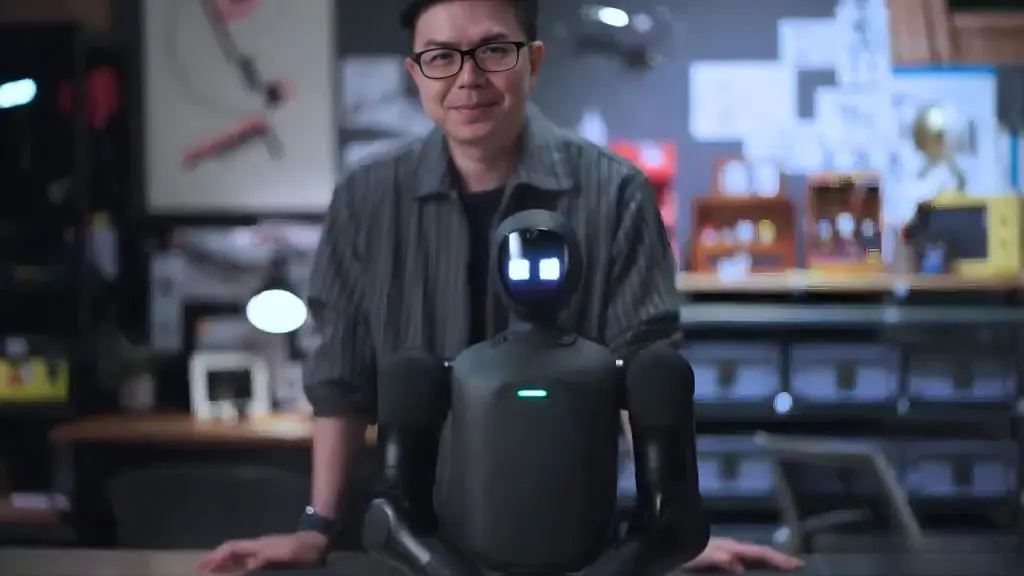
Despite its toddler-like size, the Q1 is not a toy. Agibot positions it as an entry-level humanoid that retains serious control capabilities. The robot is built with miniaturized quasi-direct-drive joints smaller than an egg, along with powerful actuators, sensors, and onboard computing designed for research-grade motion control. In its launch video, the Q1 performs martial arts movements and flips that would be dangerous near a small child.
According to Agibot, the Q1’s lighter build improves crash resistance and lowers the cost of iteration. The company is marketing the robot as a personal lab humanoid, offering open-source software and hardware development kits, zero-code tools, and support for custom 3D-printed shells. The robot’s intelligence is powered by Agibot’s Linksoul platform, which enables natural voice interaction and application-level features such as English tutoring and dance coaching.
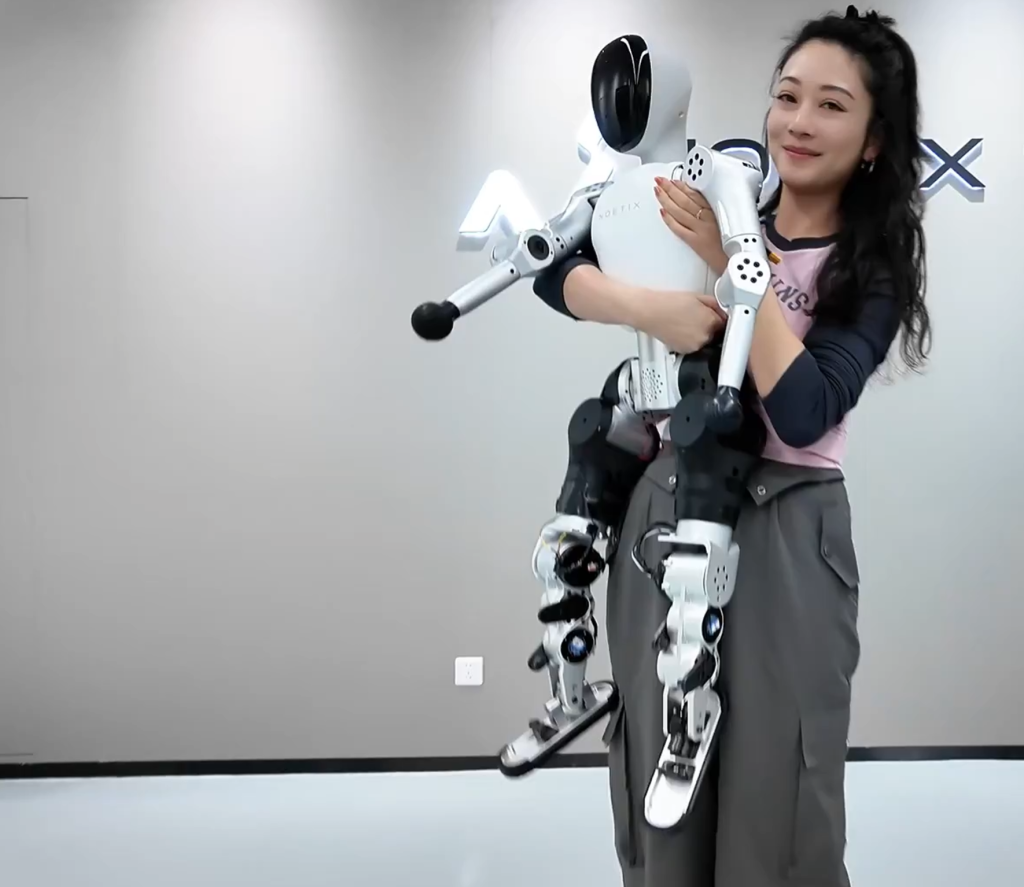
While Agibot has not disclosed pricing for the Q1, its entry-level humanoids like the Linxi are commonly cited at around $14,000. Pricing below $5,000 would make the Q1 competitive with other pint-sized humanoids such as Booster Robotics’ K1 and Noetix’s Bumi, which are priced around $1,400. Beijing-based Noetix reports shipping more than 2,000 humanoid robots in 2025 and is now pushing its wheeled humanoid robots with realistic faces into the service sector.
UBTECH’s Border Assignment
Another Chinese firm, Shenzhen-based UBTECH, recently shared footage of its thousandth industrial humanoid rolling off the assembly line at its Yizhuang factory. According to the company, more than 500 Walker humanoids have already been delivered, with plans calling for 10,000 units in 2026.
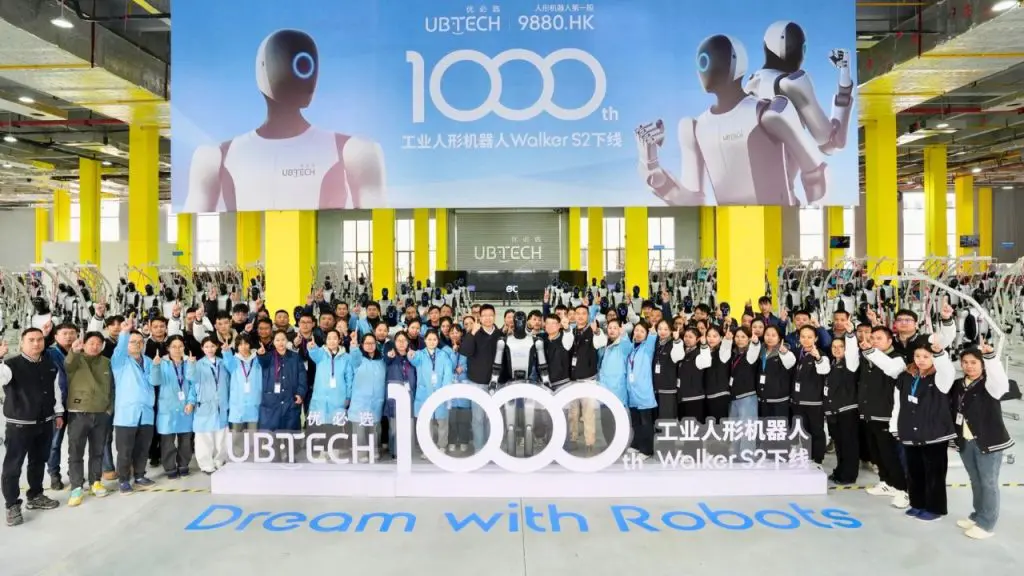
Still relatively unknown in the West, UBTECH is aggressively scaling production across a diverse lineup of robots after reportedly securing nearly $200 million in orders throughout the year. One of its most publicized and lucrative 2025 contracts involves deploying Walker S2 humanoids at border facilities in Guangxi.
Vietnam’s Most Advanced Robot
As part of the $37 million deal, the robots will assist with guidance, inspections, patrol support, and logistics. The region sits along China’s southern border with Vietnam, where VinGroup subsidiary VinMotion has just unveiled its second-generation humanoid robot.

The robot, called Motion2, features a more refined design and a more human-like walking gait compared to the first-generation prototype introduced six months earlier. In its launch video, the robot lifts 40 kg (88 lbs) with its back and demonstrates its ability to bend down, pick up objects from the ground, recharge itself, and return to work when its battery level is sufficient. Vietnam’s largest conglomerate launched its robotics division in January 2025 with $39 million in initial capital, positioning the humanoid for light-duty industrial tasks such as material transport, visual inspections, and basic assembly support.
LimX Oli Wins Climb Challenge
Back in China, the humanoid robot Oli from LimX Dynamics claimed an early victory for 2026 by winning a climbing challenge at Guangzhou Tower.
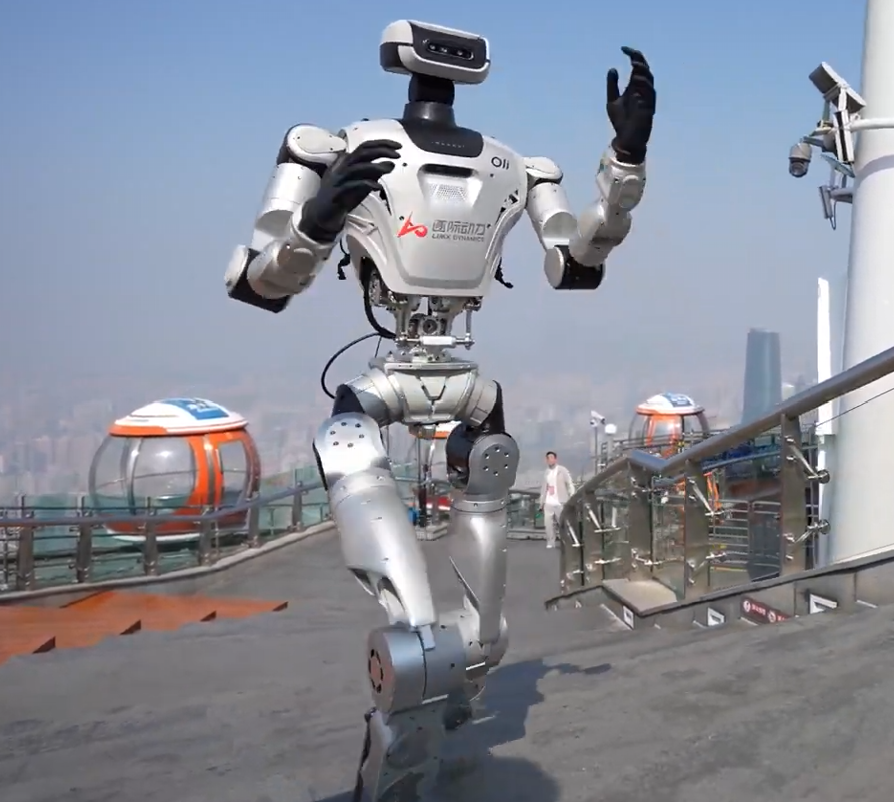
The competition took place on an observation-area staircase featuring roughly 30 curved steps with height variations, wind exposure, and uneven surfaces. The remotely controlled bipedal humanoid completed the course in just over 12 seconds. According to Chinese reports, 11 robots across multiple categories competed in the challenge, with O1 placing first in the bipedal category and Meila X from Midea Group’s research institute placing second.
Founded in 2022, Shenzhen-based LimX Dynamics has quickly established itself as a major player in China’s humanoid robotics scene. Its full-size humanoid robot is priced starting at around $22,000.
Following China’s Humanoid Race
Subscribe here to stay up to date throughout 2026 and beyond.