
In the race toward general-purpose robotics, one Chinese firm has taken a giant leap toward global domination.
Barely known in the West, UBTECH Robotics is aggressively scaling production of its diverse suite of AI-powered robots after scoring what’s being called the largest humanoid procurement deal ever. The Shenzhen firm has a massive head start compared to most of its competitors in the mainland and abroad. UBTECH started piloting its humanoids in the real-world years ago, before rivals even introduced their first prototypes.
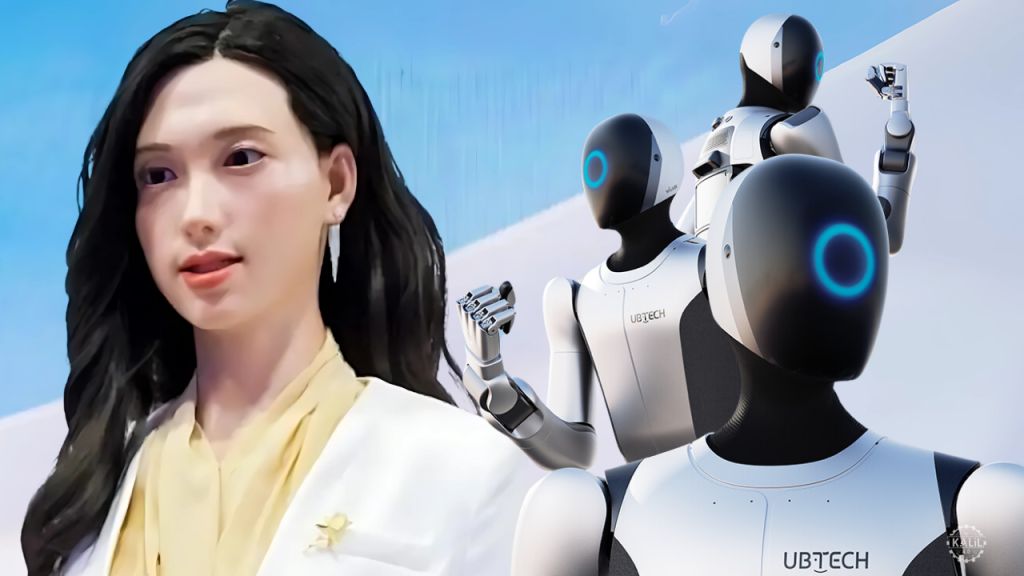
It’s already shown it can sell robots to the masses and scale production at an industrial pace. Now, it’s autonomous machines are taking over human jobs at a staggering rate for some of the world’s largest companies. And they’re just getting started.
UBTECH’s Origin
Zhou Jian launched UBTECH Robotics in 2012 in the booming Chinese tech hub of Shenzhen.
Like Unitree Robotics founder Wang Xingxing, the engineer-turned-entrepreneur rose to the upper echelon of China’s tech scene outside of its usual elite robotics pipeline. He graduated from Nanjing Forestry University in 1999 with a bachelor’s degree in Wood Processing Engineering and also holds an MBA from Concordia University Wisconsin. His career started at Michael Weinig, a German woodworking machinery company, where he worked in a sales and technical management role.

In 2007, he founded Union Brother Shanghai, a small business that built automation solutions for high end building materials production lines. Handling everything from client management to systems integration, the founder quietly developed expertise in servo motors, motion control, and factory automation.
Over a 5-year period, he grew convinced that humanlike robots would be the next big technological leap and the key to transforming manufacturing, logistics, and service industries in the mainland.
He left the company he founded in 2012 to focus on founding UBTECH Robotics. It was around this time that Beijing began prioritizing robotics and artificial intelligence as part of its grand plan to move beyond cheap labor and toward high value, automated manufacturing. Zhou saw it as the perfect moment to align his vision with national policy support and rising industrial demand.
UBTECH Early Days
In the early years of building UBTECH, Zhou also served in a marketing and sales leadership role at Robstep Robotics. The small Chinese firm’s self-balancing scooters looked and functioned almost exactly like the original Segway. They were marketed aggressively at a fraction of the cost, targeting malls, campuses, and tourist sites as well as for personal use.

The double life was pretty common in Shenzhen’s 2010s startup scene. Founders like Zhou would consult, freelance, and take strategic roles in adjacent companies while quietly bootstrapping their own ventures.
Early on, Zhou came to the conclusion that servo technology was the bottleneck preventing humanoids from becoming practical. At the time, most available components were expensive imports from Japan and Europe, making large-scale humanoid development nearly impossible in the mainland. Zhou believed that if China could master its own high-performance, low-cost actuators, it could leapfrog global competitors and dominate the humanoid robotics market.
Digital Servo Systems
Early UBTECH team members developed proprietary digital servo systems that were both cheaper and more efficient than competitors.
A servo system is what makes a robot move smoothly, precisely, and reliably. In humanoid robotics, it’s the combination of motors, sensors, and controllers that lets a legged machine walk, bend, grip, and balance without falling over.
A digital controller continuously compares the desired position, as specified in its programming, with the actual position derived from sensor feedback. Technology called digital signal processing makes thousands of micro adjustments per second to keep a robot’s movements stable and accurate.
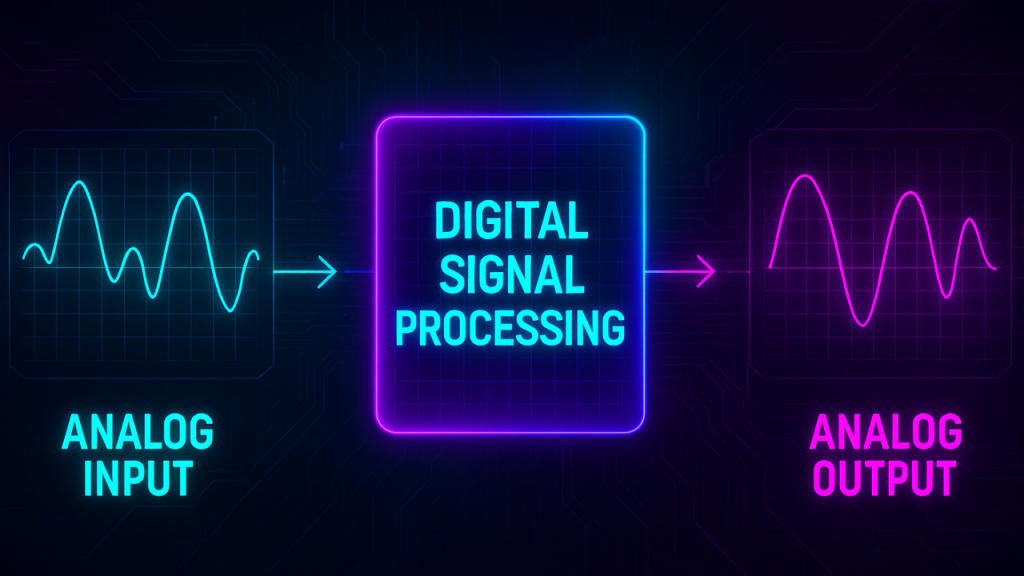
Before the breakthrough, China relied almost entirely on imports from companies like Japan’s Harmonic Drive and Nabtesco and the Swiss firm Maxon Motors. The parts often cost between $2K and $4K apiece. Since a humanoid requires between 30 and 40 at least, the pricing squashed any chance of mass production.
The innovation gave UBTECH, and later China’s broader robotics ecosystem, a massive competitive advantage.
Alpha Robots Target Nao
By 2015, Zhou shifted his focus entirely to UBTECH as the startup launched its Alpha series of humanoid robots targeting education and consumer markets.
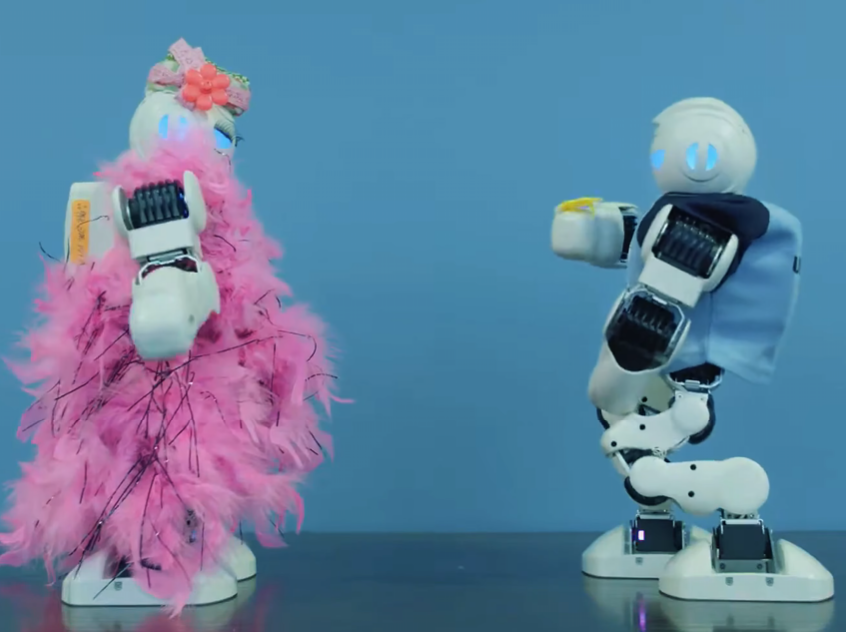
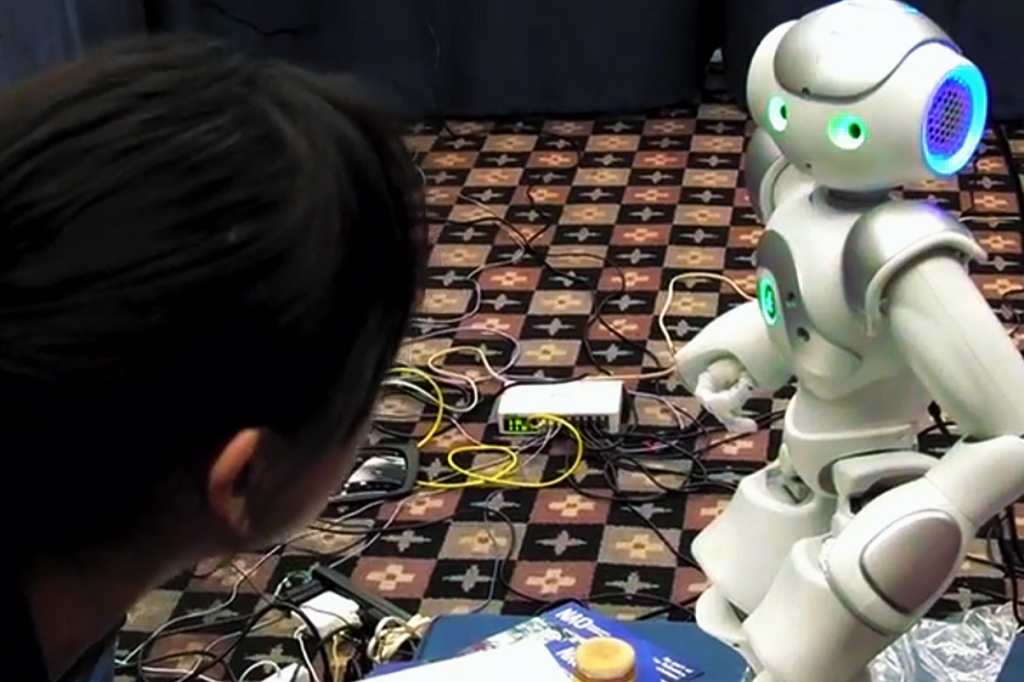
UBTECH developed it to compete with Nao by the French company Aldebaran Robotics, which had slowed development of the platform after its acquisition by the Japanese tech giant SoftBank. Nao was widely adopted in universities, robotics labs, and STEM classes but was expensive, typically priced between $6K and $8K per unit.
UBTECH’s Alpha bots delivered a similar form factor and programmability, but at a fraction of the cost, often around $500. The startup’s strategy wasn’t to beat Nao on intelligence but to democratize access. By undercutting Nao’s price by more than 90 percent, UBTECH broke into the global consumer robotics market and used Alpha’s success to fund research and development for more sophisticated humanoids.
UBTECH extended its reach to younger learners and aspiring builders with an array of kits for beginners that started at around a hundred dollars and were available at places like Best Buy, Target, and Apple Stores. UBTECH also collaborated with Disney on an official Storm Trooper robot that retailed around $300 to coincide with Star Wars: The Last Jedi. In 2017, the company expanded into the US smart home market with Lynx, an Alexa powered AI assistant humanoid that was priced around $800.

During this era, the humanoid robotics market was relatively low key.
Honda’s ASIMO was still active but was starting to wind down as it was perceived as expensive and un scalable. Robots like Atlas from Boston Dynamics and Hubo from the Korean Advanced Institute of Science and Technology (KAIST) were coming along but had a long way to go before entering the real world.
There was surging interest in the idea of synthetic humans, which set the stage for robots like Sophia from Hanson Robotics to capture global attention, but no one expected hyper realistic fake humans to become mainstream anytime soon. The only humanoid robot with meaningful commercial deployment was SoftBank’s Pepper, but its capabilities were extremely limited.

Cruzr Service Bot
UBTECH unveiled its first full-sized humanoid robot, named Cruzer, at CES Asia 2017 in Shanghai.
The wheeled bot was designed as a customer-facing service humanoid for retail, hospitality, healthcare, and corporate settings. It navigated autonomously and avoided obstacles, using its built in LiDAR, ultrasonic, and depth cameras.

Cruzer interacted with people with its cloud-based conversational AI system with speech recognition and natural language processing. With its facial and emotional recognition, the humanoid could recognize returning customers, which is particularly useful in retail and hospitality. Standing 120 cm (4 feet 8 inches), the 45 kg Cruzr has a large touchscreen face for user interactions.
It was priced starting around $8K to $10K, undercutting SoftBank’s Pepper, which had a total cost of ownership of around $20K with mandatory subscription fees. By 2019, UBTECH reported selling more than 2,100 of the service humanoids.
Cruzr, which is still an active product in UBTECH’s portfolio, validated the startup as a player in robotics beyond classrooms. Along with its Alpha Bots, it established steady revenue and opened them up to more financing opportunities as AI and robotics became increasingly central to China’s future vision.
Walker Series
At CES 2018 in Las Vegas, UBTECH introduced the world to its first bipedal humanoid robot, aptly named Walker. A full-sized Walker humanoid debuted the following year.
Standing 145 cm (4 feet 9 inches), 35 kg humanoid boasted 36 degrees of freedom (DoF) powered by UBTECH’s proprietary digital servos. It was heavily inspired by Honda’s world-famous ASIMO in both design philosophy and technical aspirations, but UBTECH approached it from a different angle.
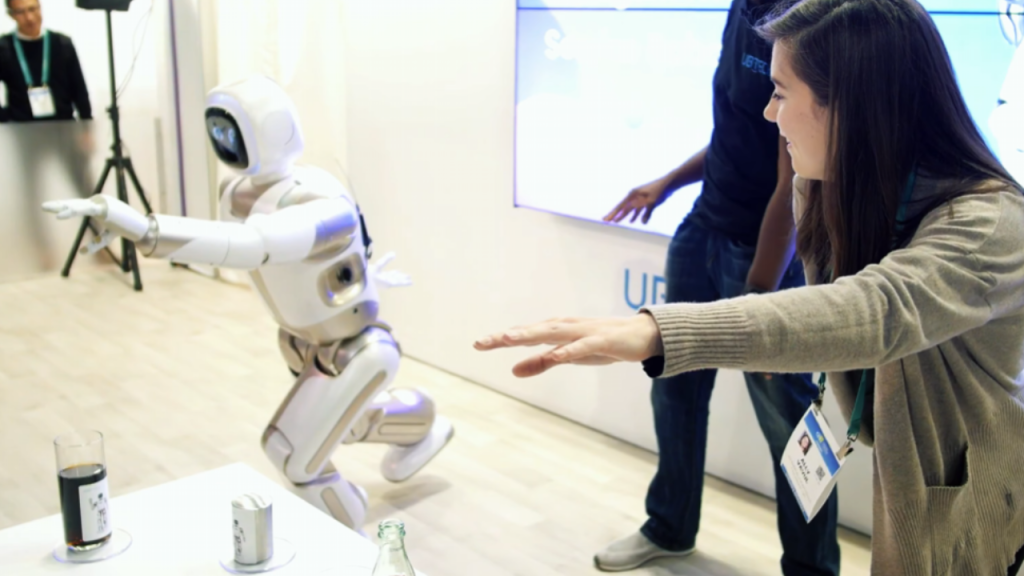
While Honda treated its humanoid robotics program as an innovation engine for next gen applications, UBTECH sought to build a lighter, more cost-effective platform that could one day be scaled for the masses.
When UBTECH introduced its next generation iteration, the Walker X, at the 2021 World Artificial Intelligence Conference (WAIC) in Shanghai, it was widely considered China’s most advanced humanoid robot.
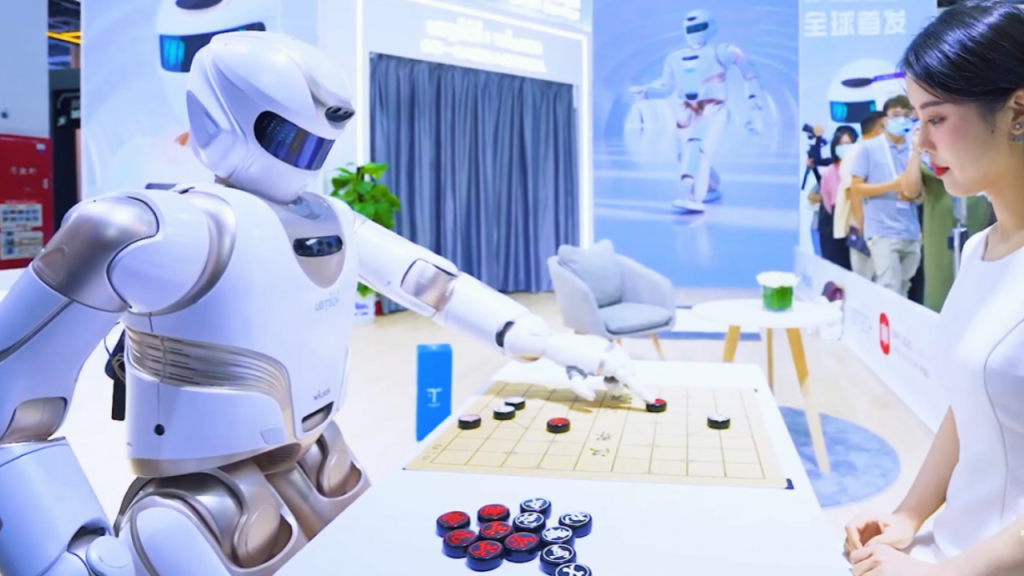
It showcased smoother balance, better dexterity, and more sophisticated AI-driven perception. It debuted just months before Tesla even announced Optimus, which would send the emerging race toward fake humans into hyperdrive. As that race began heating up, UBTECH became increasingly fixated on humanoids for industrial work.
Industrial Humanoids
By 2023, when the Chinese government identified humanoids as a disruptive technology frontier, UBTECH was positioned as a national champion, securing partnerships with giants like BYD, Volkswagen, Foxconn, Geely Auto and others. Its early mover advantage gave it a two-year head start over most of its competition in China and beyond.
UBTECH’s rapid rise after launching its industrial Walker S series in 2023 was supercharged by its location in Shenzhen, China’s hardware capital. The Chinese government transformed the former small fishing village into a tech metropolis with a population of nearly 18 million when it designated it as the republic’s first Special Economic Zone in 1980.
It boasts an insanely dense supply chain where components, servos, sensors, and AI hardware are built just miles apart. The local workforce grew up surrounded by factories, automation, and robotics. The one-of-a-kind ecosystem empowered UBTECH to prototype faster, manufacture cheaper, and scale quicker than Western competitors.
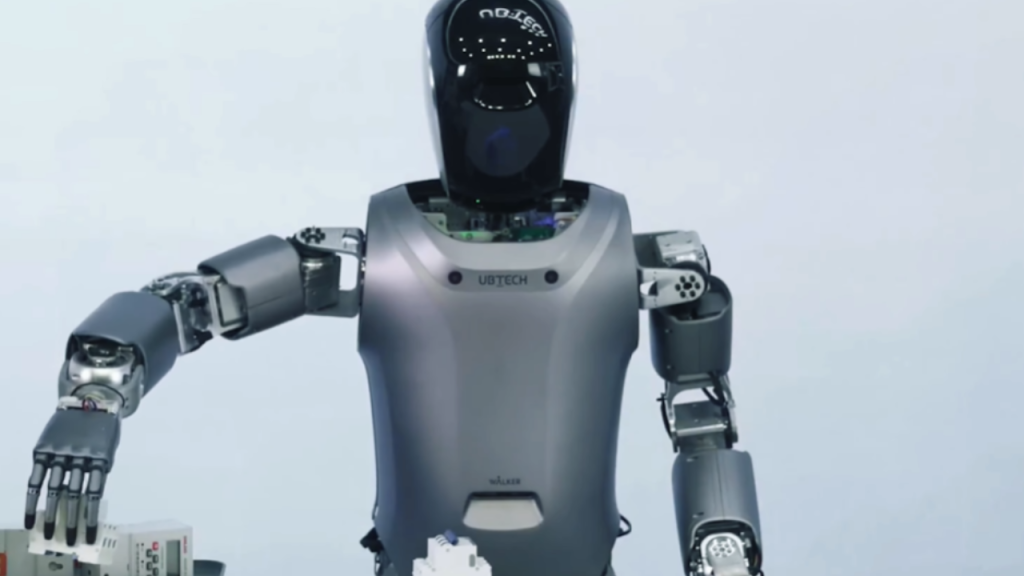
UBTECH’s first full-scale industrial humanoid, the Walker S, stood 172 cm (5 feet 6 inches) and featured 41 DoF. It was built for factory jobs like assembly, material handling, and quality inspections. UBTECH also launched a downsized version called the Walker S Lite, designed for faster deployment and integration into smart manufacturing plants.

The company became the first Chinese humanoid robot maker to go public in December 2023 with its listing on the Hong Kong Stock Exchange (HKEX).
During its IPO listing ceremony, a bipedal robotic panda named YouYou , walked confidently to the podium and presented Zhou with a gong mallet. A new Walker S humanoid and the founder struck the gong to open trading.

In summer 2024, UBTECH began sharing demo footage of its industrial humanoids at real Chinese factories while competing firms were still unveiling first generation prototypes.
Two of its Walker S Lite humanoids worked around-the-clock for at least 21 days at Zeekr’s 5G Smart Factory. Zeekr, as well as other EV makers like BYD and Nio, used the humanoids as a testbed for larger deployment that would follow.
Mass Production Era
In early 2025, UBTECH announced plans to begin mass production of its industrial humanoids by year’s end.
At this point, UBTECH’s competition within Shenzhen alone had grown considerably:
- EngineAI, launched in 2023 by serial robotics entrepreneur Zhao Tongyang, kicked off the year going viral with its $15K humanoid’s freakishly lifelike bipedal locomotion.
- Pudu Robotics, a global leader in commercial service robots that’s shipped more than 100,000 units, launched wheeled and bipedal humanoids to sell into its sizable customer base.
- Shenzhen Dobot, which grew from a Kickstarter campaign to an industrial automation leader in under a decade, was preparing to mass produce its first bipedal humanoid, Atom, with pricing starting at $27K.
- LimX Dynamics, whose flagship humanoid is widely regarded as China’s answer to Atlas by Boston Dynamics, was moving toward a mass production-ready humanoid priced starting around $22K.
- Astribot, also known as Stardust Intelligence, was working toward deploying a thousand of its intelligent wheeled S1 humanoids within two years.
- Leju Robot, whose flagship robot Kuavo was the first humanoid to integrate with Shenzhen-based Huawei’s Harmony OS, was preparing for mass deployments in logistics.
- A newer startup, Lumos Robotics, was kicked off the year celebrating $28 million in new funding to accelerate development of its bipeds.
Meanwhile, UBTECH expanded its scope, introducing its first hyper realistic android in February 2025 at the LEAP Tech Conference in Saudi Arabia.
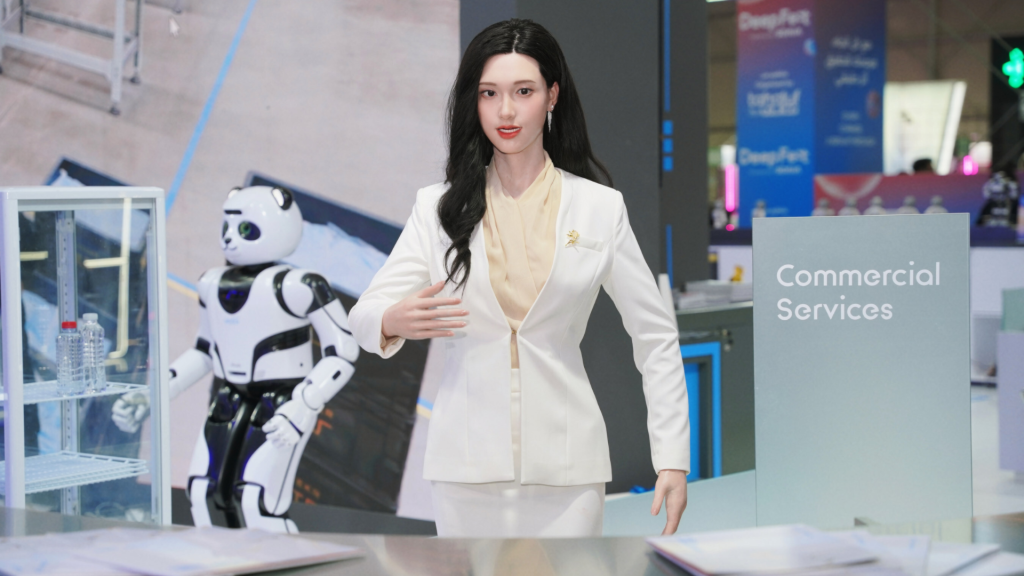
Priced around $68K, the fembot named Una is designed to bring a warm and social, but automated, presence to places like hotels, hospitals, and retail stores. Built for emotional intelligence, the robot understands natural language and interprets nonverbal cues.
Intelligent Swarm
UBTECH went on to shock the world in March 2025 when it shared this footage of a large fleet of its S1 humanoids operating as a so-called intelligent swarm at Zeekr’s factory. The company said the humanoids work together using its self-developed BrainNet AI system, which reminded many of Skynet from the Terminator franchise.
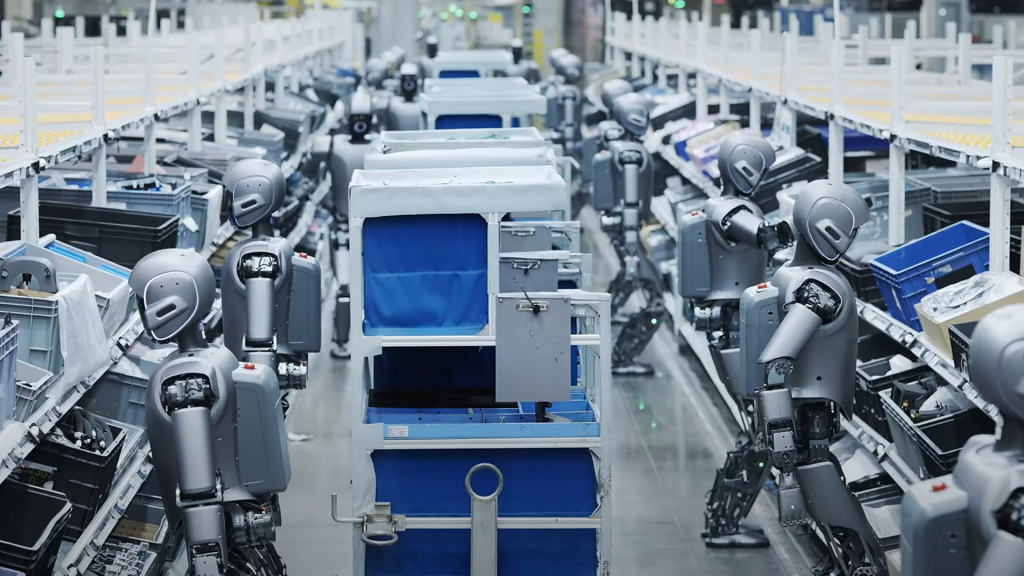
According to UBTECH, the robots self-organize and distribute tasks without needing human involvement. With cross-field fusion perception, the robots combine vision, touch, and AI decision-making to understand their surroundings and take actions.
The marketing video ends with a cinematic scene of one of the Walker S1 bots recharging a robotic coworker after its battery runs out.
UBTECH took that even farther just a few months later when it introduced its next-gen Walker S2 humanoid. In dramatic demo footage, the AI-powered humanoid uses its dual arms to remove a depleted battery from its torso and insert a charged replacement from a docking station, all without human intervention. UBTECH says the robots can even decide whether to swap or recharge in place depending on the situation.
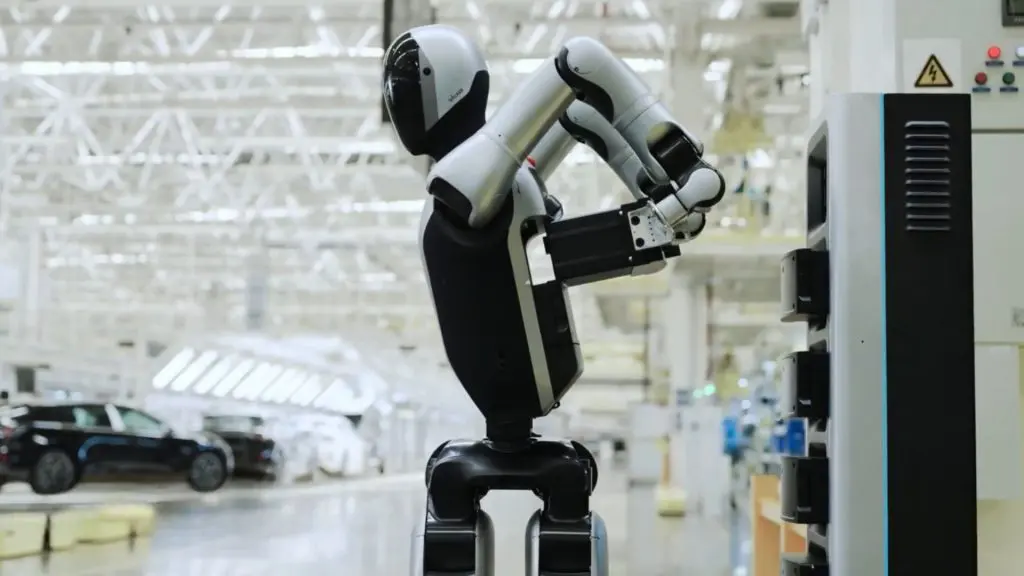
The company hasn’t publicly shared pricing, but it’s estimated in the upper five figures. With mass production, the price could potentially drop to $50K or below, which would be easy for companies to justify if it can perform general-purpose work 24/7.
Diverse Humanoids
UBTECH also offers a research-grade humanoid, called Tiangong Walker, developed in collaboration with the Beijing Humanoid Robot Innovation Center, also known as X-Humanoid. That robot is priced around $41K. The company reported fulfilling more than 100 orders of its Tiangong Walker robots, with expectations to deliver at least 300 educational units by the end of the year.

Another humanoid, the Walker C, made its high-profile debut in Japan at Expo 2025 Osaka, greeting guests and giving interactive tour guidance. The service-oriented bipedal humanoid served as China’s ambassador at the exhibit, which surpassed 1 million visits by late July. The expo runs from April to October.
Record Deals
In late August 2025, UBTECH shared its financials for the first half of the year. Its sales are rising but it’s still operating at a deficit due to heavy R&D investment and capital-intensive scaling.
The company reported $87 million in revenue, up 28 percent year over year driven by industrial humanoid rollouts, preorders, and commercial contracts. That includes a record-setting $35 million procurement contract with an undisclosed company for its Walker S2 robots, which UBTECH called the largest single order in the global humanoid sector.

UBTECH says it’s on track to ship around 500 industrial humanoids in 2025 while exceeding annual production capacity of 1,000 units. Customers deploying the robots reportedly include Foxconn and automotive giants like BYD, Audi-FAW, FAW Volkswagen, and Dongfeng Liuzhou Motors.
UBTECH has around 2,000 employees and maintains a modest physical footprint, with its headquarters and factory in Shenzhen and another office in the Netherlands that serves as its European base.
However, UBTECH is planning an aggressive global expansion. It recently secured a massive $1 billion credit line from Infini Capital, which is based in Abu Dhabi and Hong Kong, earmarked for building a super factory in China and research center and regional office in the Middle East.
Looking ahead, UBTECH anticipates shipping at least 5,000 industrial humanoids in 2026. The company is also preparing a push into the consumer market with a $20K home companion humanoid planned.