
Recreational running and humanoid robotics are surging in parallel across China.
While millions take to the streets for long-distance races, cutting-edge AI robots are creeping into daily life. As the marathon boom contributes to local economies, the emerging Chinese humanoid robotics industry is projected to reach over $1 billion in sales revenue in 2025, indicating solid economic potential.
The two worlds just converged in a first-of-its-kind event that’s captured global attention.
First-of-its-kind Event
The city of Beijing just hosted the world’s first humanoid robot half marathon, during which 21 bipedal robots raced alongside roughly 12,000 human runners. The race aired live on Chinese state television, serving as a platform to demonstrate the People’s Republic’s progress as it aims to mass produce humanoids throughout 2025 and rule the emerging market by 2027.
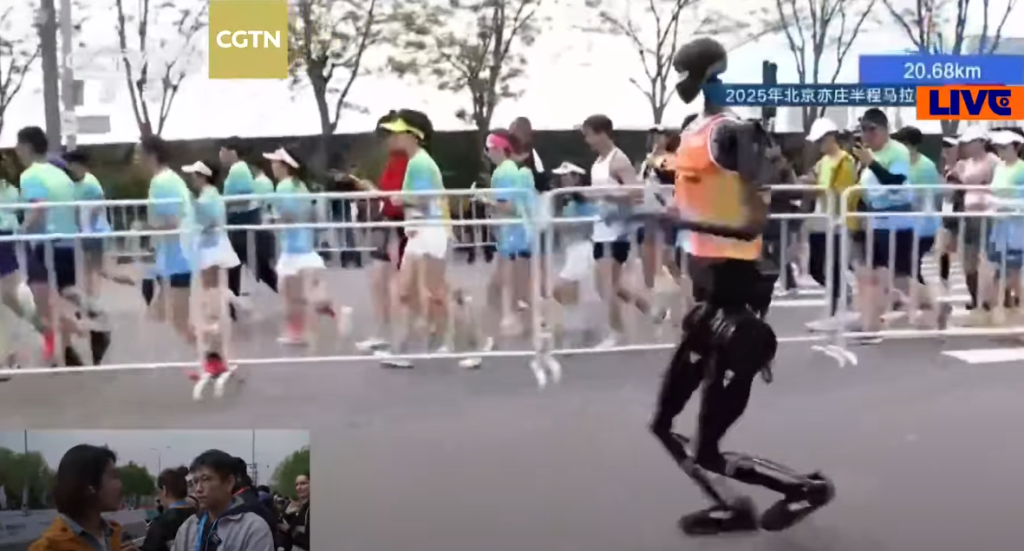
The event was held in the Beijing Economic-Technological Development Area, also known as E-Town, as part of the Beijing Yizhuang Half Marathon. The area is a hub for robotics, with more than 100 local firms and a 10 billion-yuan government fund for development. E-Town reportedly plans to deploy 10,000 robots, including a thousand humanoids, across sectors including manufacturing, healthcare, and municipal management.
The race was initially scheduled for April 13th but was postponed for a week due to forecasts of strong winds. The race covered more than 21 km, beginning at the South Square of Nanhaizi Park and finishing at the National Information Technology Application Innovation Industrial Park by Tongming Lake.

Robots had 3.5 hours to complete the race. To qualify, robots were required to have a humanoid form factor and bipedal locomotion. No wheels were allowed. Heights ranged from 45 centimeters to 2 meters. They competed for cash prizes up to 5,000 yuan (about $690), but the visibility was the real benefit.
Robots could be remote-controlled, semi-autonomous or fully autonomous. Battery swaps and relays were allowed, with each swap incurring a 10-minute penalty.
Tiangong Ultra
A local robot named Tiangong Ultra was declared winner. Developed by the Beijing Innovation Center of Humanoid Robotics, the humanoid finished the race within 2 hours and 40 minutes. The robot fell once due to low battery but recovered.

The robot’s pace was slightly slower than the average human recreational runner by 10 to 40 minutes. The men’s human winner finished in 1 hour and 2 minutes, over an hour faster than Tiangong Ultra.
According to its developers, Tiangong followed a planned route using real-time location tracking and could change direction and speed on its own. The general-purpose humanoid robot runs on a platform called Wisdom Kaiwu.
Engineers equipped Tiangong Ultra with light but strong leg joints that could handle the stress and impact required for long-distance running. Heat control systems prevented the robot’s motors from overheating during the long race.
Standing 1.2 meters (5 feet 9 inches), Tiangong completed the race with three battery swaps. A handler ran alongside it in case of falls.
After the race, the innovation center unveiled the next version of its flagship humanoid called Tiangong 2.0, with better joints, stronger arms, and longer battery life.
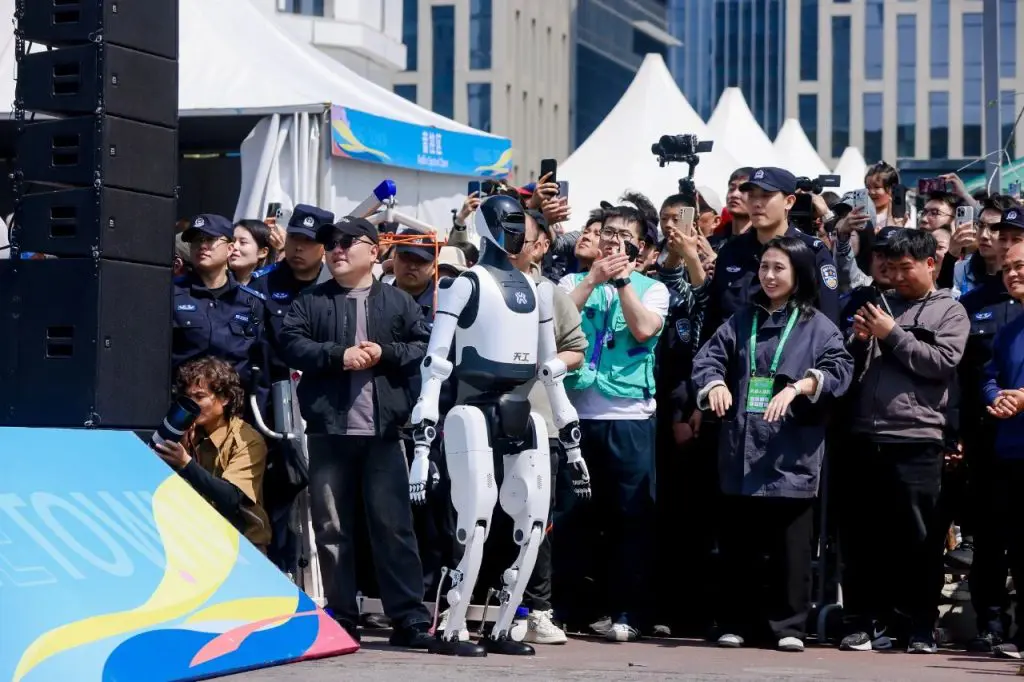
Some robots struggled early, with one collapsing at the start and another crashing into a barrier, requiring human assistance. Others failed to complete the race.
Unitree G1 Struggles
Robots struggling with the race included G1 humanoids manufactured by Chinese robotics leader Unitree. The company issued a statement clarifying that the robots were handled by independent teams, not Unitree. The robotics firm said its current focus is preparing for its upcoming humanoid robot combat events rather than endurance races.
2nd and 3rd Place
The second-place runner was the N2 humanoid from Beijing-based NOETIX Robotics, which finished in 3 hours and 37 minutes. Shanghai DroidUP’s X02 took third place with a time of 4 hours and 9 minutes.
The Cutest Participant
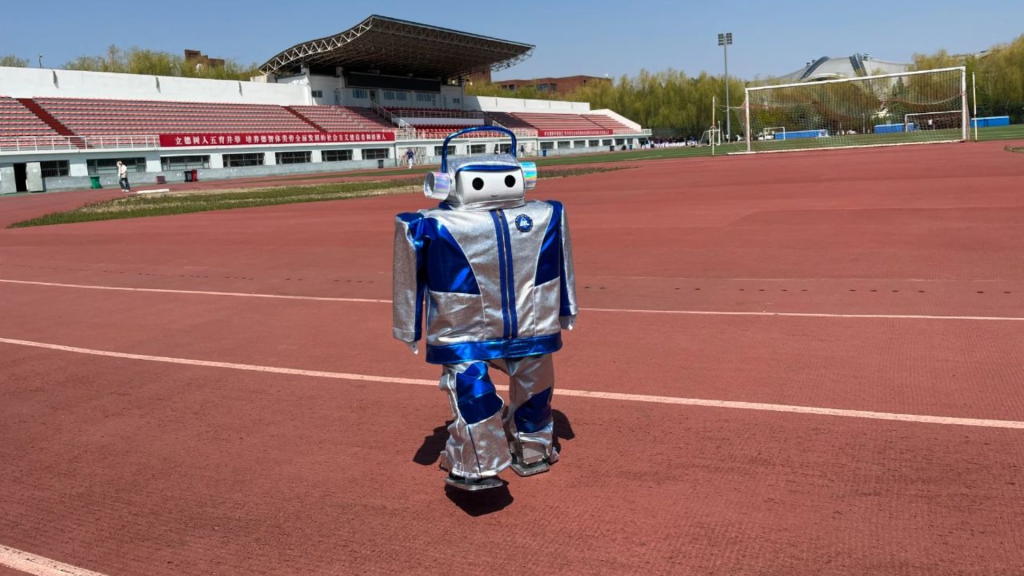
One of the participants that got the most attention didn’t finish the course. Little Giant, developed by researchers at Beijing Polytechnic University, mimics human gait and arm swings to navigate smoothly. Standing 76 centimeters tall, Little Giant was the smallest robot in the competition. During the race, the remote controlled robot experienced a technical issue where it paused and emitted smoke from its head.
Another robot that didn’t finish in time, Kuavo by Shenzhen-based Leju Robot, completed a 5K with no errors or swaps in the days leading up to the event.
The day clearly belonged to Tiangong, which underwent extensive training months before the big race. The development team collected real-world running data from professional athletes to train the robot’s gait, cadence, stride strength, and posture, aiming to replicate human runners as closely as possible.
An early iteration of the robot participated in a half marathon in Beijing back in November 2024. Tiangong joined that race about 100 meters from the finish line, serving as a closing pacer.
Beijing plans to host the inaugural World Humanoid Robot Sport Games in August 2025, featuring robot competitions in track, field, and football.
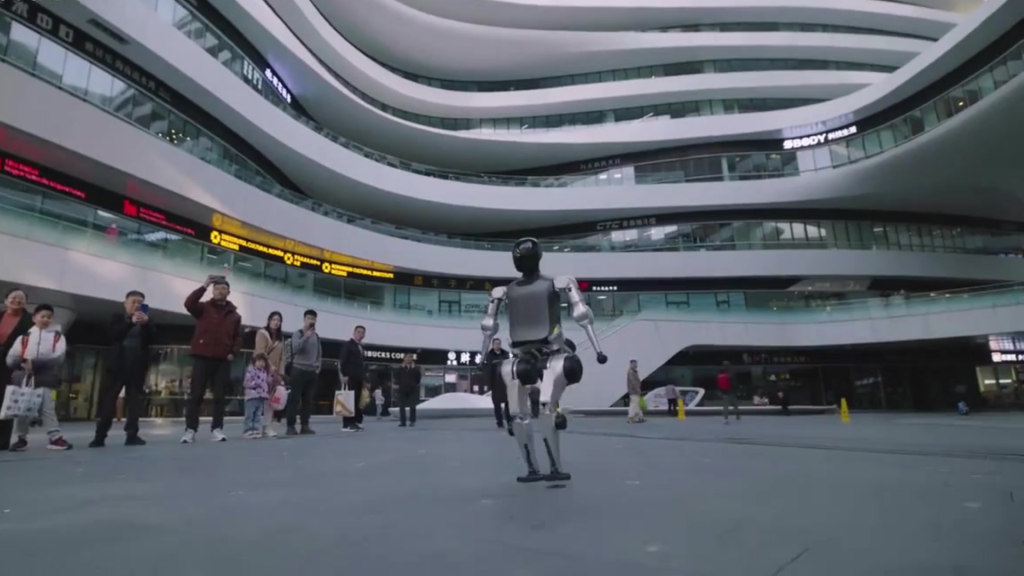
PNDBotics’ Adam Showcases New Strut
Elsewhere in Beijing, PNDbotics just showcased the improved walking gait of its flagship humanoid named Adam.
The startup says the smooth locomotion is thanks to reinforcement learning. The training method has become a cornerstone in the development of humanoid robotics across leading companies like Tesla, Figure AI, Unitree Robotics, and Shenzhen-based Engine AI.

Using the technique, robots learn complex behaviors through trial and error in simulated environments. The digital twin’s learning is then transferred to the physical robot with a process called Sim2Real, short for Simulation to Reality. The humanoid robot Adam’s design incorporates a biomimetic pelvis that enhances its ability to mimic human movements.
Daimon’s DM Hand1
In Shenzhen, Daimon Robotics just introduced its new DM Hand1, a five-fingered robotic hand with the world’s first millimeter-level vision tactile sensor.
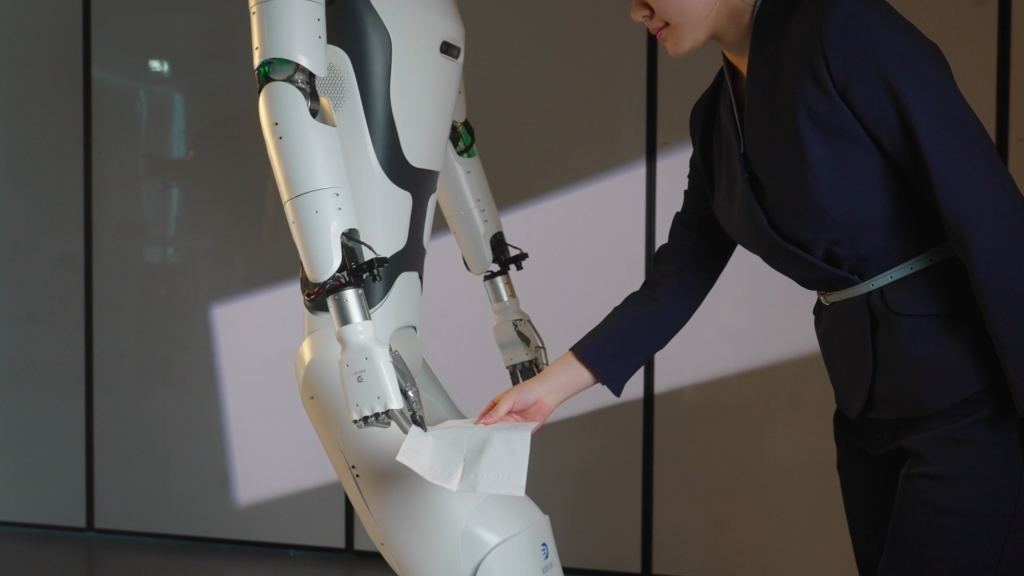
Daimon says the hand is equipped with its proprietary Tac W sensor, which combines a vision system with tactile sensing. With the integration, the robotic hand captures real-time deformation data upon contact to detect object properties like texture, shape, slippage, and force with high precision.
According to the robotics firm, the sensor boasts 40,000 sensing units per square centimeter, surpassing the tactile resolution of the human hand and current industry standards. The Hand1 employs a hybrid control algorithm that replicates human movements and enhances its ability to perform complex manipulation tasks with human-like dexterity.
Daimon, founded in 2021, also unveiled a wearable teleoperation device for controlling robots remotely and collecting training data.