
The thin blue line is getting a robotic upgrade.
Robots are expected to play a key role in the future of policing. Around the world, police departments are increasingly deploying AI-powered robots amid rising threats and staff shortages.
The global security robotics market is projected to reach $44 billion by 2030, growing at a compound annual rate of 15 percent. The shift is supercharging police work, unlocking new powers of prediction and precision, but also pushing the boundaries of privacy and control.
Thailand’s AI Police Cyborg 1.0
Thailand’s Songkran Festival is famous for massive water fights and street celebrations, but it also raises serious public safety concerns each year. Large gatherings can lead to petty crime, violent incidents, and overcrowding.
In 2024, Bangkok authorities installed hundreds of CCTV cameras to spot pickpockets and wanted criminals and to monitor crowd density. The high-tech push was part of a bigger government effort to use artificial intelligence for safer tourism and public events.

Against this backdrop, Thai authorities just unveiled the country’s first AI-powered police robot during the New Year festivities in Nakhon Province, which is just west of Bangkok. The robot, named AI Police Cyborg 1.0, was stationed on Ton Son Road during the April celebrations.
According to Royal Thai Police, the wheeled robot features 360-degree surveillance cameras within its head and torso, allowing for panoramic monitoring of its surroundings. The department announced the robot to the world via its Facebook page.
The robot’s AI computer instantly processes live video. The police cyborg serves as a node in a large surveillance network. It’s linked to the city’s closed-circuit television cameras and aerial drones.

For communication, the system links directly to a provincial command and control center through a wireless network, which streams analyzed data and alerts to human officers in real-time.
The robot scans faces in crowds, comparing them against a blacklist of suspects, wanted criminals and individuals flagged as high risk. If a match is found, the system alerts nearby police to intervene. If a suspect is identified, the robot can track the person’s movements across the venue. The humanoid is also trained to recognize weapons and dangerous objects.

Its video analytics software is programmed to detect anomalous or aggressive behavior, so maybe physical altercations can be stopped before they get out of hand. According to the developers, the system can even detect when crowds surges or panics, though this technology is still emerging.
Unitree, EngineAI Robots Join the Ranks
In China, several advanced robots are vying to become the country’s top robocop.
Unitree’s G1 humanoid robot is becoming a popular platform for departments looking to experiment with robotics. Standing 133 cm, the G1 has been seen serving alongside police in Shanghai, Liuzhou, Guangxi and Hangzhou, where Unitree is based.
According to Chinese state media, the Hangzhou Police Department has equipped the robot to detect hazardous gases during patrols. The robot works in community engagement and safety monitoring roles.
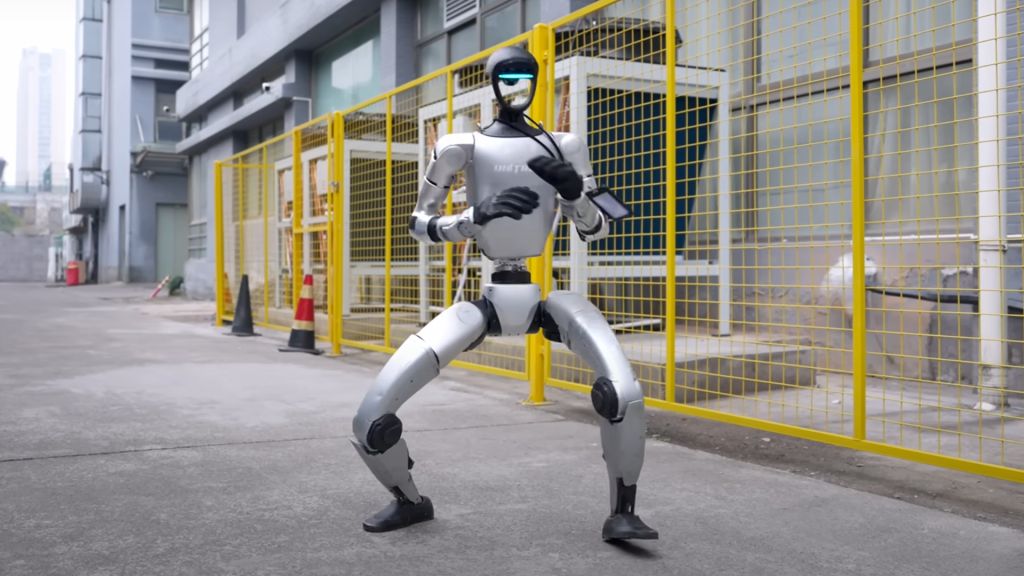
In Guangxi, Unitree’s robots have been seen marching in formation and patrolling alongside officers during large events. The robots are also reportedly used in high-end residential areas for smart surveillance in Shanghai. They monitor perimeters using AI vision and act as a community-facing presence to deter intrusions.
In Shenzhen, police are working with rising startup EngineAI to integrate its humanoid robots into its regular operations. Video clips circulating on social media show EngineAI’s robots undergoing regular training, assisting police officers on the streets, and interacting with the public.
The robots are now being actively used in the Nanshan and Futian districts for grid-based community work and law enforcement.
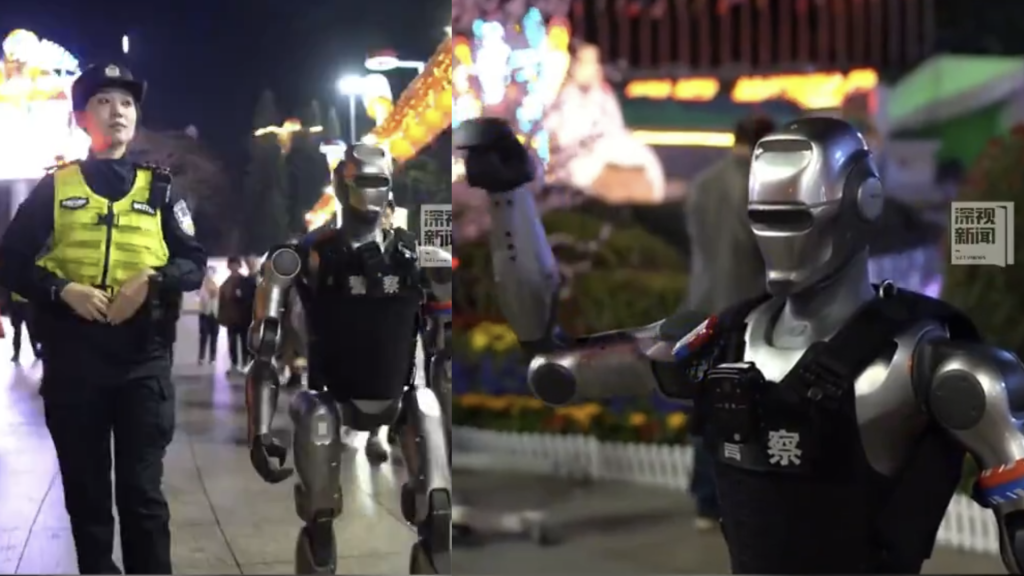
The PM01 humanoid, introduced in December 2024, is a lightweight robot intended for research and development applications. EngineAI touts the robot’s customizability and its relatively low entry price starting under $14K. Standing 138 cm, the PM01 is a scaled-down version of Engine’s full-sized humanoid robot, the SE01.
Knightscope Expands in Silicon Valley
In the US, Knightscope Incorporated is scaling up production of its autonomous security robots. Founded in 2013, the startup just announced it’s moving into a new 33,000 square-foot headquarters in the heart of Silicon Valley.

Knightscope says it’s adding another work shift at their factory to build more robots faster. The company recently reported over $2 million in new contracts, with especially notable growth in higher education, transportation, and the public sector.
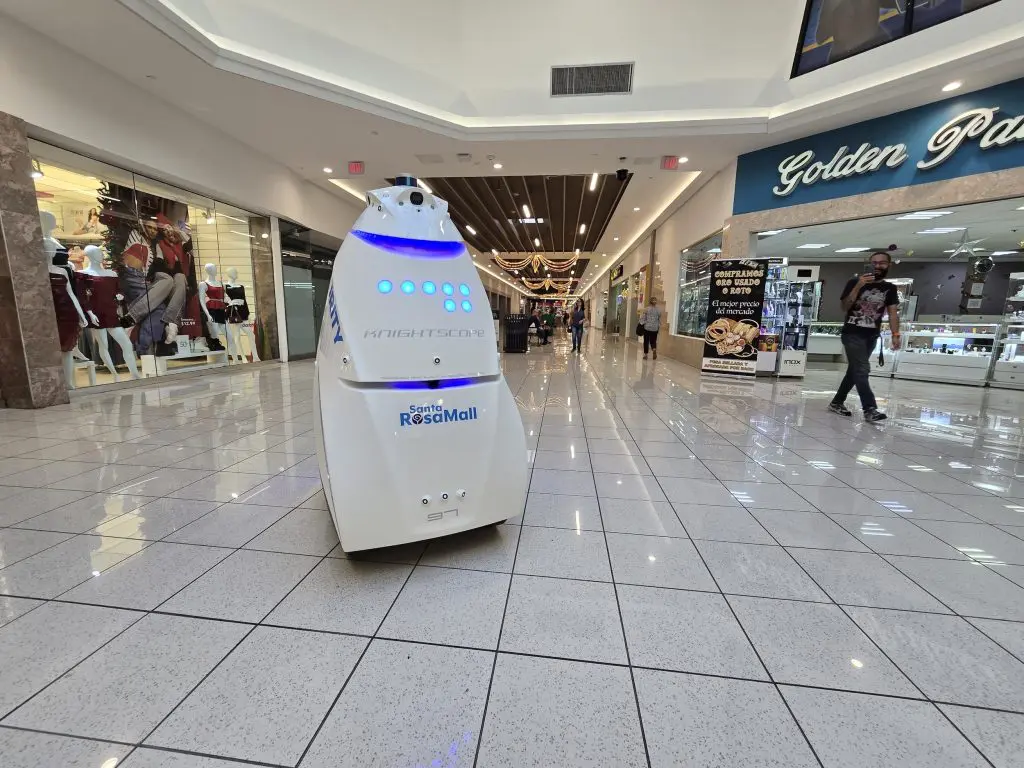
Knightscope autonomous security bots have been deployed by police departments and public safety agencies. The K5 Autonomous Security Robot is Knightscope’s flagship outdoor patrol unit. Standing over 1.5 m, the K5 is equipped with 36-degree cameras with thermal imaging, license plate recognition, and real-time data transmission.
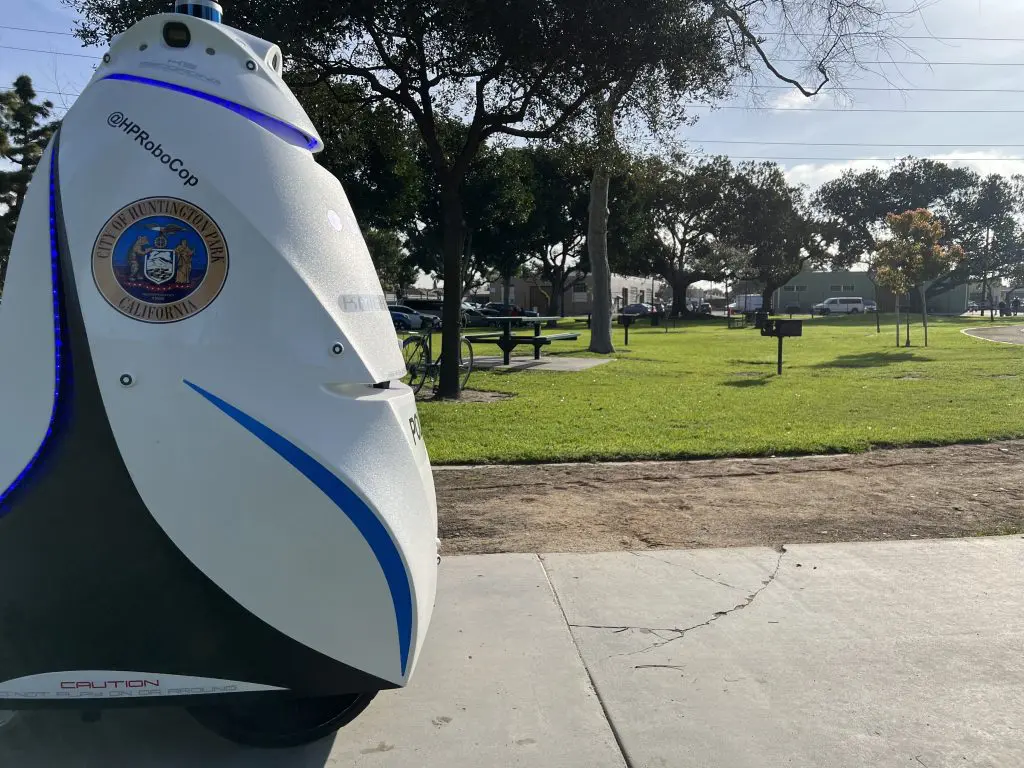
The robot navigates using sensors and artificial intelligence. It patrols places like parks, parking lots, campuses, and transit stations without human control. The K5 also features a built-in emergency call button and two-way communication system for the public to interact with security personnel.
The K5 has been credited with reducing crime and increasing situational awareness in the areas it patrols. In Huntington Park, Calif., police reported a 46 percent reduction in crime reports and a 10 percent decrease in emergency calls during its first year of patrolling a public park. The city renewed its contract with Knightscope for the sixth consecutive year in 2024.
On the flip side, a pilot program in New York City’s Times Square subway station was discontinued after just a few months due to limited mobility on stairs and platforms, high operational costs, and public criticism.
Knightscope offers its technology as subscription services, typically around 5 or 6 thousand dollars per month for a single unit. The service includes remote monitoring via the Knightscope Security Operations Center.
Looking Ahead
To stay up to date as AI-powered police robots advance rapidly, subscribe to my YouTube channel for first updates.