
Tesla is boasting the progress it’s making training its Optimus humanoid robot for the real-world as the EV maker prepares to scale its production.
In new footage, the Tesla Bot is seen traversing rough terrain for the very first time. Tesla shared the clip from its official Optimus account on the X social media platform.
Daily walks help clear your mind pic.twitter.com/dUsW58trS6
— Tesla Optimus (@Tesla_Optimus) December 9, 2024
According to a post by Optimus engineer Milan Kovak, the AI robot’s ability to walk on mulched ground isn’t the remarkable part. He said Optimus is keeping its balance blind as it relies solely on its on-board sensors and neural networks, without any visual input.
The AI controls each limb independently without the need for teleoperation. The engineer said the Optimus team is adding vision for better planning, making the gait look more natural on diverse terrain, and improving the robot’s responsiveness to velocity and direction commands. The neural network processes data in just 2 to 3 milliseconds.
On Elon Musk’s X platform, users were particularly impressed with the Tesla Bot’s quick recovery when it almost slips. Kovac said the team is teaching Optimus to minimize damage when falling is unavoidable and how to get back up.
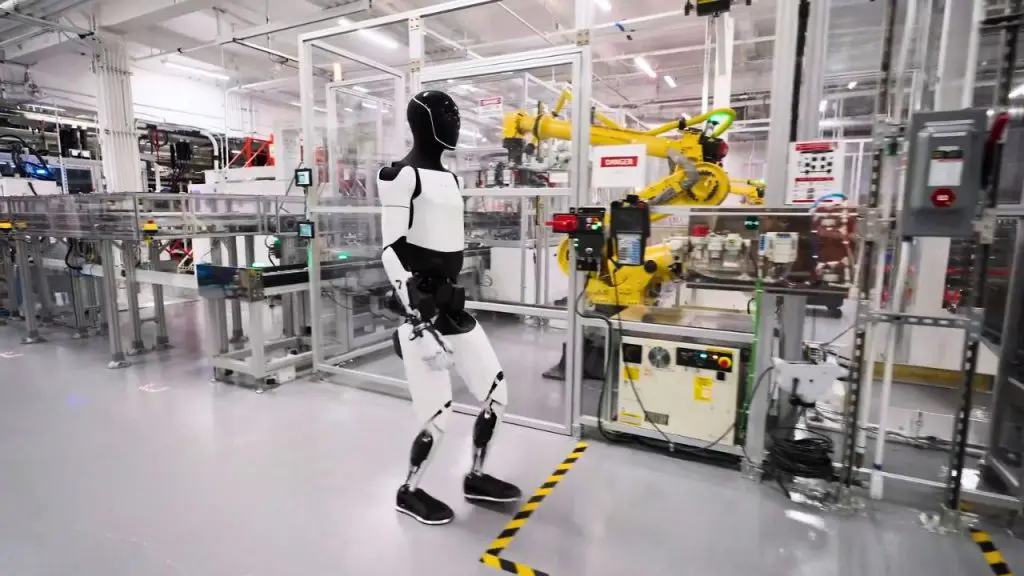
Tesla plans to manufacture at least a thousand Optimus robots to work in its factories in 2025. They’re aiming to commercialize the Tesla Bot starting in 2026. On X, Elon Musk said Optimus humanoids are cruising around Tesla’s facility in Palo Alto, where its vision is used for static and dynamic object avoidance.
When it does become available, the Optimus is expected to be pricey until production is scaled.
To tide people over, Tesla has released a $40 Optimus figurine with its own Cyber Hammer. Offering a glimpse of the future demand for Optimus, the toy robot sells out within minutes when new stock has been added, and the demand even crashed Tesla’s online store.
Musk has said the Tesla Bot could eventually retail for between $20K and $30K, which he considers a deal for a machine that can do almost anything a human can do.
Tesla belongs to a growing array of companies globally trying to perfect bipedal locomotion as they race to mass produce their advanced AI robots.
Atlas by Boston Dynamics is known for its agility and ability to navigate rough terrain. The legacy hydraulic version of the robot became well known for its ability to perform parkour movements. However, demos of the new fully electric Atlas have focused on industrial tasks rather than stunts.
Digit by Agility Robotics specializes in logistics and warehouse tasks but can navigate varied terrains. Early commercialization efforts in the early 2020s emphasized its extreme terrain adaptability, as Digit was positioned as a last-mile delivery solution. Digit has also shown it can get itself back up after falling.
China-based startup Engine AI may be giving Tesla a run for its money in achieving humanlike walking gait with AI. The company’s SE01 robot has also demonstrated the ability to navigate uneven terrain thanks to its dual processors and stereo cameras.
Other Chinese firms are also rapidly advancing the locomotion of their bipedal robots over varied terrains, including Robot Era whose Star1 recently became the world’s fastest humanoid robot, and Unitree Robotics, whose G1achieved a human-like gait with two days of simulation training.
Tesla may be the first to proclaim blind navigation, and the automaker has a huge advantage with its proven ability to scale production of complex machinery.
Tesla has 38 open positions on its website related to the Tesla Bot, including:
- 33 AI and robotics-related roles, including software, hardware, and system design positions
- 3 engineering and information technology roles focusing on mechanical and supplier industrialization
- 1 manufacturing engineer
- 3 internships for engineering students in winter/spring 2025.
The careers page has a heavy emphasis on AI, seeking expertise in reinforcement learning, motion planning, and autonomy foundations.
Open roles related to physics simulation, 3D modeling, and testing indicate Tesla is optimizing the design and operation of its robot before deployment. Multiple roles like manufacturing engineer and systems engineer are tasked with bringing the Tesla Bot from prototype to mass production.