
When Boston Dynamics introduced the new fully electric Atlas in April 2024, it seemed like a deathblow to hydraulics for humanoids.
But now two buzzy startups are going against the grain and betting on hydraulics. They’re using cutting-edge tech that they say overcomes limitations that previously made hydraulic actuators impractical for widescale deployment.
During the rise of industrial robots in the 1960s and 70s, hydraulic systems became the dominant choice for powering factory automations. In the 80s and 90s, market demand shifted toward electrical actuation systems thanks to breakthroughs in motors and control systems.
For the rapidly expanding humanoid robotics market, hydraulic systems have increasingly been seen as a dead-end.
Sanctuary AI and Clone Robotics disagree. They’re boasting the humanlike capabilities of their creations powered by hydraulics.
Sanctuary AI General-Purpose Robotic Hand
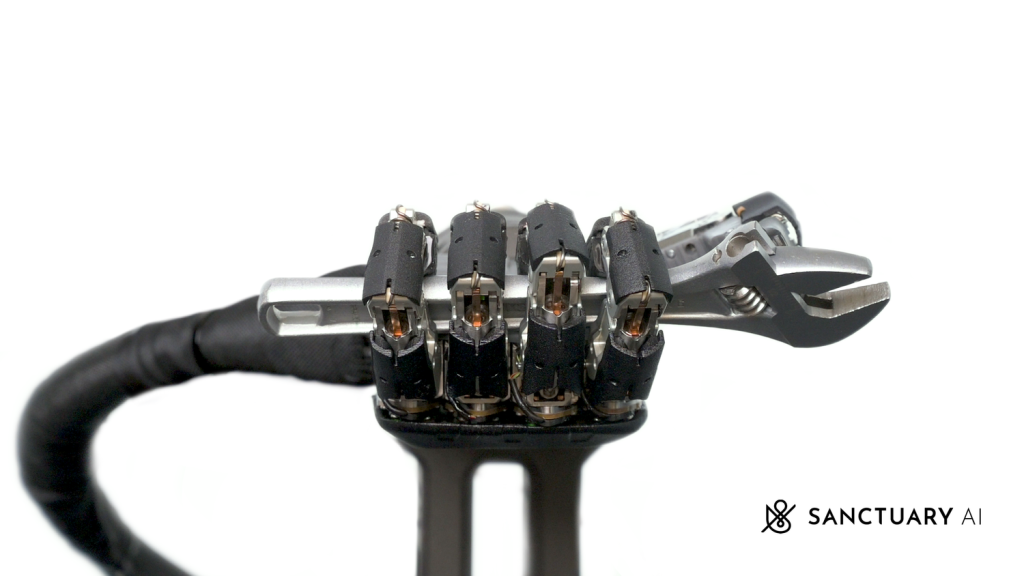
Vancouver-based Sanctuary just released a demo of its next-gen robotic hand with 21 degrees of freedom (DoF). The design uses miniaturized hydraulic valves, which the startup says delivers superior power density compared to electric systems.
The company, which surpassed $140 million in funding earlier in 2024, says the valves have been tested to withstand over 2 billion cycles without leakage or degradation. According to Interesting Engineering, the hydrualic actuators use food-safe oil.
Sanctuary’s general-purpose robotic hand has one fewer DoF than Tesla’s next-generation Optimus hand but seems designed for tasks needing greater strength. Humanlike dexterity paired with beyond human strength could prove useful in semiconductor manufacturing and electronics assembly. While Sanctuary looked to hydraulics for its new hand, Tesla engineers reportedly moved the Optimus robot’s actuators to its forearm to better mimic human muscles.
The new hand integrates with Sanctuary’s flagship humanoid robot, Phoenix. Sanctuary CEO James Wells told prominent X poster @TheHumanoidHub that he’s confident about the company’s “hand first” development roadmap. He said the company is leaning into its IP portfolio, as Sanctuary is ranked fourth globally in patents for general-purpose robotics and dexterous manipulation technologies.
I got to chat with the interim CEO of Sanctuary, James Wells, at the Humanoids Summit yesterday. He was really confident about their ‘hands-first’ development roadmap and their ability to leverage their IP portfolio.
— The Humanoid Hub (@TheHumanoidHub) December 12, 2024
Clone’s Water-Powered Torso 2

Meanwhile Clone Robotics, which operates out of the U.S. and Poland, is going viral for its Torso 2 android’s humanlike movements that remind people of HBO’s Westworld.
Clone says its android is powered by water and electricity. Other robots like Festo’s Aqua Jelly leverage water-based systems, but Clone’s ambitions are next level. The company, which is working toward synthetic humans, aims to eventually mass produce its robots for home use.
The startup calls Torso 2 the most advanced android ever created with an actuated lumbar spine and corresponding abdominal muscles. The robot’s white transparent skin shields 910 synthetic muscle fibers that animate 164 DoF.
According to Clone, the robot in its new demo uses pneumatic actuation with off-the-shelf valves, which explains the noise.
For reference, the Clone arm below uses the quieter design.
Using water alleviates concerns that previously made hydraulic robots unfeasible for households. Traditional hydraulic systems that use dangerous chemicals like phosphates, glycols, and other toxic additives. However, maintenance would likely remain a challenge for people without specialized training, at least for initial iterations.
Clone plans to ship 279 of its Alpha androids in 2025. The price is to be determined, but Clone likens its first release to a limited-edition supercar. The startup aims to eventually manufacture their humanoids at scale so they can be obtainable by the masses.
Clone says it will soon demonstrate a full-bodied version of its Alpha robot. Once they pass that hurdle, mass producing the design will likely be a huge challenge, especially if they’re going for the consumer market.