
Six Little Dragons are rising in China, breathing fire across artificial intelligence, robotics, and even the human brain.
The unofficial yet widely adopted nickname refers to a sextuplet of rising startups in Hangzhou, a city of more than 12 million that’s rapidly becoming the next Chinese tech powerhouse.
DeepSeek’s Impact
The Hangzhou Little Dragon with the strongest brand recognition outside China is DeepSeek.
The AI startup propelled the Six Little Dragons into the global spotlight in early 2025 with its open-source large language model (LLM) that matched ChatGPT-level reasoning while operating at a fraction of the cost.

Officially known as Hangzhou DeepSeek Artificial Intelligence Basic Research Company, the startup was launched in July 2023 as a spin ff from the AI-driven hedge-fund High-Flyer. Liang Wengfeng, who founded the fund back in 2016, serves as CEO of both entities.
Estimates for DeepSeek’s valuation are all over the place, ranging from $1 billion to $150 because it’s backed by High-Flyer’s $7 billion hedge fund. There’s no indication that Deep Seek plans to pursue an initial public offering.
Throughout 2024 and 2025, DeepSeek rolled out a succession of increasingly powerful and efficient models. With an estimated 150 to 200 employees, the company says its focus now is research and development.
Its AI is already entrenching itself in the robotics world.
Chery Automobile, China’s largest exporter of passenger vehicles, has integrated DeepSeek models to power the conversational capabilities of the humanoid robots it developed in collaboration with AiMOGA Robotics. The lifelike android named Mornine has reportedly been deployed for sales support at Chery dealerships across China and Malaysia.

Beyond customer service, the robot has been pitched for roles like tax accountant and live streamer. According to Chinese state media, Chery has delivered around 220 Mornine units for dealerships. Pricing remains undisclosed.
Deep Seek’s AI has also made its way into commercial appliances through brand partnerships with juggernaut manufacturers like Haier, HiSense, and TCL.
Game Science Teases Black Myth Follow-up
The West’s first major exposure to the Six Little Dragons was in August 2024 when Game Science released its breakout role playing game, Black Myth Wu-Kong.
Founded in 2014 by former Tencent employees, the game studio was virtually unknown outside the mainland until its surprising blockbuster. Black Myth had a groundswell of support that started in 2020 when a game play trailer went viral on Chinese social media.

It’s sold more than 25 million copies so far, 10 million of which were in the first 3 days. On launch, it drew nearly 1.5 million concurrent players on Steam, making it one of the most played games immediately after its release. The sales have reportedly generated nearly $1 billion for Game Science.
Inspired by the 16th century novel Journey to the West, the RPG puts players in control of the Destined One, a monkey warrior. Game Science is busy developing a follow up that’s inspired by the folklore figure Zhong Kui, known as a ghost hunter in Chinese mythology. Development is still in its very early stages.
Unitree Robotics’ $7B IPO Plans
Meanwhile, another rising Hangzhou dragon wants to bring the thrill of video game action into physical reality.
The leading Chinese robotics firm Unitree is reportedly seeking a valuation of up to $7 billion in its upcoming initial public offering (IPO). The startup recently confirmed its IPO plans and said required paperwork will be submitted before the end of 2025. According to reports, Unitree’s IPO is expected to take place on Shanghai’s STAR Market, a tech-focused board of the Shanghai Stock Exchange, similar to NASDAQ.

Launched in 2016 by hardware engineer Wang Xingxing, Unitree burst into the affordable robotics market in 2021 with its Go1 quadruped. Priced under $3,000, the Go1 was marketed as an affordable alternative to research-grade robotic dogs like Boston Dynamics’ $75K Spot. Its successor, the Go2, currently sells for as low as $1,600. Unitree also offers higher-end quadrupeds for industrial use cases, priced starting around $90K.
The startup also disrupted the humanoid robotics market with its short humanoid, the G1, which launched in May 2024 with an entry price of $16K. Unitree has since introduced an even cheaper bipedal robot, the R1, which starts at $5,900.

The company’s flagship full-sized humanoid robot is the H1, which is priced starting around $90K, targeting research labs, advanced developers, and enterprise customers. However, Unitree is preparing to launch a next gen full-sized humanoid that could potentially expand access.
Quadrupedal robots account for 65 percent of its revenue. Eighty percent of the robotic dogs are used in research, education, and consumer applications, while the remaining 20 percent are for industrial use cases like inspections and firefighting.

Unitree’s robodogs have appeared with lethal mods in footage from the People’s Liberation Army and other militaries, including the US and Ukraine. However, Unitree insists all military modifications are from third parties and not endorsed by the company. On the eve of China’s Victory Day military parade in Beijing, Unitree shared a statement on social media emphasizing its role as a civilian technology company. The robotics firm is trying to quell fears about its robots to avoid export restrictions that could hurt its value as it goes public.
Humanoid robots generate 30 percent of its revenue, mostly for research and education applications. Components like sensors, actuators, controllers, and other modular parts make up around 5 percent of its sales.
Unitree has spent much of 2025 training its humanoid robots for MMA-style fighting, which has already caught the attention of UFC President Dana White. White tried out one of the kick boxing robots before a recent UFC fight night in Shanghai. The battling robots have also become a staple at major AI and robotics conferences and have popped up at underground matches in San Francisco.
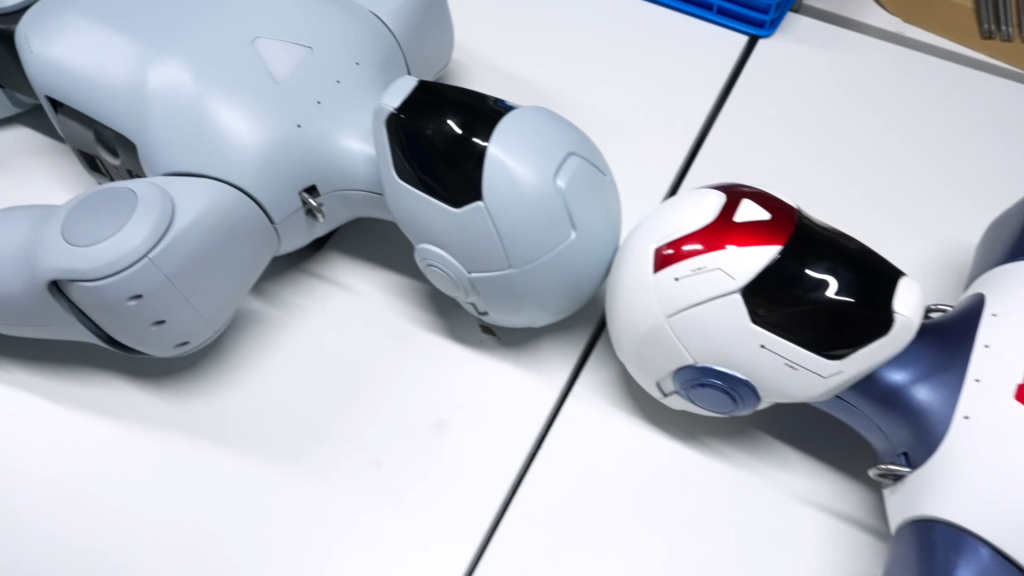
As Unitree aggressively drives down prices, it’s increasingly marketing to the hobbyist market. They’re following a playbook similar to what Shenzhen-based DJI used to dominate the consumer drone market during its emergence.
On the current trajectory, pricing for Unitree’s starter humanoids could dip into the hundreds. If interest in humanoid boxing continues to rise, they could become a fixture at hobbyist stores that sell RC vehicles and drones.
DEEP Robotics Starts Mass Production
While Unitree aims for mass appeal, another Hangzhou dragon is scaling production of industrial grade legged machines.
Spun out of Zhejiang University in 2017, DEEP Robotics just shared this drone footage to announce it’s achieved mass production and delivery of its full suite of quadrupedal robots.
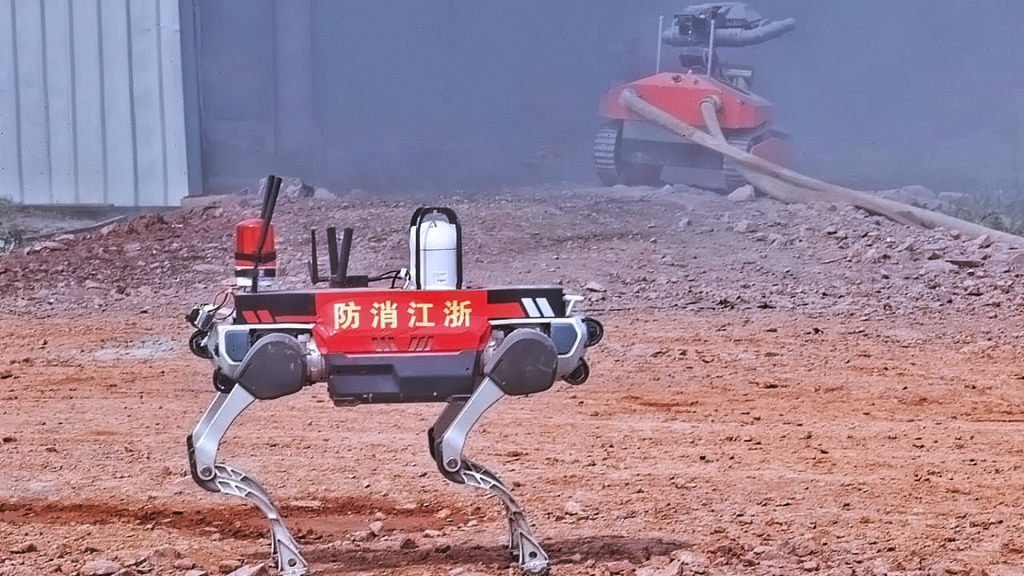
The startup recently secured nearly $70 million in a financing round to boost R&D into its quadrupeds, humanoids, and other next gen machines. According to Dealroom, the company has an enterprise value of about $1.3 billion.
DEEP Robotics offers entry robodogs for under $3,000, but its emphasis is industrial use cases like power inspections, firefighting, mining, and logistics. The startup focuses heavily on all terrain mobility so its robots can climb stairs, navigate rubble, and operate in dangerous places where wheeled machines and humans struggle.
Its flagship quadruped is the X30, which is priced starting around $65K. The robot is built for harsh environments and can withstand temperatures as low as -20 to 55 degrees Celsius or -67 to 131 degrees Fahrenheit. It’s been deployed alongside lower-end X20 models, which are priced starting around $30K, throughout China at places like power stations and factories.
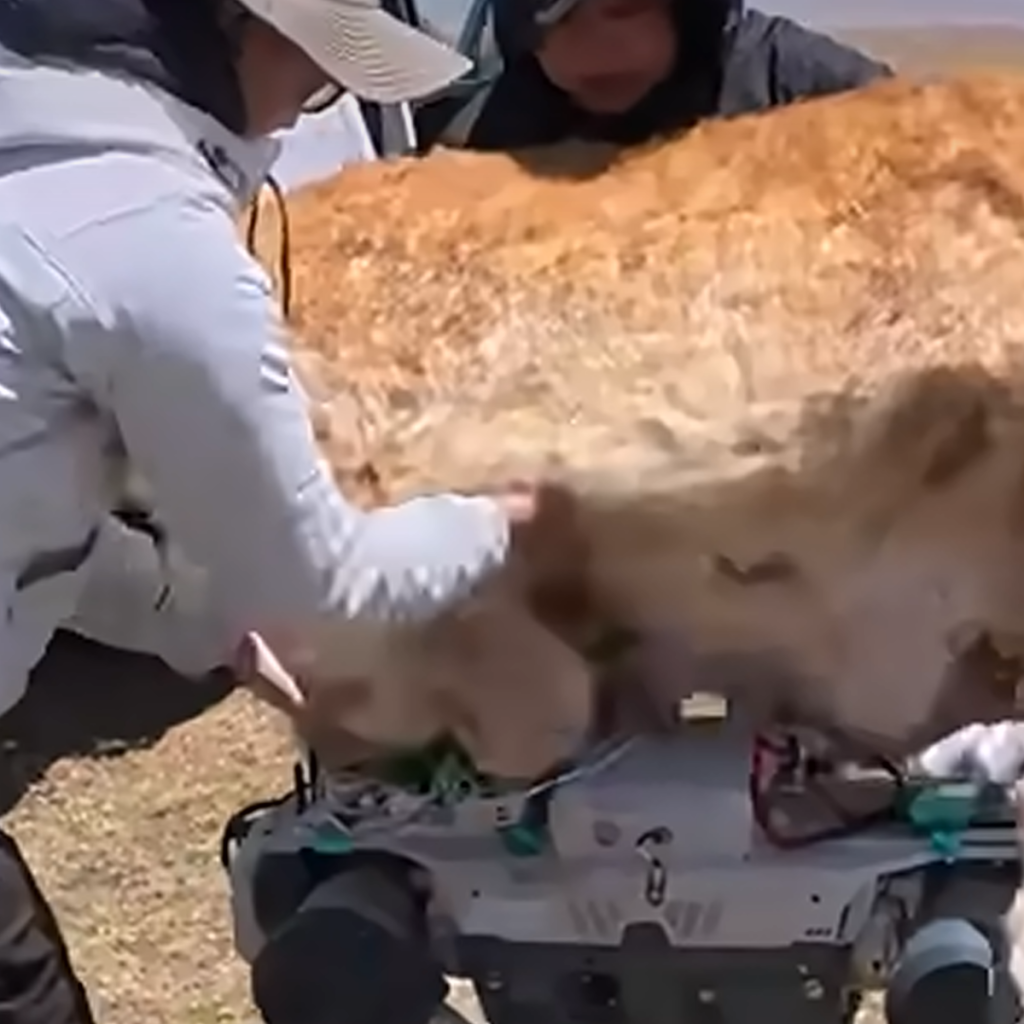
In collaboration with the Chinese Academy of Sciences, DEEP Robotics outfitted one of its higher end robots with an antelope costume to spy on real endangered herds 4,500 meters above sea level in the Tibetan wilderness. In Singapore, X30 robots inspect underground power tunnels, scanning for cracks, water ingress, and other anomalies.
BrainCo Seeks Pre-IPO $100M
Meanwhile, another Hangzhou Little Dragon is working to make mind controllable robots accessible to the masses.
Launched in 2015 by Han Bichung when he was a PhD student at Harvard, BrainCo develops tech that extends human capabilities, including brainwave headbands for focus, bionic hands for amputees, and robotic hands for research and industry. BrainCo is reportedly in talks to raise $100M in a pre-IPO financing round.

The startup is most known for its brainwave sensing headbands, which generated headlines in 2019 when they were tested on Chinese students to monitor their attention spans. The headbands raised alarms over privacy, but BrainCo stressed that the devices only tracked focus levels and were meant as learning aids, not surveillance tools.
BrainCo claims it’s since shipped more than 100,000 units, which are priced starting around $300 and are used for focus training, meditation and research.
The startup says it’s started mass producing its AI-powered prosthetic hands. They’re priced starting around $10K for amputees, which BrainCo says is about a fifth of the cost compared to foreign imports. A dexterous robotic hand for research is priced starting around $8K.
Manycore Challenges Autodesk
Rounding out the Six Little Dragons is Manycore, which has grown from a home design software startup into the world’s largest AI-powered spatial design platform.
Founded in 2011, Manycore is actively working toward going public on the Hong Kong Stock Exchange (HKEX) as it cements itself as China’s answer to Autodesk. Its main platform, Kujiale, has broadened access to CAD technology far beyond professional architects and engineers.

Its customers range from small furniture makers and freelance interior designers to large real estate developers and multinational retailers. Manycore has built one of the world’s largest libraries of 3D design assets.
Its proprietary models like Spatial LM and SpatialGen automatically generate and interpret complex 3D environments. Designers, decorators, and even homeowners use the platform to experiment with layouts, furniture, lighting and other elements to iterate quickly. Businesses convert the high-fidelity renderings for marketing materials and to translate designs into production-ready instructions.
Manycore boasts its end-to-end pipeline that connects design, visualization, and production to cut delays. Through Coohom, its international brand, it already serves users in more than 200 countries.