
Could a Chinese humanoid robot beat Forrest Gump in a table tennis match?
Researchers from UC Berkeley shocked the Internet with footage of a Unitree G1 robot, aptly named HITTER, rallying 106 ping pong shots against a real person without missing once. Its sub-200 millisecond reaction time surpasses human abilities and makes it easily the best humanlike robot to ever hold a paddle.

The team detailed its finds in the paper, “HITTER: A Humanoid Table TEnnis Robot via Hierarchical Planning and Learning.” They said their study shows that humanoid hardware can handle activities that require timing, precision, and full-body coordination. Their system could be adapted to accelerate deployment of autonomous humanoids in places like factories and warehouses.
“These results advance humanoid control toward more agile, interactive, and human-level behaviors,” they wrote. “Eventually we hope to have humanoids play championship-caliber table tennis against skilled opponents.”

To reach the milestone, the team trained a digital twin of the robot’s AI brain in a simulated world, playing thousands of matches to learn the best moves through reinforcement learning. The virtual replica learned all it could about predicting bounces, handling spin, and optimizing shot placement.
The knowledge was then transferred to the physical robot through a process called Sim2Real, short for Simulation to Reality. They refined the behaviors using motion data from elite human athletes, teaching the robot how real players shift their weight, position their feet, and control their paddles. The researchers said this made its swings more natural and efficient, with patterns closer to a pro than a machine.

In the real world, HITTER benefitted greatly from an external vision system that effectively gave it superhuman perception. Nine OptiTrack motion cameras, placed strategically around the ping pong table, tracked both the ball and the robot’s position at 360 frames per second.
The high-speed cameras fed real-time data directly into the robot’s AI brain, where its model-based planner predicted the ball’s trajectory and strike timing almost instantly. Lower-level whole body controllers handled balance, footwork, and coordinated arm swings.
With this setup, HITTER would obviously be disqualified from any serious human table tennis competition, but it’s still a step toward greater autonomy and natural decision-making in robotics. The unfair advantage would be especially useful for automated assembly lines, high-speed packaging, quality inspections, and even surgical assistance.

While the robot beat humans in consistency, people are still more creative with their moves and better at adapting to unpredictable situations.
So even with all of its advantages, the robot would still lose to Forrest Gump, whose chaotic spins, unpredictable angles, and lightning-fast shots would be too much for HITTER’s AI to process. In a longer endurance contest, HITTER might out last him, but probably not.
Unitree’s G1 humanoid robot has surged in popularity over the last year thanks to its relatively low entry price of around $16K. As it scales production of its machines, the Hangzhou-based firm is reportedly preparing for an initial public offering (IPO) on the Hong Kong Stock Exchange (HKSE).
As of late, Unitree has been showcasing its short humanoid’s abilities in the ring. The company’s kickboxing humanoids have been seen by millions on Chinese TV, which aired Unitree’s first MMA-style tournament earlier this year, and major events like the 2025 World Robot Conference (WRC) in Beijing and the World Artificial Intelligence Conference (WAIC) in Shanghai.
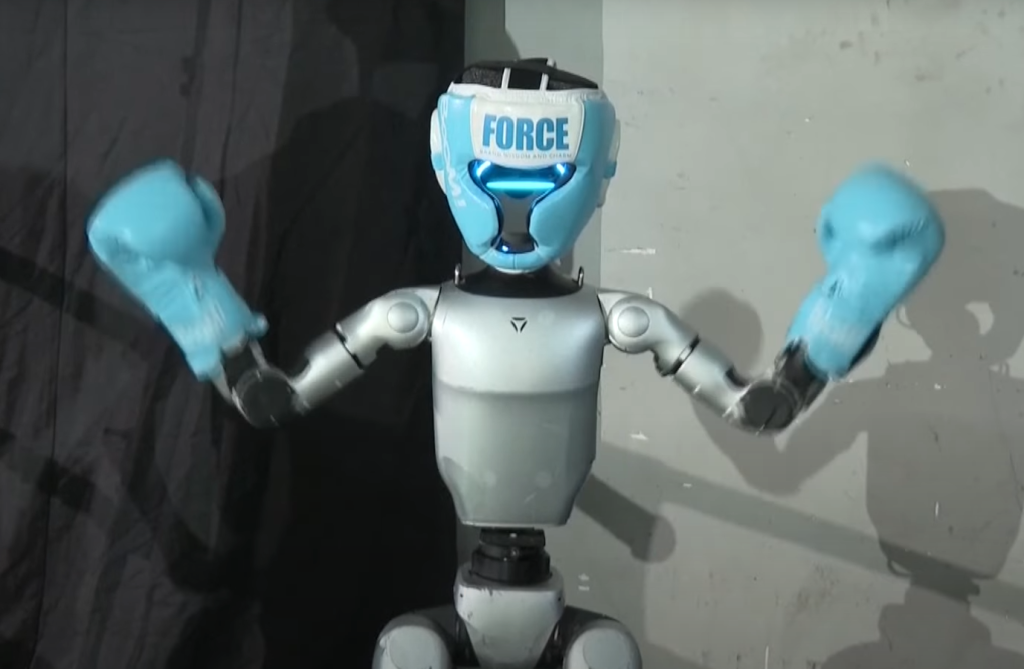
Now, Unitree’s short king appears headed for the Ultimate Fighting Championship (UFC) circuit. During a recent visit to Shanghai, UFC President Dana White had the chance to operate a 35 kg Unitree robot built for the ring remotely.
The moment gained virality after one of Unitree’s robots reportedly went off script during the demonstration, prompting White to unexpectedly retreat. Though the UFC chief was unharmed and seemed amused, the incident, and others like it, raise questions about the limits of human control over advanced robotic systems in public.
The collaboration comes as the UFC continues its expansion within the People’s Republic, whose government has set a national mandate to mass produce humanoids by 2025 and own the market by 2027.
Unitree, which manufactures more than 60 percent of the world’s quadrupeds, has effectively become the DJI of humanoids since it lowered the barrier of entry with its G1 robot. As it faces stiffening competition from fellow Chinese firms like AgiBot, Noetix Robotics, and EngineAI, Unitree is ramping up production and is preparing to launch a next-generation full-sized humanoid.