
The global digital twin market is set for meteoric growth, with one region in particular driving adoption.
According to a new report from Allied Market Research, the digital twin market will rise from $6.5 billion in 2021 to $125.7 billion by 2030. The expected compound annual growth rate is nearly 40%.
Digital twins are virtual replicas of real-life entities that provide deep insights for predicting and optimizing performance across sectors.
Allied Market Research says the automotive and transportation markets are especially driving demand, aiming to develop more efficient and innovative vehicles. Asia Pacific is expected to be the fastest-growing region, with strong economic growth necessitating automation and significant investments in the Internet of Things and smart technology.
Digital twin technology is evolving at such a rapid rate it’s hard for virtually anyone to keep up. The following are just some notable recent developments. Subscribe to my YouTube channel to stay up to date as digital twinning advances and leave a comment to suggest digital twin projects that should be included in future roundups.
Olympic Swimmer Digital Twins
For the first time ever, digital twins of elite swimmers are being used for Olympic training for this summer’s games in Paris.
Researchers from Emory University and the University of Virginia have been working on creating virtual replicas of Olympic swimmers since 2015.
They use devices called inertial measurement units to record swimmers’ body measurements 512 times per second. The swimmers wear the sensors on their wrists, ankles, or back during tests to ensure every movement is measured. Advanced sensors measure the force generated by swimmers’ hands, delivering rich insights to improve their technique.
The researchers reported the results to Scientific American.
US Digital Twin Strategy
The United States government is working on a strategic plan for digital twin technology that will guide all federal agencies on the technology.
The Networking and Information Technology Research and Development program is seeking input on its national digital twins R&D strategic plan until the end of July.
The plan will seek to unify digital twin integrations so the technology can be deployed at scale. It seeks commentary on anything that involves creating virtual models of physical entities that reflect their real-world states.
The program’s RFI mentions AI integrations, data management, regulatory challenges, and international collaboration as the encouraged topics.
GR-1 Humanoid Robot Integration
New footage of the GR-1 general-purpose humanoid robot appears to show a brain-computer interface for robotic control. Shanghai-based Fourier Intelligence released new footage of the 5’5″ humanoid robot.
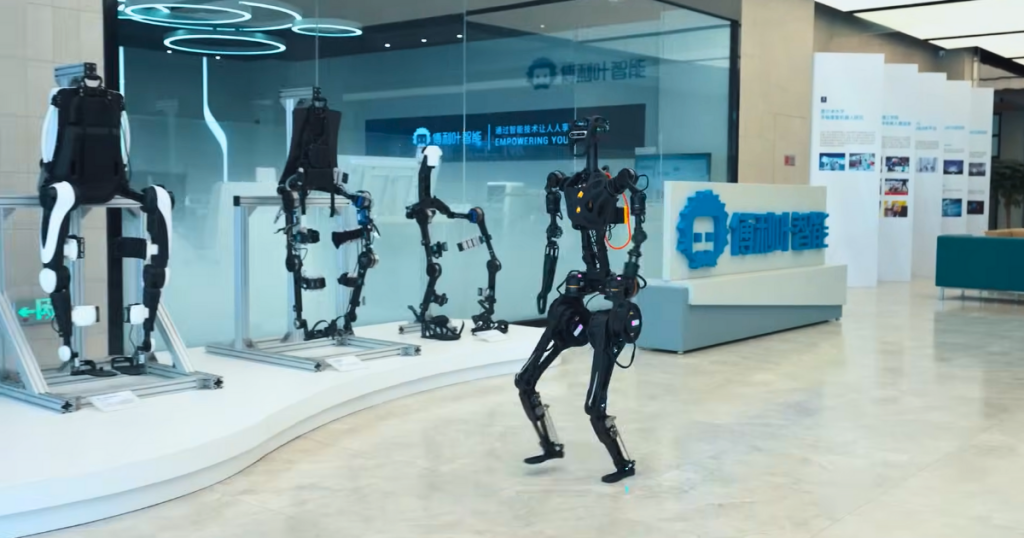
The video notes improvements to the robot over the last six months, including more flexible hands, voice interaction training, integration with digital twin technology, and extended reality applications. Weighing 121 lb, the GR-1 can carry objects up to 110 lb and features 40 degrees of freedom.
The robot can navigate complex environments with advanced motion control and self-adaptive balance capabilities. Its camera-based pure vision system uses six RGB cameras for a 360-degree view. The robot is intended for industrial, healthcare, and domestic tasks.
Organic Solar Cell Microfactory
Researchers say they tested nearly 12,000 organic solar cells in 24 hours by combining leading-edge digital twin and machine learning capabilities with legacy printing technology.
The international team created a platform called Microfactory to improve solar cell production in a closed-loop system. They use digital twins for simulations and process optimizations.
The virtual replicas provided comprehensive data used for rapid iteration and refinement of solar cell designs. They printed the cells using roll-to-roll technology, a highly efficient manufacturing process allowing for continuous production of flexible materials.
The findings were reported in Cell Reports Physical Science.
Xiaomi Hyper Intelligent Manufacturing Platform
Xiaomi says its new fully automated smart factory can make 10 million smartphones per year. In a video posted to X, Xiaomi founder and CEO Lei Jun said the dark factory has 11 production lines, and 100% of key processes are automated.
The factory, located in China’s Changping District, will produce new foldable phones at a rate of one device every 3 seconds, around the clock. Jun said the heart of the factory is the Xiaomi Hyper Intelligent Manufacturing platform.
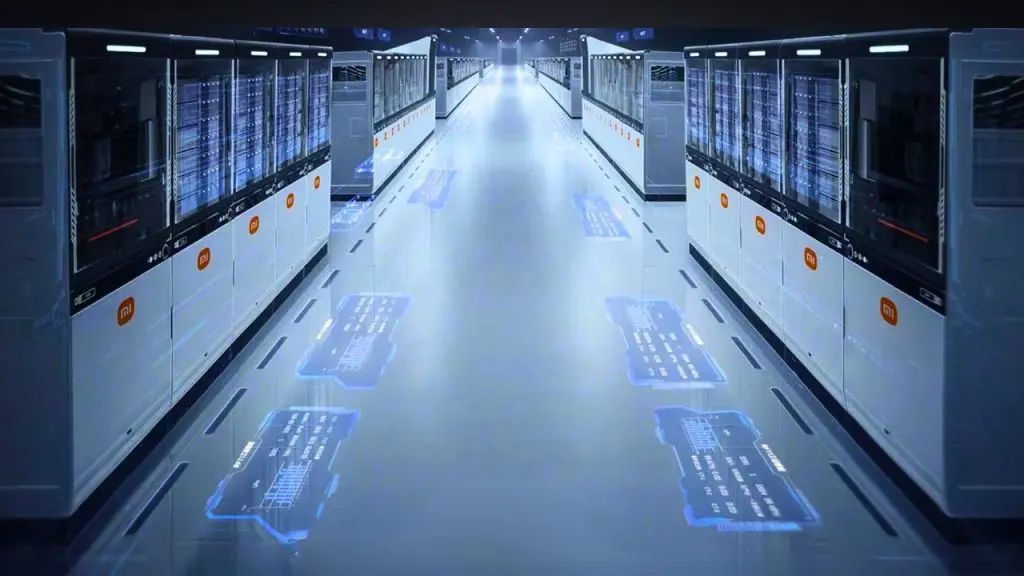
The software uses advanced AI-powered digital twins to proactively find and solve issues before they cause disruptions. The 880,000 sq. ft. factory’s key processes are controlled by Xiaomi’s homegrown AI-driven platform.
The software gives the factory highly advanced self-perception, self-decision-making, and self-execution capabilities using real-time data. The system independently diagnoses equipment problems, improves process flows, and manages entire production processes from raw material procurement to delivery.
According to reports, micron-level dust removal systems ensure a meticulously clean production area, similar to an operating room. A select few humans work in the factory’s control room, wearing full gowns and caps to maintain the environment. The new fully automated factory follows a pilot project in Yizhuang.
The smaller factory produced around a million units per year. The Yizhuang facility served as a testing ground for Xiaomi’s autonomous tech before scaling to the much larger, more advanced factory.
Realistic Humanoid Characters
Humanoid characters can move more realistically through complex 3D worlds with a new technology developed by researchers from Nvidia.
The system, called PlaMo, uses reinforcement learning to make characters walk, run, and crawl naturally. PlaMo is short for Plan and Move. It combines planning paths and controlling movements to navigate terrain and obstacles.
PlaMo allows humanoids to follow planned paths effectively while responding to dynamic environmental changes. Potential applications include video game development, immersive and realistic virtual reality, robotics, animated entertainment, and simulation training programs.
Nvidia also generated buzz with its new AI tool designed to make digital humans more lifelike than ever. The tech giant just announced the release of Nvidia generative AI microservices to create super realistic digital humans.
Companies in customer service, gaming, and healthcare are among the early users of the tools. The suite includes tools for speech recognition, language understanding, and realistic facial animations.
Dell x Nvidia x Grok AI Factory
Dell and Nvidia are partnering to build an AI factory that will help improve Elon Musk’s Grok AI model. Dell is providing computers, storage, and software, while Nvidia supplies powerful H100 GPUs for the factory.
The facility will be one of the largest AI factories in the world. The project aims to make artificial intelligence easier to use for businesses. The factory will manufacture and assemble computing infrastructure like server racks and liquid-cooled architectures. Th
e companies plan to create a supercomputer that enhances Grok’s performance. Oracle will also be involved to further boost AI capabilities. Its planned location has not been disclosed.
The factory is expected to be operational by Fall 2025.
More Digital Twins
To stay up to date on the latest in digital twin technology, subscribe to my YouTube channel.