
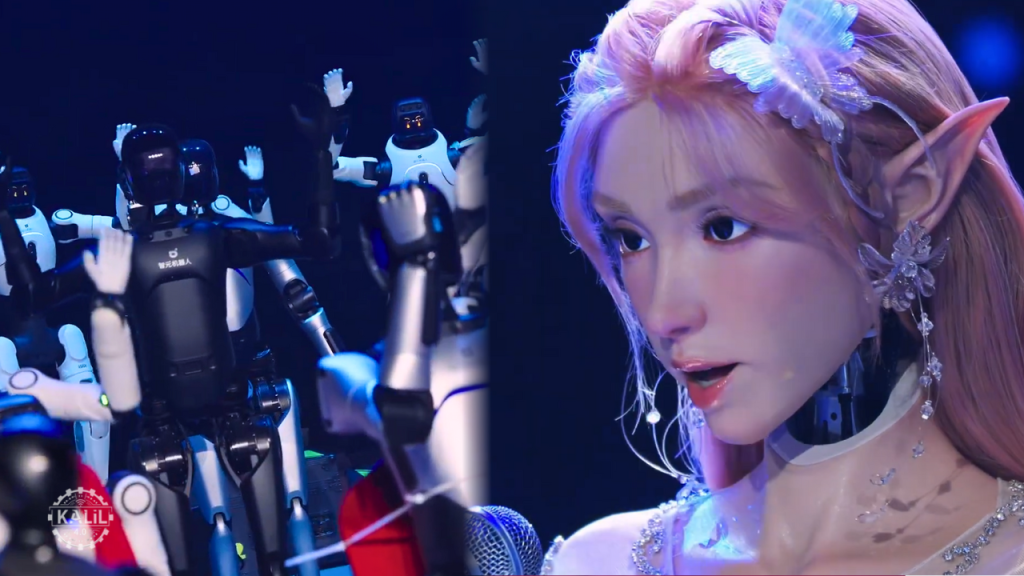
Under stage lights in Shanghai, a lifelike robot sang softly to an audience of fellow machines. The pink-haired android performed a love song penned by its creator, a Chinese social media star with Ivy League schooling, who believes robots are destined to form more meaningful and intimate relationships with humans.
The spectacle could be a glimpse into that vision with its scenes that would have seemed unimaginable just a year ago. As a growing number of Chinese firms aggressively pushed their synthetic humans out of the uncanny valley, could the future of human machine relationships be a little stranger, and more elf aware, than the movies predicted?
Who Yuhang Hu?
Yuhang Hu launched Aheadform in Shanghai in 2024 at age 26 while still enrolled in a Columbia doctor program. Born in 1997, he grew up in Quanzhou, an historic port city on China’s southeast coast known for its strong entrepreneurial culture. He studied mechanical design, manufacturing, and automation at Xiamen University’s Jiageng College, where he reportedly ranked first in his major for eight consecutive semesters, filed several patents related to logistics automation, and founded a startup that built automated carbon ceiling machines.
Like Unitree founder Wang Xingxing, Hu excelled at engineering but struggled with English. Determined to study abroad, he spent years trying to overcome language barriers. He had grown to believe that breakthroughs in robotics required theoretical grounding and access to frontier research. He took the standardized TOEFL nine times and the GRE four times before finally passing. His persistence paid off in 2019 when he received offers from several top universities. He ultimately chose Columbia University, drawn by the Creative Machines Lab led by professor Hod Lipson, who’s known for his pioneering work in self-aware and self-learning robotics.

At Columbia, Hu established himself as a rising researcher as he chronicled his experience on his popular Douyin account. He was the lead author on “Teaching Robots to Build Simulations of Themselves,” published in Nature Machine Intelligence. In the study, a robot watched video of its own movements and gradually figured out the shape of its body and how its motors work. Using that info, it built an internal model of itself, allowing it to predict how it could move and adapt without being explicitly programmed.
Columbia’s Emo
As he completed his masters and sought a PhD, Hu grew fascinated with the emotional dynamics of human-robot interactions. His most visible work was as lead researcher on Emo, a platform for studying human robot facial co-expression.
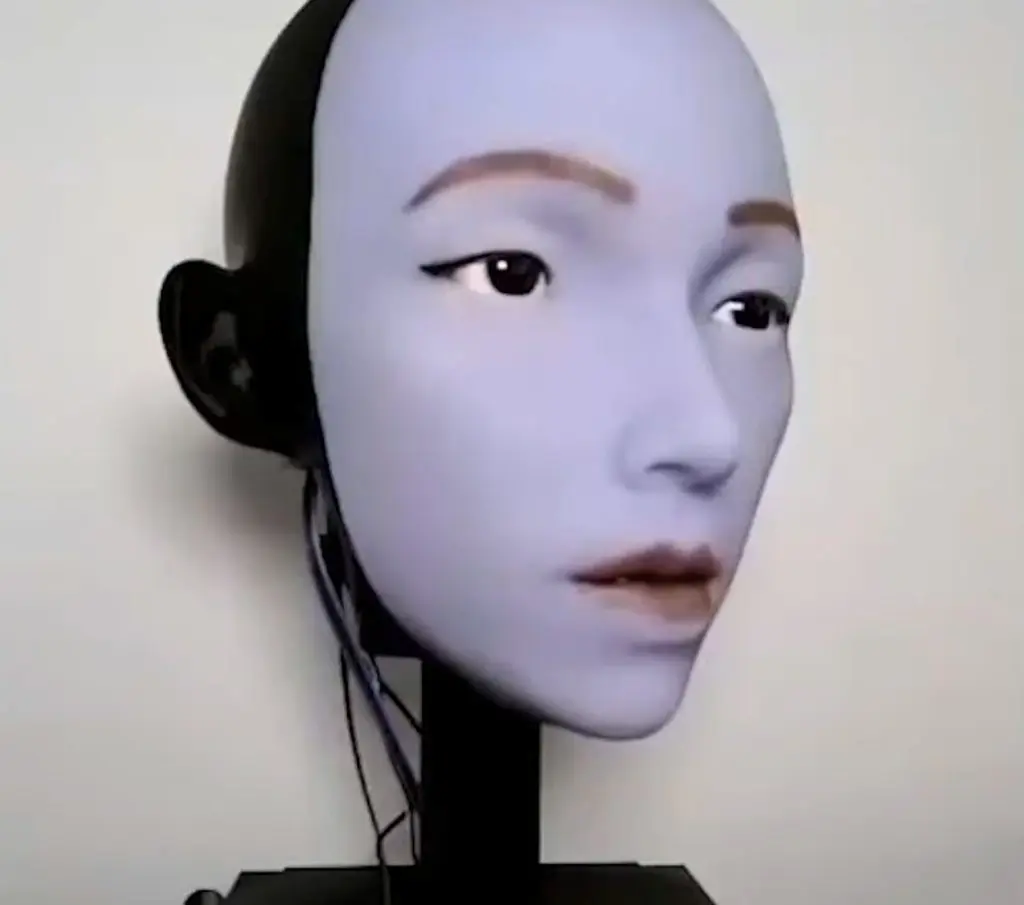
Under its soft silicone skin, Emo has about 30 tiny actuators and brushless micro motors that power its subtle movements. Cameras in its eyes and microphones around its head feed visual and audio data into an AI model trained to predict a person’s emotional state and intent. The system detects nascent emotional cues like the beginning of a smile. It processes that along with language and body signals and then generates corresponding facial output through Emo’s hardware.
The project gave who his first shot of international virality. The research demonstrated that timing and emotional alignment matter for social connection just as much as physical realism. Emo served as the technical foundation for Hu’s next-generation creations that would propel him to the upper echelon of China’s humanoid robotic scene.

Giving AI a Head
Hu launched a head form in June 2024, defining its mission as giving artificial intelligence a head. At the 2024 World Robot Conference (WRC) in Beijing, he told the South China Morning Post that synthetic humans barely distinguishable from real people are closer than most realize. He said that in a decade, humans could be interacting with robots almost as peers. and that in 20 years the machines could walk, talk, and perform tasks just like their human counterparts.
At the time, a truly staggering number of humanoid startups were forming after the Chinese government made it national policy to mass produce the robots by 2025 and to own the market by 2027. Aheadform was an outlier. While most robotics firms raced toward general-purpose usefulness, Hu fixated on the face and its emotional layer. Aheadform secured seed investment from MiraclePlus, the Chinese tech incubator founded by former YCombinator China head Lu Qi alongside other angel investors.

Aheadform’s creations include an android replica of the monk from Journey to the West and a mech-style robotic head inspired by the 2015 Neill Blomkamp film Chappie. But the startup has gotten the most attention from its series of ultra-realistic elf humanoids. It started with Elf V1, a female-presenting android bust with 30 degrees of freedom (DoF) for eerily lifelike facial motions. Following that was Xuan, a name that translates to beautiful jade and symbolizes purity, nobility, and timelessness.
The next-gen iteration of the bionic figure was developed in collaboration with Hangzhou-based NetEase Games to embody a fantasy video game character in physical form. A heavy-metal variant named Elf Iridium appeared on stage for a performance at the 2025 Taihu Music Festival in Wuxi.
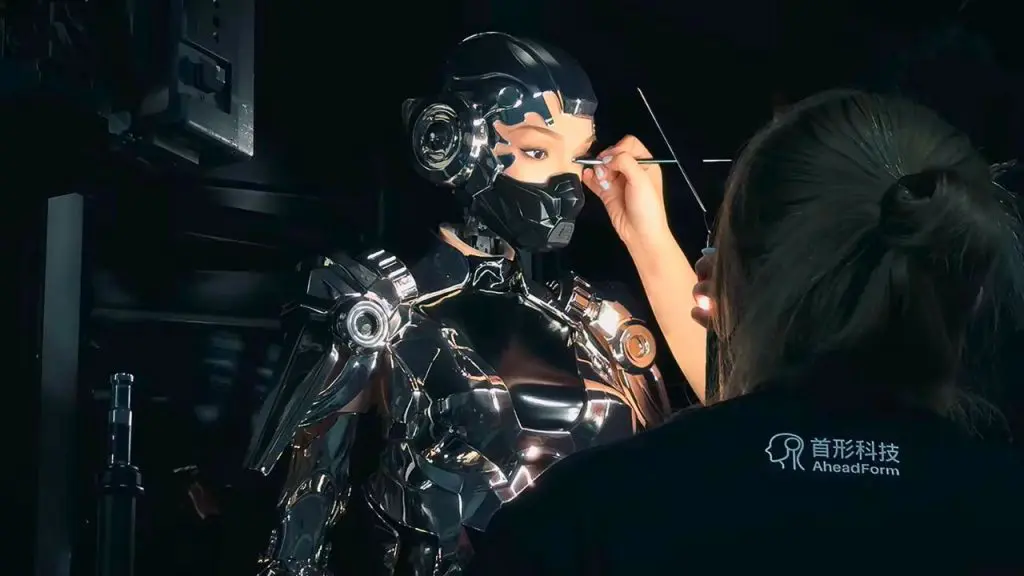
According to the company, the robotic elves can perceive the world, communicate, learn, and interact intelligently with human users. They run on a head form’s character mind emotional intelligence system. The system builds an internal emotional model of the human partner by fusing visual, audio, timing, and motion data from its suite of cameras, mics, and sensors. Aheadform says it’s a step toward humanlike robots that behave less like programmable machines and more like emotionally aware agents.
The company also introduced its first commercialized platform, the Origin M1, that can serve as a standalone interactive system for exhibits or research and as a core module that can be incorporated into larger robotic bodies in the future.

Aheadform’s hyper-realistic creations gaining mobility seems inevitable, if not imminent. Combining humanlike expressivity and walking has long been one of the steepest hurdles in robotics because they rely on opposite engineering priorities. Facial animatronics drain system power, generate heat, and demand computing resources that could otherwise go to locomotion and stabilization. Synchronizing the systems is becoming easier thanks to better lightweight motors, smarter motion control, and more accurate sensors.
AgiBot Gala
For Aheadform, one very likely route is through a partnership with Shanghai’s AgiBot, one of China’s perceived leaders in the humanoid race. The startup, launched in 2023 by Peng Zhihui, another Chinese social media star with a cult following, says it shipped more than 5,000 humanoids in 2025. The company is aggressively scaling production of its diverse suite of robots that span industrial, logistics, service, and educational use cases.
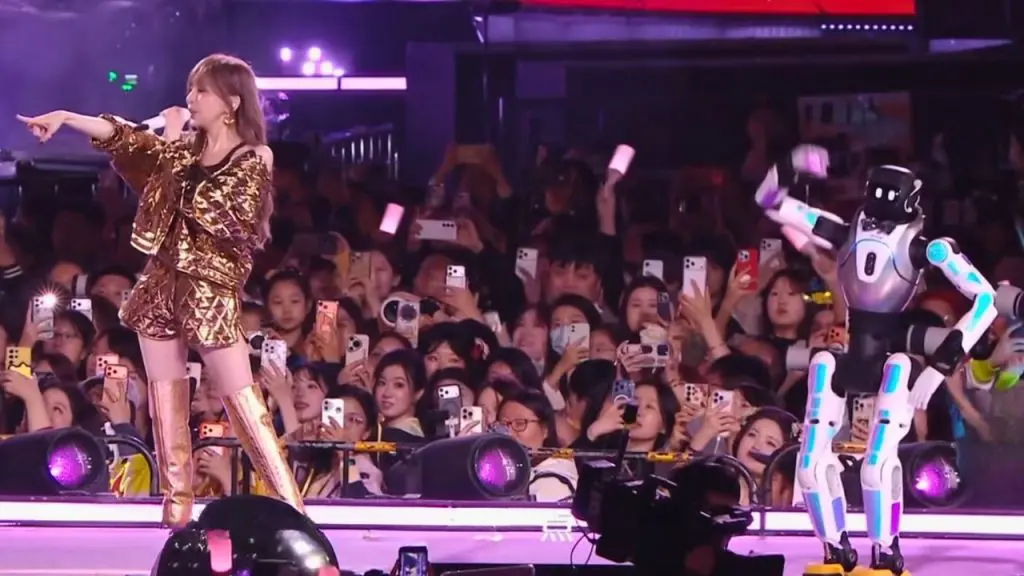
AgiBot featured as Xuan Elf prominently in what it calls the world’s first robot-powered gala. The upgraded elf humanoid boasts a reported 42 independent facial motors for nuanced expressions. The hour-long live production showcased dozens of legged and wheeled robots pulling off synchronized dance routines, magic tricks, and an aerial illusion.
Aheadform’s robo-elf sang a love song, called “Robot White Moon,” written by its creator to an audience of robots. The soft love ballad frames the connection between humans and machines as a mutual presence rather than control.
“We will find that today’s robots and AI will become more and more like real people,” Hu said during the event. “It is inevitable they will slowly understand human emotions. When this emotion starts to connect with people, between a man and a robot, what kind of relationship will it be?”
Aheadform is developing its next-gen creations with at least $14 million in funding with major backers including Ant Group and AgiBot. For AgiBot, a highly expressive social humanoid would be a natural extension of its already broad robotics portfolio. And for Aheadform, which does not yet publicly disclose pricing, mobility may be required to stay competitive with a growing array of firms focused on hyper realism.