
The Trump administration is reportedly planning a major robotics push in 2026 to counter China’s growing dominance in the age of embodied artificial intelligence.
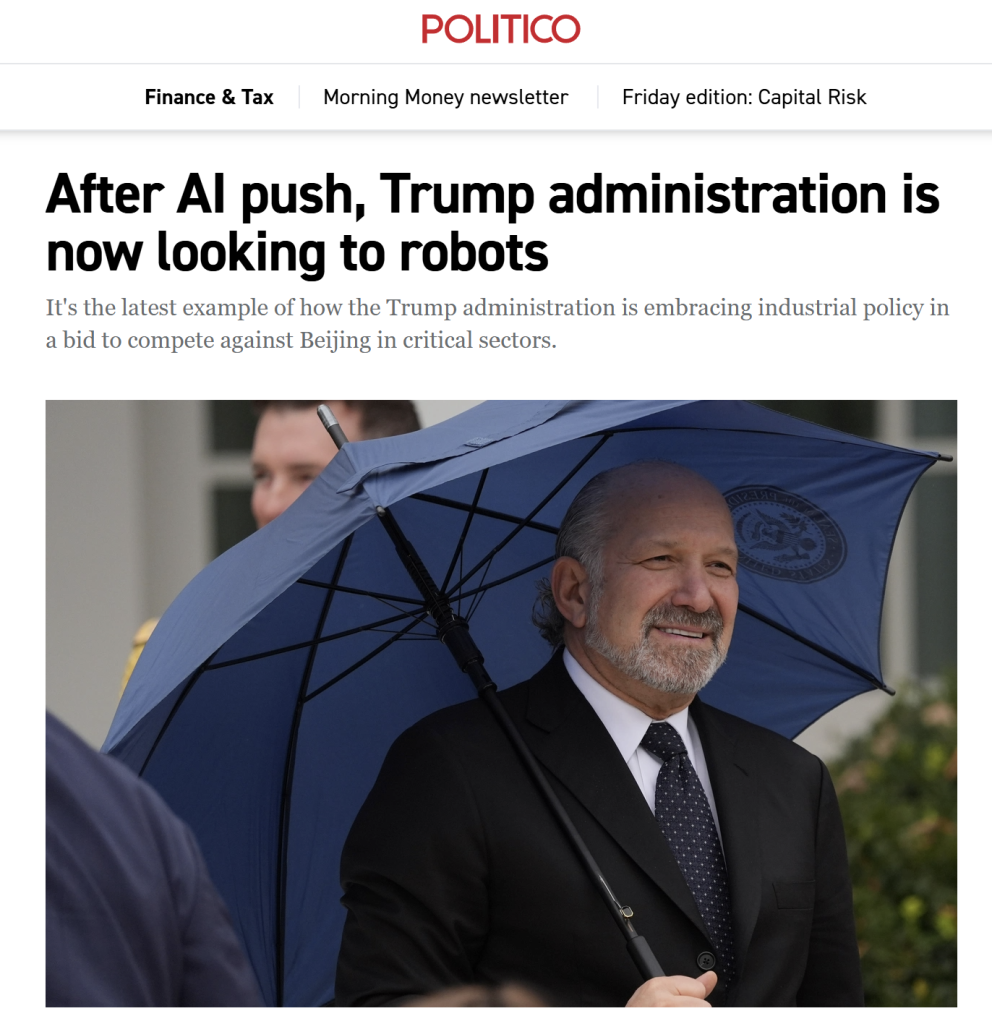
After spending most of 2025 framing AI as a strategic asset, President Trump is shifting his attention toward robotics. According to Politico, the Commerce Secretary Howard Lutnick has been meeting with robotics CEOs as the Trump White House prepares an executive order for 2026. The Department of Transportation is also reportedly preparing a robotics initiative.
The robotics surge is colliding with rapidly hardening partisan lines, leaving doubt about how stable the policy environment will be. If Trump goes all in on robots, there could be a major spike in investments as companies align with federal initiatives, permitting changes, and procurement priorities.
Robotics is starting to emerge as a major campaign issue for the 2028 election as technology advances faster than political institutions can adapt. As fears rise about job displacement, which tech leaders themselves are sounding alarms about, it could become the kind of issue Democrats are looking for to resonate with voters.
The general public is nowhere near as enthusiastic about automation as Silicon Valley. Most adults report using AI tools regularly, but polls also show more than half of Americans feel more concerned than excited about its expanding role in daily life. Trust remains low and support for stronger regulation is rising. Regulations are cheap to promise, and Trump’s actions could easily be reversed through executive orders in January 2029 depending on who voters send to the Oval Office.
California Gov. Gavin Newsom, a probable Democratic 2028 contender, has positioned himself as a defender of state authority over AI and robotics, pushing back against federal efforts to preempt his state’s new regulations. Another potential candidate, Congresswoman Alexandria Ocasio-Cortez (D-NY), has taken a nuanced by increasingly skeptical tone on robotics, floating ideas like a “robot tax” for companies that replace workers with machines and warning that the surge of investment is creating a dangerous economic bubble similar to 2008.
US Sen. Bernie Sanders (D-VT), who is unlikely to run in 2028 but remains highly influential in shaping the Democratic Party’s agenda for the next cycle, has been sounding alarms about emerging technologies for most of 2025. He warns that automation could replace tens of millions of jobs and concentrate unprecedented influence in the hands of a few tech billionaires.
“There is a very real fear that in the not-so-distant future, a superintelligent AI could replace human beings in controlling the planet,” he said in a recent address.

Republicans, in contrast, generally frame AI and robotics as engines for economic growth, national competitiveness, and reindustrialization, favoring rapid deployment with minimal regulatory barriers. The party is largely for a unified federal framework rather than a patchwork of state regulations they argue would slow innovation and weaken the US against near-peer adversaries.
“Overregulation by the States is threatening to undermine this Growth Engine,” Trump posted on Truth Social in November 2025.
The main driver for the push is China’s accelerating lead in robotics. The Chinese government has poured massive investments into industrial automation over the past decade, building the world’s largest robot manufacturing base and deploying robots in its factories at a scale unmatched by any other nation. By 2024, China had installed four times more industrial robots than the US, giving it a structural advantage in manufacturing speed, cost, and scale.

The People’s Republic is on track to easily surpass its national goal of manufacturing 10,000 humanoid robots by the end of 2025 and to lead the market by 2027. Chinese firms like UBTECH Robotics, Unitree Robotics, Fourier, Agibot, and EngineAI are scaling production of next-generation humanoids and deploying them into China’s workforce.
In the US, well-backed companies like Tesla, Figure AI, and 1X Technologies are aggressively moving toward mass production, banking on their proprietary AI systems giving them the ultimate edge. News about Trump’s robotics plans triggered sharp increases in robotics-related stock prices for US firms like iRobot, Richtech Robotics, Tesla, and Realbotix.
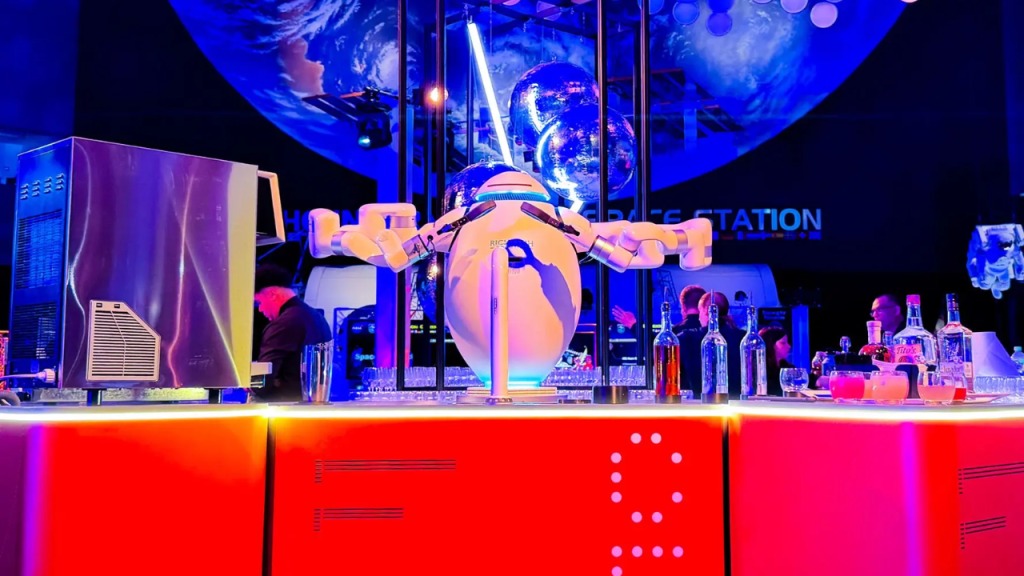
Robotics is seen as key to reshoring manufacturing, but in the long-term automation could take over and replace many of those roles. This adds tension to the strategy’s core: Robotics can help restore the US’s manufacturing capacity, but that same efficiency also reduces long-term demand for traditional labor.
On the Joe Rogan Podcast, NVIDIA founder Jensen Huang echoed the White House’s framing of robotics and automation as key to long-term technological leadership. He credited recent on-shoring of chip production, including NVIDIA’s new Blackwell AI chips, to Trump policies. He argued that AI and robotics adoption can’t scale without supportive policies.
“We are in a technology race, and we are always in a technology race,” Huang said. “Technology gives you superpowers.”