
Could the most influential humanoid robot of all time actually be a human?
Robot Maria from the 1927 classic Metropolis introduced the robotic aesthetics that endure to this day. The German silent film did for androids what Night of the Living Dead (1968) did for zombies.
Metropolis flopped when it premiered nearly a century ago, but today it’s more relevant than ever. As technology catches up with the futuristic vision in Metropolis, let’s take a look back at False Maria’s never-ending impact on pop culture, artificial intelligence, and next-generation robotics.
Newlyweds Fritz Lang and Thea von Harbou started working on the treatment that would become Metropolis in 1924. The German director and screenwriter, recognized as leading creative forces within Deutschland’s silent film industry, first collaborated on Destiny (1921), Lang’s breakthrough film that’s considered a landmark in German expressionism.

The two engaged in an extramarital affair as Harbou became Lang’s primary screenwriter on films like Dr. Mabuse, The Gambler (1922), Die Nibelungen: Siegfried (1924), and Die Nibelungen: Kriemhild’s Revenge (1924). Lang’s wife died in 1921, under mysterious circumstances, and Harbou divorced her husband in 1922. The two wed that same year.
Soon after, the director and writer, both in their early 30s, began work on their treatment for a futuristic sci-fi epic. Harbou penned a screenplay for Metropolis concurrently with a 1925 novel of the same name.

The story is set in a futuristic city where a utopian surface hides a dystopian underbelly. The year the story takes place is debated. A 1963 Ace Books edition of the novel and Giorgio Moroder’s 1984 re-edit specify 2026. Other interpretations range from Y2K to the year 3000.
Lang drew inspiration from his first visit to New York City for the film adaptation’s aesthetics. Towering skyscrapers symbolize industrial prowess and corporate power.
In the layered urban structure, the elite live atop shining skyscrapers. The middle levels handle operations and administration. In the bottom tier, workers toil underground in dark, oppressive factories.

Gargantuan machines power the city. In Metropolis, workers serve as mere extensions of machines, foreshadowing modern debates on AI and automation.
When production on Metropolis began in 1925, robotics was a relatively new concept.
In 1920, Czech playwright Karel Čapek introduced the term in Rossum’s Universal Robots (R.U.R.). The term is derived from the Czech word “robota,” which translates to “forced labor.” The play depicted mass-produced, humanlike androids that rebel against their creators.
In the 1921 Italian film, The Mechanical Man, a giant robot is controlled by an evil scientist.
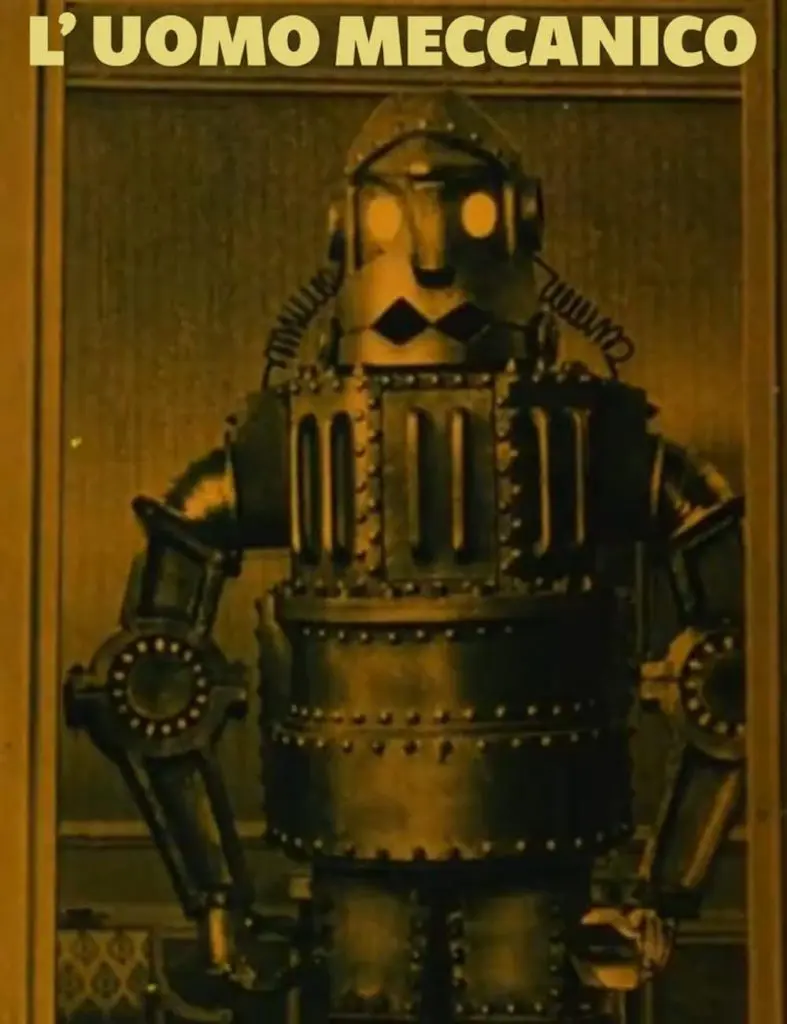
Metropolis, however, shaped robot depictions to follow. Shot at UFA Studios in Berlin, the big-budget production spanned 17 months.
In the movie, Gustav Fröhlich is Freder, the naive and wealthy son of a city ruler who becomes a bridge between the social classes. He falls for Maria, a kind-hearted leader of the working class who preaches peace and unity.
A mad scientist, played by Rudolf Klein Rogge, develops a robotic double of Maria to manipulate and incite chaos among the workers. In her acting debut, 17-year-old Brigitte Helm is both the saintly human Maria and the malicious robotic doppelganger.
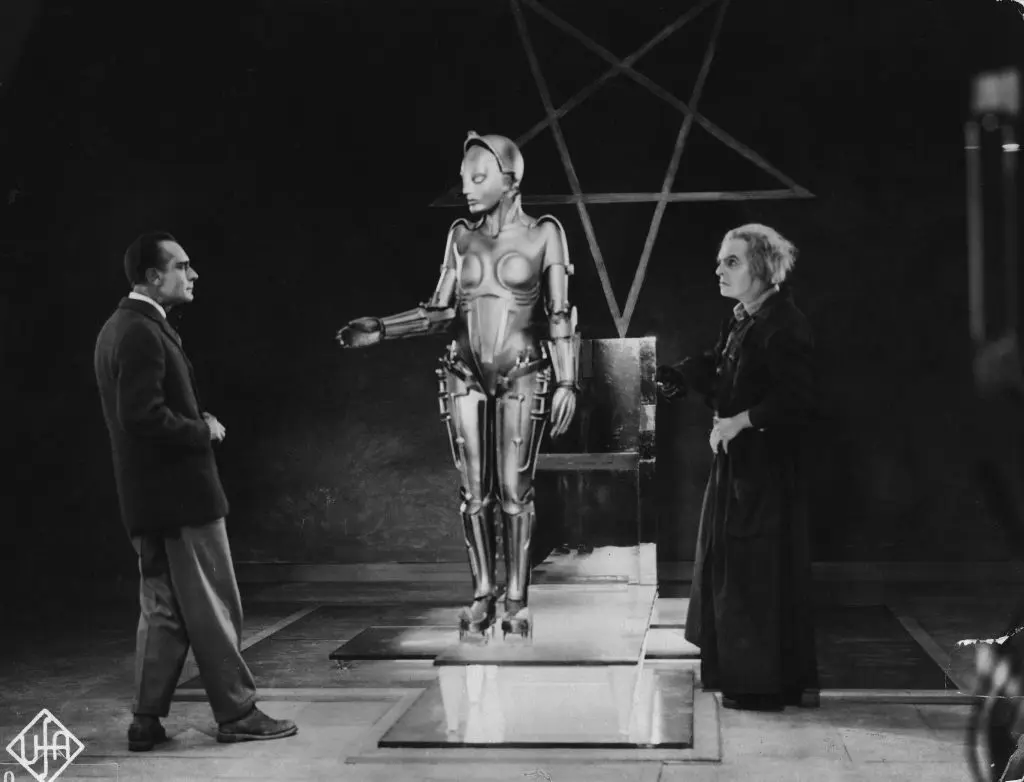
Known as the Maschinenmensch, which translates to Machine Person, it’s the first cinematic depiction of a humanoid robot.
Groundbreaking visual effects and costume design brought the creation to life. Walter Schulze-Mittendorff crafted the Art Deco-inspired Robot Maria costume. Made of flexible materials painted to appear metallic, it was notoriously uncomfortable for the actress.
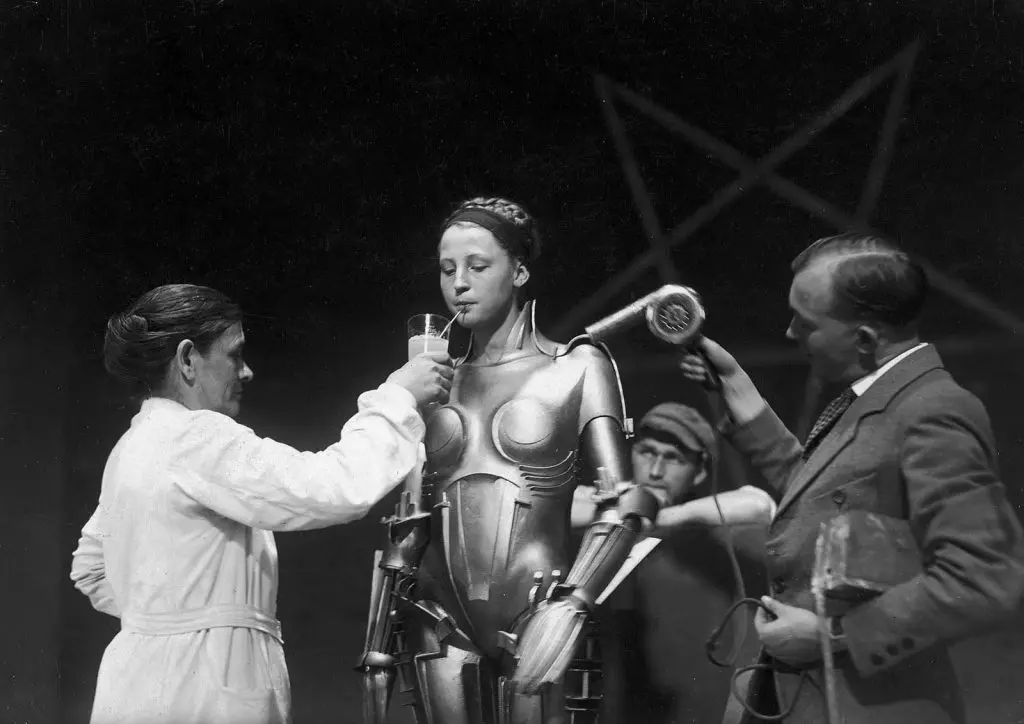
In the story, Robot Maria is commissioned to replace human labor and control the working population. The deranged scientist kidnaps the real Maria and transfers her likeness to the robot in a groundbreaking transformation scene. The crew used multiple exposures, neon lights, and matte cutouts to create the effect of a machine turning into a human.
While the False Maria sows chaos, the real Maria is held prisoner in the scientist’s lab. The robotic imposter incites violence, leads workers to destroy their own underground city, hypnotizes the elite through seduction, and brings Metropolis to the brink of collapse.

Once they realize they’re being deceived, the workers turn against Robot Maria. An angry mob captures the robot and burns it at the stake in a witch trial-style execution. The human facade melts away as flames consume Robot Maria.
Upon its release in 1927, Metropolis was a disappointment. It got mixed reviews in Germany. Some critics praised its visual effects, but others said it was too long, overly dramatic, and politically confused. It failed to recoup its massive budget of 5.3 million Reichsmarks.
As the first fully realized humanoid robot in film, False Maria set the template for cinematic androids and cyborgs to follow. Metropolis also introduced the idea of AI taking human form to manipulate society, a theme revisited in Blade Runner (1982), the Terminator series, Westworld, The Matrix (1999), and countless others. Ralph McQuarrie directly referenced the robot’s Art Deco design as inspiration for C-P30 in Star Wars.
Robot Maria, a deepfake in robotic form, symbolizes fears about AI and automation that mirror modern day concerns. The final message is AI needs a human heart to function justly.

Though Metropolis premiered at the tail end of the silent film era, its legacy endures, with its appeal transcending generations. In the 1980s, Queen’s music video for Radio Ga Ga used footage from Metropolis. Madonna, at the height of her fame, paid direct homage to the film in her Express Yourself music video from 1989.
Janelle Monáe’s debut EP and 2010 album The Arch Android were also directly inspired by the film. The singer portrays Cindi Maryweather, a rebellious android, echoing Maria’s transformation from controlled machine to revolutionary symbol.
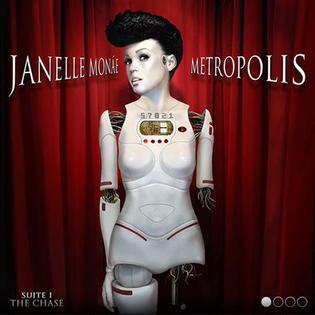
In 2011, Lady Gaga incorporated futuristic robotic aesthetics in her Born This Way era. Beyonce also paid tribute at the 2007 BET Awards, performing her hit “Get Me Bodied.”
Today, Robot Maria’s influence is seeping into the real world more than ever.
As digital deepfakes become harder and harder to detect, a new breed of AI-powered humanoid robots are inching toward mass deployment. A growing array of companies are introducing robots that mimic the way humans walk, talk, and look.
In 2025, hyper realistic robots from the likes of Realbotix Corp., EX Robots, and Clone Robotics aim for their creations to be barely distinguishable from real people.
At some point, a real-life machine person is bound to pull one over on the masses. The only question is when.