
The rising Shenzhen startup LimX Dynamics says its new robot, the TRON 2, is designed to collect the kind of data that’s considered most valuable for training humanoids to take over human jobs.
The startup, launched in 2022 by SUSTECH professor Zhang Wei, just officially launched the follow-up to its breakout TRON 1 biped. It builds on the original’s modular three-in-one design that can switch between bipedal walking, wheeled-assisted rolling, and hybrid foot-wheel movement.
TRON 2 mostly adds a full upper body to the OG biped, which LimX launched in 2024 with pricing starting around $15,000. LimX calls the latest iteration a “multi-form embodied robot.” Though its fully configured form factor is humanoid, it could never be mistaken for a real person with its exposed joints, rigid limbs, and visible sensors in its head.

According to LimX, each of the robot’s arms can carry up to 5 kg (11 lbs) at full extension, with a 3 kg (6.6 lbs) nominal working load. It’s also designed for whole-body load handling, carrying up to 30 kg (66 lbs) while moving on flat ground and around 20 kg (44 lbs) when climbing stairs. In a marketing video, a TRON 2 robot hangs from overhead rings while elevating the full weight of a woman holding a water jug.

The TRON 2 maintains the mobility of the original, which can reportedly reach speeds up to 3 m/s (6.7 mph) in bipedal mode and up to 5 m/s (11.2 mph) using its wheel-foot configuration. It’s rated to handle 15-degree slopes when walking and up to 30 degrees in wheel-assisted mode.
LimX calls the TRON 2 an “all-in-one data platform” that collects, manages, and uses its own real-world experiences to continuously improve. As the robot moves, manipulates objects, and makes mistakes, it records visual, motion, and interaction data that can be fed into training and simulation systems. That data is then used to refine models and improve the hardware’s behaviors.
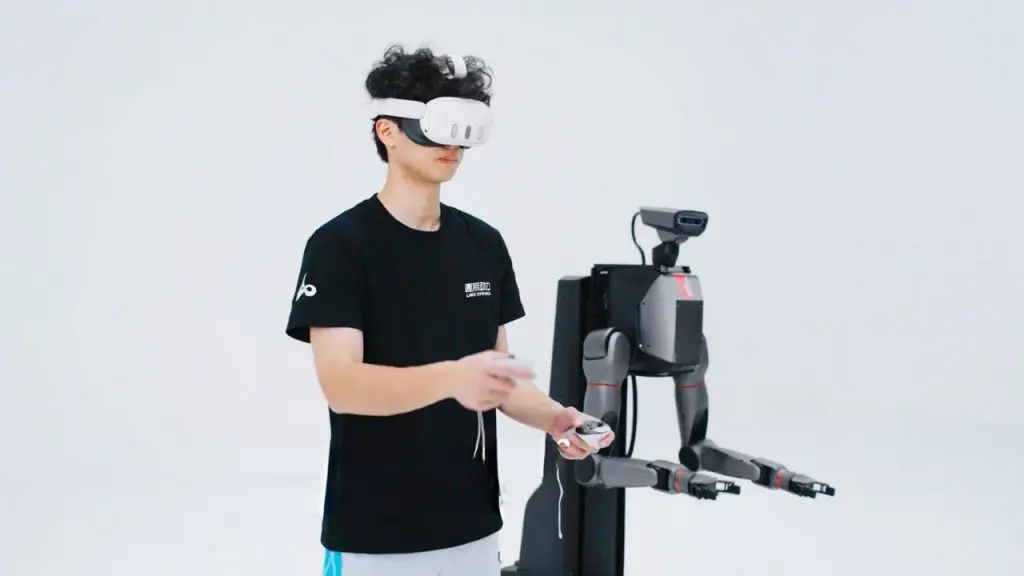
Robotics firms are hoarding massive amounts of human video and synthetic data to improve their vision-language-action (VLA) models, but real-world interaction data is the most coveted. It includes what the robot sees through its own cameras, how its joints and motors move in response to commands, how much force it applies, and what happens when things don’t go as planned. Slips, missed grasps, balance corrections, and other small errors are especially important because they teach the system how the real world works.
That data is the hardest to scale due to the price of hardware. TRON 2 seeks to lower the barrier to entry with its reported starting price around $6,800. LimX also offers an EDU version of the TRON 2 for research and development teams. The higher-end model includes onboard AI computing, support for ROS software, simulation tools, and developer kits.
LimX trains its robots using a proprietary framework it calls DreamActor. First, the robot’s digital twin trains in a simulated world. It learns through reinforcement learning, with millions to billions of variations of each movement tested to pick the best maneuvers. Once stabilized, those skills are transferred to the physical robot and refined through real-world feedback. With the DreamActor system, LimX’s robots can learn from human videos, which are becoming a hot commodity in the humanoid sector.

LimX Dynamics has quickly established itself as a leader in Shenzhen’s humanoid robotics scene. Competition is intensifying heading into 2026 as a truly staggering number of Chinese firms scramble to stay in the game. In Shenzhen, it’s racing to mass deploy its humanoids alongside UBTECH Robotics, which has reported more than $110 million worth of orders in 2025; Dobot, the publicly listed Kickstarter success story that’s begun mass producing its flagship humanoid Atom; and EngineAI, which is training its heavy-duty T800 humanoid for what it calls the world’s first full-sized humanoid boxing tournament.
EngineAI’s new humanoid is priced starting around $25,000, which is in the same range as LimX’s flagship humanoid, Oli. Though LimX and EngineAI have overlapping product offerings, they market themselves very differently. LimX presents its robots as calm, deliberate beings learning to exist in the world, while EngineAI’s newest viral humanoid is literally inspired by T800 (Arnold) from The Terminator.
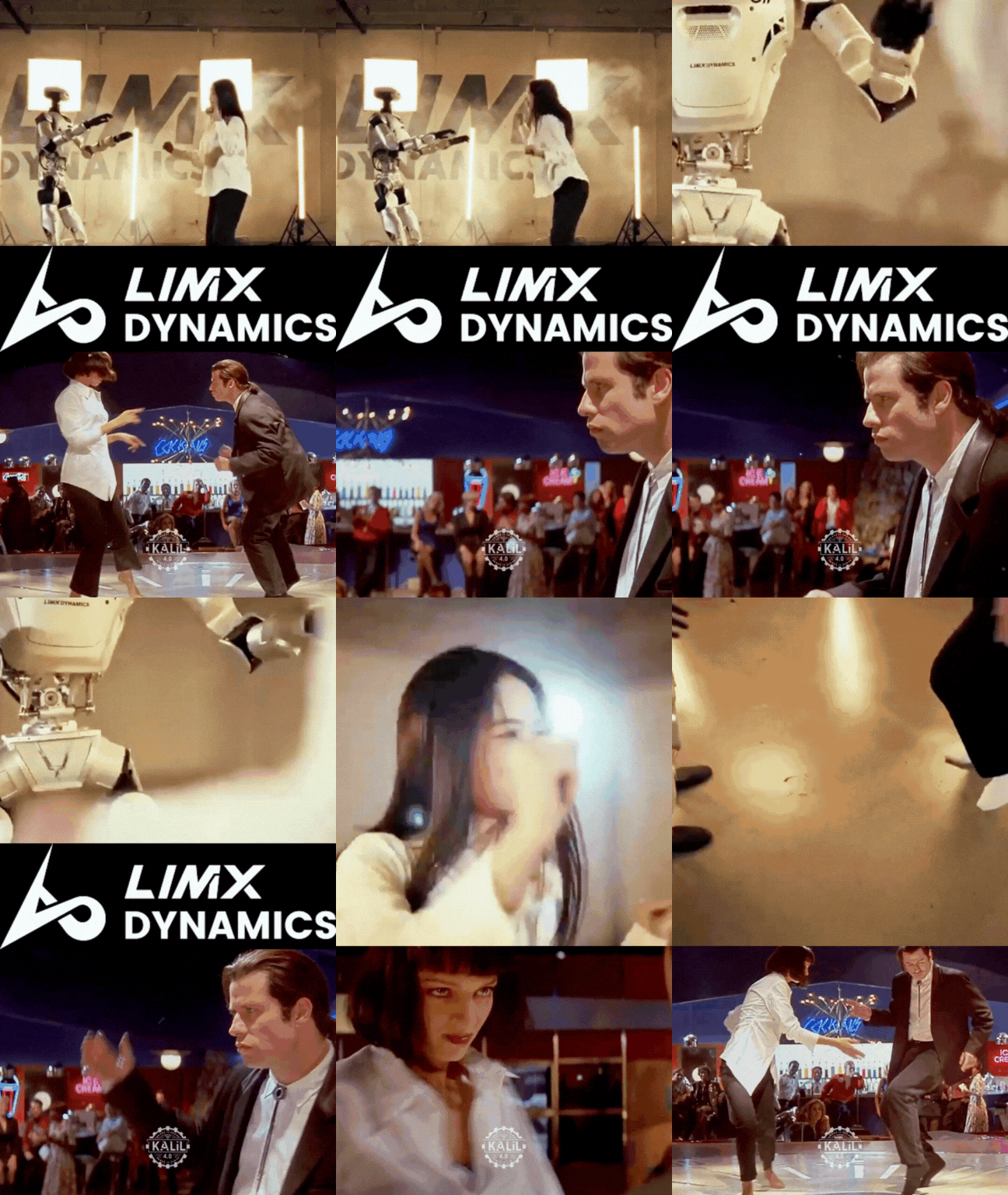
They both lean heavily into dancing. While EngineAI gained international attention when its axe-wielding compact humanoid, the PM01, in a homage to the 2004 Hong Kong cult classic Kung Fu Hustle, LimX recently paid tribute to Quentin Tarantino’s Pulp Fiction (1994) in a demo. During a two-minute video, LimX Oli robots reimagine Uma Thurman and John Travolta’s Twist Contest routine. The video also showed the robot performing a classical Chinese dance to the Spring Courtyard Snow, the Lonely Shake to the song lonely by C-Pop star Yao Xiaotang, and the viral sweep leg challenge.
Standing 165 cm (5 feet 5 inches), Oli boasts a reported 31 degrees of freedom (DoF). It’s the mass production-ready iteration of LimX’s flagship series first revealed in 2023. Its loco-manipulation has improved dramatically, evolving to handle uneven terrain, squatting, lying down and getting back up autonomously, and even yoga-like stretches. It also has features that are superhuman, like its 360-degree rotating hip.
LimX Dynamics has raised more than $90 million to date, including a $69 million round early in 2025. Its major backers include Alibaba Group, Lenovo Capital, NIO Capital, China Merchants Venture, and JD.com.