
Anduril Industries says it’s racing ahead with plans to build a massive smart manufacturing plant for hyperscaling the production of autonomous weapons.
Arsenal-1, the 5 million square-foot facility, will rapidly manufacture AI-powered systems for air, land, and sea defense. Anduril just unveiled site for the one-of-a-kind facility that promises 4,000 new jobs, with an average salary of $132K, over the next decade.
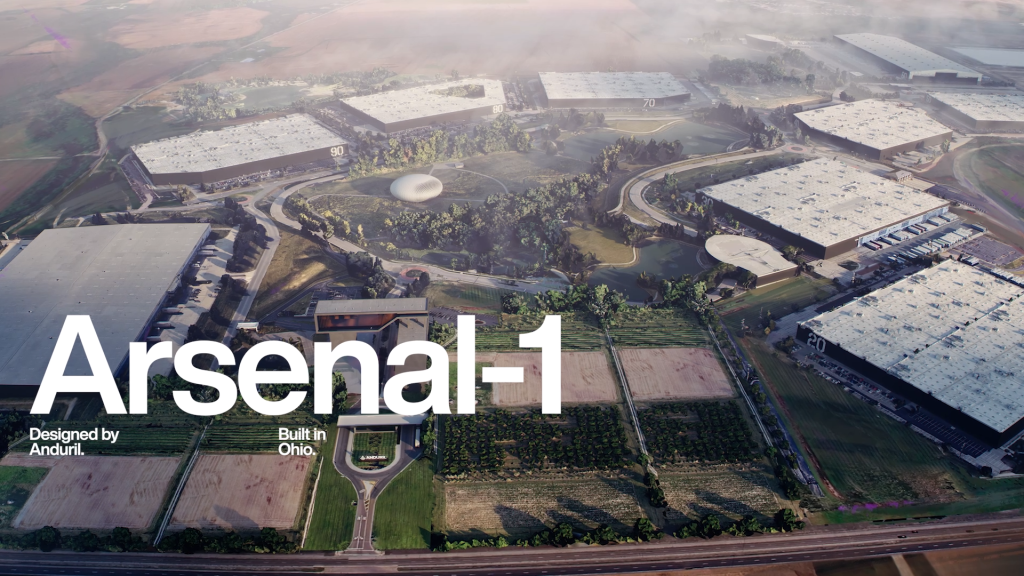
The project is touted as the largest potential job creator in the Buckeye State’s history. Plans call for production of the first phase to commence in July 2026. Anduril is funding the project with $1 billion raised through private investments, while Ohio will initially contribute $70 million.
In an interview with Bloomberg Technology, Anduril CEO Palmer Luckey said Ohio was the only state that could possibly accommodate its ambitious timeline. Luckey said he aims for an operational facility “with fighter jets coming of the line” within 24 months.
“It has to be this fast because we don’t have time for business as usual,” Luckey said. “The types of threats that the United States is facing — that our allies around the world are facing — and the fact that we are predicted to run out of munitions within the first 8 days of a potential conflict with China means that we need to hyperscale our manufacturing.”
In under a decade, California-based Anduril has established itself as a key player in the US defense tech sector, which traditionally favors juggernauts like Lockheed Martin, Raytheon, General Atomics, and Northrop Grumman.
When Luckey founded Anduril in 2017, he was known as the 20-something tech prodigy who created the Oculus Rift VR headset. Facebook, now Meta, acquired Oculus in 2014.
Luckey pivoted from the gaming industry to aerospace and defense after Facebook forced him out due to his support for President Trump. In 2025, Luckey finds himself in a very different political climate, with Big Tech embracing MAGA and the defense sector.
Anduril builds autonomous systems like drones, fighter jets, surveillance towers, underwater vehicles, and counter-drone tech. The startup describes itself as software-driven, with its Lattice platform as the backbone for its systems.
Arsenal-1 will be one of the largest new US defense manufacturing facility in decades. Its square footage equates to 87 standard American football fields. The site allows for expansion up to 500 acres, which would be 15 million square feet of factory space.
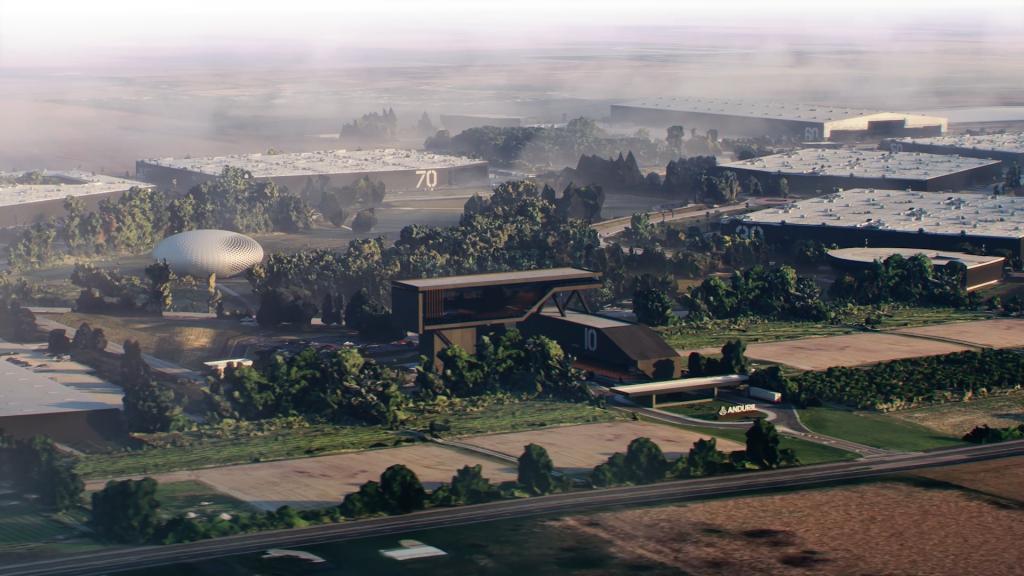
Anduril’s Arsenal-1 will be the largest new US defense manufacturing facility in decades. It square footage equates to 87 standard American football fields. The site allows for future expansion up to 500 acres, which would be 15 million square feet of manufacturing space.
“This is the next big thing in Ohio,” Gov. Mike DeWine said during a press conference. “This is a company that is going to be around for a long time. They’re relatively new and they’ve just gone up like a rocket.”
Anduril says it chose Columbus for its workforce and proximity to the Wright-Patterson Air Force Base and the Air Force Research Lab (AFRL).
“Ohio is going to be critical to allowing us to move fast on Arsenal-1 so we can build the arms the United States needs to deter and, if necessary, win large-scale conflict,” Luckey told Dayton 24/7 Now.
Arsenal-1 will be one of the largest defense manufacturing facilities in the US. Lockheed Martin’s Air Force Plant 4 in Forth Worth, Texas is more than 2 million square feet larger, though its output is much less than what Anduril plans. While the Lockheed plant produces around 150 advanced fighter jets a year, Anduril plans to eventually manufacture tens of thousands of units.
“I don’t think the United States needs to be the World Police,” Luckey told Bloomberg in September 2024. “I think we need to be the World Gun Store. We need to be able to provide our allies and our partners around the world with the tools that they need to turn themselves into prickly porcupines that nobody wants to step on.”
Since its inception, Anduril has been developing advanced manufacturing tech to hyperscale weapons production. Its manufacturing platform, Arsenal OS, integrates design, development, and mass production stages for all of its products. Anduril emphasizes simplicity in its designs, with preference for commercially available components and materials.
The startup recently formed a “consortium” with Palantir Technologies to scale the processing of massive amounts of data to power AI defense systems. They’re integrating Palantir’s AI platform to rapidly test and deploy AI models at scale while meeting national security requirements.
The partnership, announced in December 2024, aims to use Anduril’s Lattice software and Menace suite of deployable computing and communications systems to securely collect, retain, and distribute the data.
As a relative newcomer in the defense sector, Anduril maintains a startup mentality to rapidly develop and deploy next-generation technologies. Defense industry giants like Boeing and Lockheed Martin are working to adapt to speed up production and innovation to stay competitive.
In St. Louis, Boeing’s Advanced Combat Air Facility, currently under construction, will incorporate intelligent manufacturing technologies to enhance the design and production of combat aircraft.
Boeing is investing nearly $2 billion building the 1.1 million square-foot facility. The defense contractor giant says it’s integrating state-of-the-art technologies like:
- Model-based engineering (MBE) and 3D design tools that delivered an 80 percent reduction in assembly hours for its T-7 Red Hawk program
- A digital thread that seamlessly flows data from design through production, ensuring all stakeholders can access up-to-date information
- Digital twins for extensive virtual testing of aircraft performance and mission systems without the need for physical prototypes
Boeing is also expected to open its new advanced coatings center in St. Louis in 2025. The 47,500 square-foot facility will be operated by Boeing’s Phantom Works division. The center will focus on post-assembly phases of future military aircraft production.
Defense contractors are under mounting pressure to digitally transform their defense system development and production processes to maintain an edge over near-peer adversaries like Russia and China.
Congress has limited production of F-35 jets in response to ongoing delays and performance issues. The F-35 program is under increasing scrutiny. Elon Musk, a close Trump advisor, has called the program obsolete in the era of autonomous aircraft. Trump has called the program’s cost “out of control.”
The AFRL is planning a new facility to improve the beleaguered program. The F-35 Joint Program Office and its partners have invested around $70 million for the new Micro Electronics Digital Engineering Infrastructure facility.
The cutting-edge hub, located on the Wright-Patterson base, will leverage virtual models that mirror real F-35 systems in remarkable detail. Engineers will use the digital twins to test updates before applying them to real jets, simulate scenarios, and predict issues that might occur.
Of course, this is all very much up in the air with Trump 2.0 taking the reins. For first updates, make sure to subscribe to my YouTube channel.