The Kids Who Grew Up with Baymax Are Now Building Him

Many of today’s robotics leaders grew up inspired by The Terminator, but the next generation grew up with a very different and softer vision of the future: Baymax.

Tactile sensing involves measuring properties such as pressure, texture, shape, and temperature using sensors embedded in surfaces or robotic skins. In robotics, tactile sensing enhances dexterity and safety, allowing machines to grasp objects delicately, recognize materials, and interact more naturally with their surroundings, similar to how humans use their sense of touch.
Many of today’s robotics leaders grew up inspired by The Terminator, but the next generation grew up with a very different and softer vision of the future: Baymax.

Chinese robotics startups are racing to become the next major player to tap markets for massive amounts of capital. Among the front of the pack is Shenzhen-based EngineAI, known for its T800 humanoids.

EngineAI collaborated with the fellow Shenzhen-based startup PaXini to turn the bottom of the robot’s foot into a touch-sensitive surface.

The Matrix-3 is covered in 3D woven biomimetic skin with embedded tactile sensors that’s sensitive to pressures as light as a gentle fingertip touch.
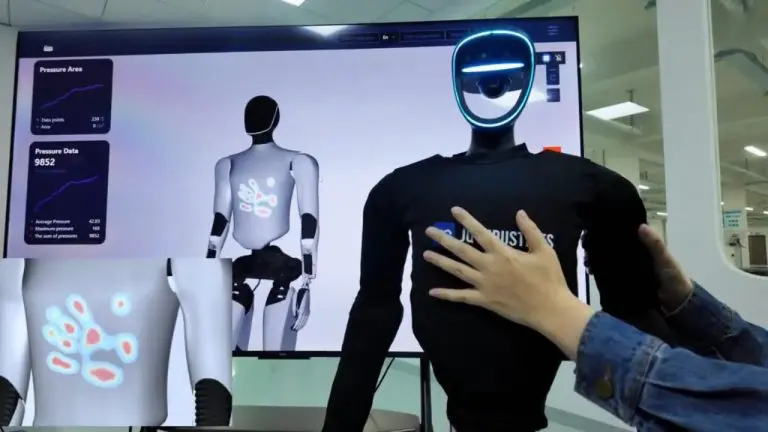
The Chinese company JQ Industries just introduced a fabric-based electronic skin (e-skin) to give robots a humanlike sense of touch.

The Japanese startup H2L just introduced its new Capsule Interface that simulates being inside a robot’s body, even from far away.

UK scientists have developed a robotic hand with skin that feels pain, heals itself, and can be melted down to make another robot.

Clone, which operates out of the US and Poland, says it’s releasing only 279 of its new Clone Alpha androids in 2025.

The AI geniuses at Meta are working on next-generation robots that understand and interact with the real world like humans.