
Unitree founder Wang Xingxing just became China’s latest tech billionaire as investors piled into his company’s blockbuster IPO on Shanghai’s STAR Market.
The public listing is considered a watershed moment in the global race toward general-purpose humanlike machines. It gives the decade-old robotics leader a massive war chest to push deeper into artificial intelligence and scale production of next-generation robots that could define the future of work, daily living, transportation, and maybe even fitness.

The man who clawed his way into China’s elite tech circles without permission couldn’t be more different than the fellow billionaires he’s in competition with. The hardware engineer built his reputation from literal scraps, trying to catch up to the robotics pioneers he idolized. In perhaps the ultimate sign of how far he’s come, some of those idols are now calling on Washington to keep his robots off US soil.
As pressure mounts, can the 36-year-old keep Unitree’s momentum going as a staggering number of Chinese competitors close in from every direction? Is this the beginning of a new era? Or the beginning of the end?
Unlikely Success Story
Born in 1990, Wang Xingxing grew up in a working-class home in Yuyao in China’s Zhejiang Province. The mid-sized industrial center is about a 90-minute drive from Hangzhou, the tech hub Wang went on to help transform.
In school, Wang was never considered a standout student. He excelled at engineering and science, but struggled in subjects that required memorization, especially English.

“During the first parent-teacher meeting in junior high school, my English teacher said to my parents, ‘This child is a little slow,'” Wang said during a 2024 keynote address at Shanghai University.
He enrolled at Zhejiang Sci-Tech University in Hangzhou in 2009, where the unremarkable student differentiated himself with his ability to build things on a budget. He made his first bipedal robot with about $30 in scrap parts and basic tools. He handled the mechanical design, electronics, motor control, and programming on his own.

The 14-degree-of-freedom robot had a crude design and could only walk a few steps, but proved he could build functional robots with extremely limited resources, and it helped him secure about $1,500 in university research funding. The engineering student became an avid self-learner, immersing himself in technical literature, and grew fascinated with the idea of neural networks years before the deep learning boom of the mid 2010s.
First Quadruped
His growing reputation as a gifted hardware engineer wasn’t enough to get him into Zhejiang University, his top choice for graduate school. Instead, he enrolled at Shanghai University, a detour he would ultimately call pivotal to his career. It’s where he developed his first quadruped robot named XDog, which won second place in a robotics and entrepreneurship competition. He got around $13,000 in prize money, his biggest financial boost yet to fuel his hardware ambitions.

When Wang got his masters in 2016, he thought the robotics market was not quite ready for four-legged robots at scale. He joined the Shenzhen-based drone manufacturing leader DJI but quit just a few months later when interest in his quadruped design blew up. Wang launched unitree in Hangzhou in August 2016 at age 26 with nearly $300,000 in funding from an angel investor.
In interviews, Wang has said he was deeply inspired by Boston Dynamics, the then-undisputed leader in legged robotics. He’s even called its founder Marc Raibert his idol. However, he took a different engineering approach using electric motors rather than the expensive hydraulic actuators that powered Boston Dynamics’s iconic Big Dog and early Spot prototypes.
Unitree’s Robodogs
Unitree’s first publicly demonstrated product was the Laikago quadruped, named after the Soviet space dog Laika in 2017. Subsequent models like the Alien Go and the A1 established Unitree’s reputation in the global robotics industry. By 2020, Unitree attracted high-profile clients like NVIDIA and Google, and reported being profitable for the first time.
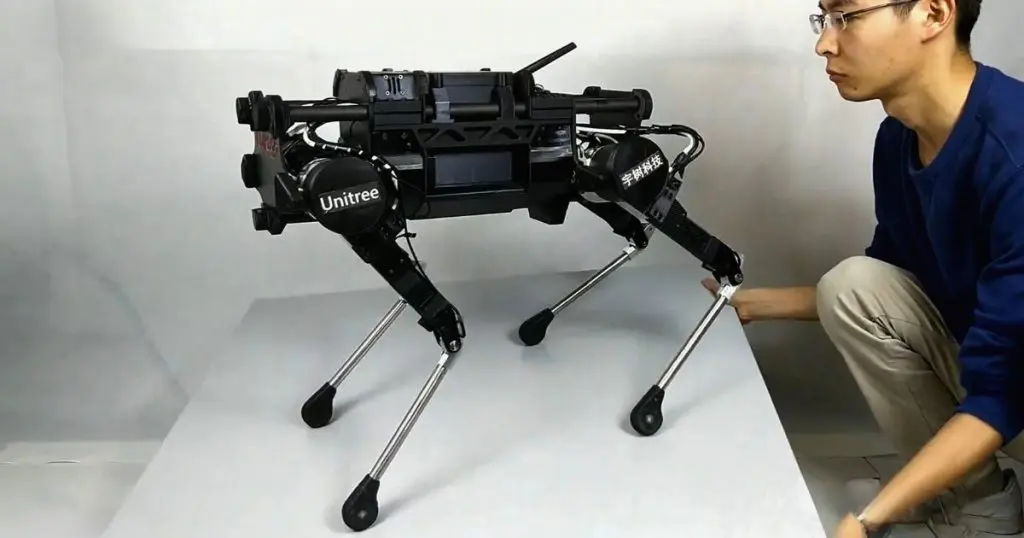
Wang credits Unitree’s participation in China’s 2021 Spring Festival Gala with accelerating the company’s ascent. Unitree sent two dozen of its A1 robodogs onto the main stage dressed as cartoonish red and gold oxen to commemorate the Year of the Ox. The robots performed alongside celebrities Andy Lau, Wang Yibo, and Guan Xiaotong, synchronizing their dance movements during China’s most viewed TV program of the year.

Unitree followed that with the release of its Go1 quadruped, which sent shockwaves through the robotics world with its entry price under $3,000. Its follow-up, the Go2, had an even bigger impact when it was released in July 2023 with its $1,600 entry point.
Weighing around 15 kg (33 lbs), the four-legged robot featured Unitree’s ultrawide 4D lighter for advanced perception along with an HD camera. The company marketed it as an affordable alternative to research-grade units like by the ETH Zurich spinout ANYbotics’ ANYmal and Spot by Boston Dynamics, which started around $75,000.
The relative low price of Unitree’s robotic dogs broadened access to quadruped robotics to hobbyists and independent developers but also made them popular among militaries around the world. US Marines experimented with a Go1 carrying an anti-tank rocket launcher while armed Unitree derived quadrupeds appeared in Chinese and Ukrainian military exercises.

Unitree emphasized that it did not support lethal modifications. In 2022, the company joined Boston Dynamics, Agility Robotics, and others, signing an open letter titled, “General purpose robots should not be weaponized.”
“As with any new technology offering new capabilities, the emergence of advanced mobile robots offers the possibility of misuse,” the letter said. “Untrustworthy people could use them to invade civil rights or to threaten, harm, or intimidate others.”
Unitree Fitness
That same year, Unitree brought its most commercially accessible product to market to power home workouts.
The Unitree PUMP was marketed as a professional gym that can fit in your pocket, geared toward people who wanted resistance training without bulky equipment or machines. It used the same core technology that powered Unitree’s robot joints for exercises like rows, curls, presses, and glute strengthening.

Wang reportedly toyed with the idea of repurposing Unitree motors for use outside robotics since 2017. Unitree’s pump is still listed for sale on its website starting at $289.
Unitree’s Humanoids
Though most of Unitree’s robot sales have historically come from its quadrupeds, humanoids are what’s catapulted its founder into the global spotlight.
The company introduced its first bipedal robot, the H1, in August 2023, a few months before the Chinese government set a national goal to mass manufacture humanoids by 2025 and to lead the market by 2027. Wang appeared in its marketing videos that racked up millions of views, kicking and pulling the $90,000 machine to show its resilience.

By early 2024, the H1 became the first full-sized biped to perform a standing backflip thanks to training with reinforcement learning and claimed the record for fastest humanoid on two legs with a running speed of 3.3 m/s (7.4 mph). That record has since been outdone several times by other Chinese humanoids, including newer iterations of the H1.
A troop of 16 of the robots also outdid Unitree’s earlier Spring Festival Gla spectacle in early 2025, performing a synchronized traditional Chinese folk dance alongside professional human dancers to usher in the Year of the Snake. Unitree worked with the fellow Hangzhou-based tech firm Alibaba to pull the performance off.

The robots used lidar to understand where they were on stage, AI-based motion control to keep them balanced, and a group control system to coordinate their actions in real time. Though it appeared seamless on TV, the routine was reportedly a major headache to make happen.
Wang became a fixture in Unitree’s viral videos, including one from May 2024 introducing the company’s game-changing compact humanoid, the G1.

Weighing 35 kg (77 lbs), the G1 stood 127 cm (4 feet 2 inches), about the size of the OG M3GAN. Its initial starting price of around $16,000 was a fraction of the cost of research grade humanoids that came before it, which often went well into the six figures.
Unitree launched its mass-production ready iteration by August 2024 and the robot’s popularity quickly soared among researchers, developers, and even content creators. Beyond research, one of its strongest early use cases was in entertainment and marketing. The robot’s increasingly fluid dance moves became a common site across China, while remote controlled versions went viral well outside the mainland.

Unitree held its first official MMA-style tournament featuring the robots in May 2025. While the San Francisco startup REK held sold-out underground fight club events with G1s piloted with VR setups like in the movie Real Steel.

Unitree developed a lower-end compact humanoid, the R1, priced starting under $5,000 to push the technology toward the consumer market.
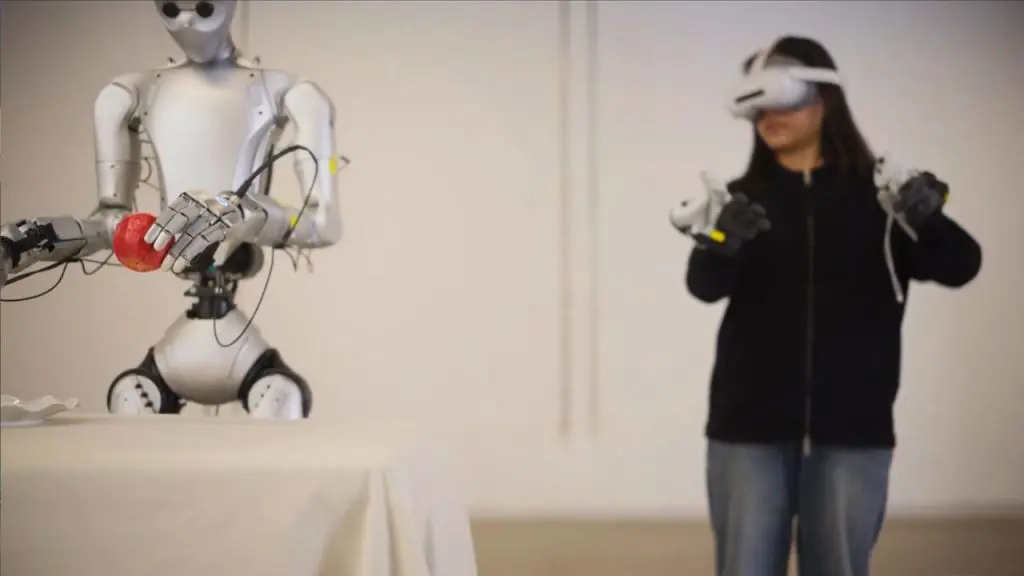
The company also lowered the barrier to full-sized humanoids with its H2, introduced in October 2025 with a listed starting price just under 30 grand. Nvidia went on to choose the H2 as the foundation for its first reference humanoid, pairing it with the Singaporean firm Sharpa’s highly dexterous five-fingered robotic hands.
US Panic
In the US, concerns about Unitree’s rapid ascent grew in early 2026 after the company’s most electrifying Spring Festival Gala performance yet. As a G1 dancing troop stunned celebrity judges on the season 21 premiere of America’s Got Talent, bipartisan proposals to restrict Chinese robots moved through the House and Senate.

The crowd-pleasing performance went viral across social media along with clips of G1 humanoids accidentally striking children in China. American robotics companies like Boston Dynamics, Agility Robotics, and Standard Bots lobbied in support of restrictions. Executives from the robotics firms said Beijing subsidies of Unitree and other humanoid manufacturers make it impossible to compete on price.
“Unitree is rapidly capturing market share in the US university research and law enforcement markets. Researchers have reported crucial Unitree cybersecurity vulnerabilities,” Matt Malchano, BD’s VP of software, told a House Homeland Security subcommittee. “Unitree’s products have also been seen in PLA military exercises and its ties to Chinese military have been noted by the House Select Committee on China as well as the Department of War.”
In submitted testimony, Boston Dynamics called Unitree’s growing stateside presence a threat to national security, pointing to a meeting in February 2025 during which Wang sat across from President Xi.
Ultimately, the FCC effectively banned new and previously unauthorized foreign made robots before the legislative process played out.

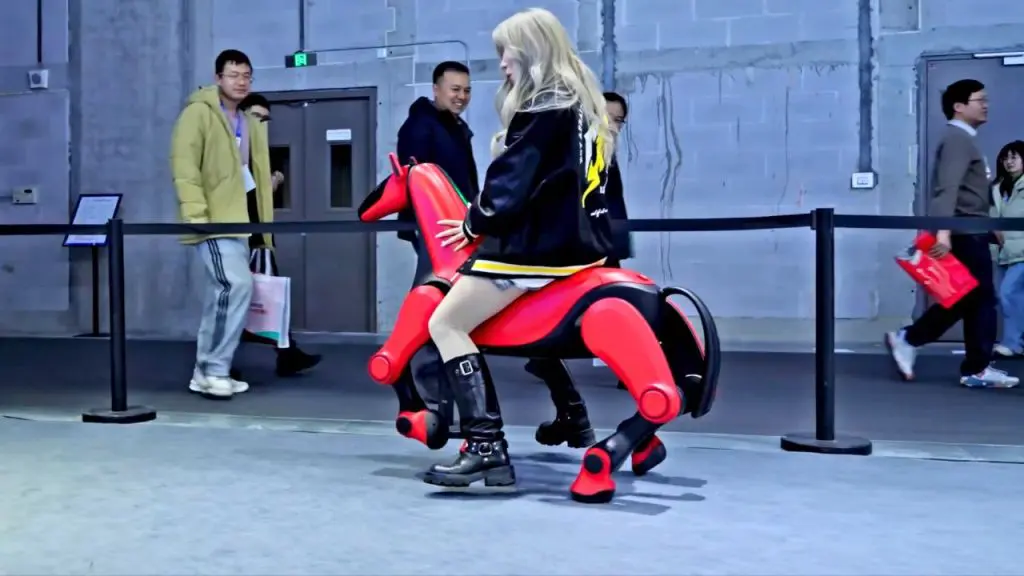
Unitree, however, could be considered an unintended beneficiary because it had already gone through the FCC authorization process for most of its products, including its flagship full-sized and compact humanoids and its robotic dogs. It potentially gives it at least a temporary advantage over Chinese competitors and even newer foreign entrance that now face a much harder path to market in the US. Unitree’s GD01 $650,000 ridable mecha, however, didn’t make the cutoff.

Blockbuster IPO
The FCC’s move had little apparent impact on Unit’s initial public offering on the tech-heavy Shanghai STAR Market.
In IPO disclosures, the robotics firm acknowledged it’s a meaningful risk in the long-term because the American market accounts for nearly 20% of its revenue in some reporting periods and warned that future robot models could have trouble getting regulatory approval.
Regardless, investor demand was extremely strong. Unitree’s listing was reportedly more than 8,000 times oversubscribed by retail investors, valuing the company at around $9 billion. The fellow Hangzhou-based technology disruptor DeekSeek invested about $21 million for a 2.1% stake.
“Entering the capital markets is a new starting point for Unitree Robotics,” Wang said during Unitree’s IPO roadshow in Shanghai. “In the future, we will stay true to our original mission to steadily refine key technologies and continue investing deeply in general embodied intelligence and core robotic components.”

Wang’s nearly 24 percent direct stake in the company is worth a reported $2.1 billion on paper, effectively making the 36-year-old a multi-billionaire. Some reports have claimed the deal makes Wang the first Chinese businessman to reach billionaire status from a humanoid robotics firm. But UBTECH founder Zhou Jian appears to have crossed that threshold earlier. When his company entered the Hong Kong Stock Exchange (HKEX) in December 2023, his stake was valued at more than $1 billion.
Wang himself has mostly avoided discussing his personal fortune, instead directing comments toward Unitree’s technological ambitions. Surprisingly, little is known about his personal life. But in a dating app profile linked to him, he reportedly seeks a sincere, kind, tech literate partner who doesn’t smoke or drink.

In a recent cover story, TIME Magazine described the founder as reserved and cautious about hype compared to other high-profile players in the humanoid race like Elon Musk and Figure AI founder Brett Adcock. He shares their views about the potential of humanoids transforming human civilization by taking over large amounts of physical labor. And he credits Musk with kickstarting the ongoing humanoid frenzy when he announced Optimus back in 2021.
He’s much more cautious, warning that expectations surrounding general-purpose robots can get ahead of what’s actually possible. He told TIME that going public creates a fair amount of pressure on Unitree and the broader industry because investors and the public now expect major progress at an unrealistic pace.
AI Focus
Unitree’s most recent demos have been far less dramatic than its earlier acrobatic and sci-fi inspired showcases. This footage, for example, shows the G1 running on Unitree’s Unifolm language action model designed to understand multimodal instructions and autonomously carry out a range of home care and wellness tasks despite disturbances.

Wang has said his biggest regret is not focusing more on AI software earlier in Unitree’s journey. The company built its reputation on hardware, but now it’s earmarking at least $280 million from its IPO proceeds for AI development with direct involvement expected from its partner DeepSeek.
The rest will go toward improving hardware, launching a new generation of products, and scaling production. Unitree’s planned manufacturing base has reportedly been designed to eventually produce more than 75,000 humanoids and 115,000 quadrupeds.
Chinese IPO Wave
Wang, who serves as Unitree’s chief executive and chief technology officer, seems very aware that competition is intensifying and he does not consider it a given that Unitree will stay ahead. Chinese rivals like UBTECH, Fourier, and EngineAI are scaling quickly while Western competitors are getting showered with fresh funding.
The biggest thorn in its side might be Shanghai-based Agibot, which has already passed Unitree in sheer humanoid volume this year, reporting around 8,400 shipments in the first half of 2026 compared to Unitree’s 5,900. However, Agibot’s figures include wheeled dual arm robots, while Unitree’s are exclusively bipeds.
Unitree’s entry into the public markets is the beginning of a wave of expected Chinese robotics IPOs as companies race to raise the enormous amounts of capital needed to stay competitive. Following Unitree on Shanghai’s NASDAQ-style board is fellow Hangzhou-based firm DEEP Robotics, which was spun out of the same institution that wouldn’t give Wang the time of day. Read all about the company’s plans right here.