
In 2025, AI-powered humanoid robots are learning to fight back.
Leading Chinese robotics firm Unitree’s G1 is leading the charge, demonstrating Kung Fu abilities after a year of getting picked on by its creators.
Teaching a robot martial arts has practical applications beyond entertainment. Practicing karate stances helps robots keep better balance and recover from external forces. Quick footwork drills improve a robot’s ability to react in emergency situations and on rough terrain.
Learning martial arts helps refine a robot’s ability to move more naturally, making their interactions with real people more intuitive. In the future, AI robots could be used as sparring partners for martial artists, in gyms for training, and physical rehabs to demonstrate proper techniques safely. For public safety and military applications, the maneuvers could prove useful to neutralize threats without excessive force.

Robots that learn martial arts can also apply their training to other complex motor skills like surgical procedures and precision assembly. Training AI in controlled combat scenarios helps develop better prediction models for robots to thrive in dynamic environments.
Martial arts training can also reduce wear and tear in industrial applications by making movements more fluid.
Unitree Robotics, established in 2016 in Hangzhou, introduced the G1 humanoid robot in May 2024. It’s a downsized version of the company’s full-sized general-purpose humanoid robot, the H1. Standing 127 cm (4’1″), the G1 weighs about 35 kg and boasts between 23 and 43 degrees of freedom (DoF), depending on the configuration.
The G1 robot has grown in popularity among researchers, developers and hobbyists after Unitree launched its mass production version last August. Its base model pricing begins at $16K.
The G1 introduced itself to the world wielding a baton, demonstrating its precise control and dexterous manipulation capabilities. Looking at the way the humanoid is treated by its creators, you can’t blame the G1 for wanting to protect itself.
Since its introduction, the G1 has become more and more athletic.
Unitree says updates to its training algorithm have enabled its robots to quickly learn dynamic, human-like movements.
Unitree’s humanoid and quadrupedal robots learn within Nvidia’s Isaac Simulator. They begin their training in a virtual environment, meaning they don’t need to physically exist yet to start learning. A digital twin of a robot observes human movements through motion and video data and reinforcement learning. The learned behaviors are then transferred to the physical robot with a process called Sim2Real, short for Simulation to Reality.
Fresh off a viral performance featuring 16 full-sized H1 humanoids during China’s Spring Gala event, Unitree started showcasing the smaller robot’s ability to bust a move. After skeptics questioned whether the dancing was computer graphics, the robot moved on to martial arts.
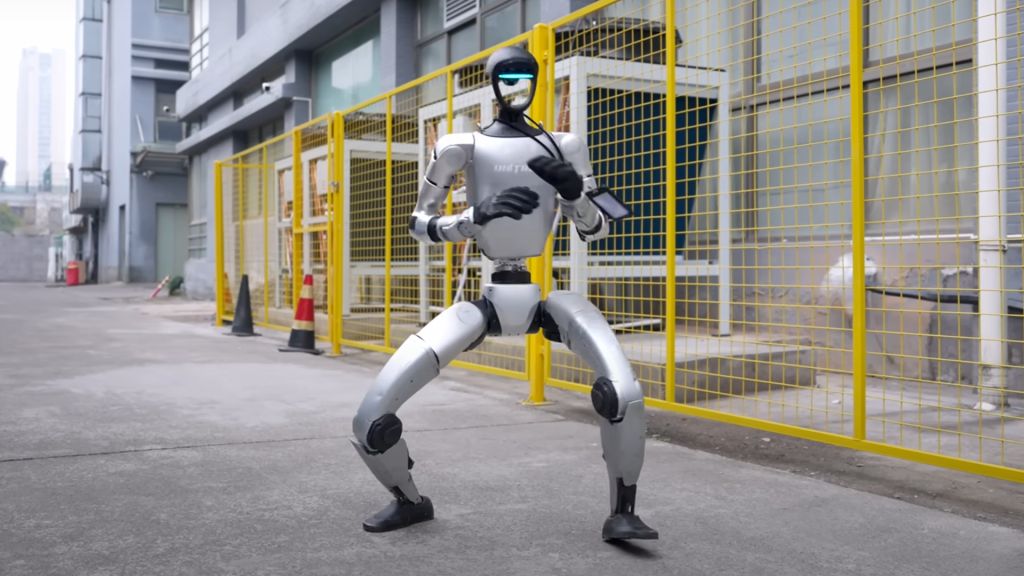
The humanoid robot has demonstrated the ability to perform moves like punches and roundhouse kicks while maintaining balance. The robot slips at one point but quickly recovers. Now the robot is learning to better protect itself against attacks.
In a short demo Unitree just shared, the G1 pulls off a 720-degree spin kick. The robot demonstrates its advanced agility and adaptability as it’s attacked with a stick. The company urged its followers on social media to not attempt at home.
The robot performs the moves in front of glass doors and windows, with reflections that would be very challenging to make with CGI. This is likely intentional to pre-emptively address skeptics.
Unitree is positioning the G1 as a general-purpose humanoid for domestic and industrial tasks.
In a video by GPU maker Nvidia, Unitree Robotics co-founder Ackles Chen said the Hangzhou company’s humanoids are designed to handle dangerous, dirty, and boring tasks in diverse settings across factories, hospitals, and households. He said Unitree’s ultimate vision is for humanoid robots to become everyday companions at home and at work.
A G1 humanoid also just showcased its social capabilities in this footage from the state-run China Global Television Network. It didn’t attempt any martial arts moves. A G1 robot also showed restraint when a TV reporter pushed it while covering a recent event.

Unitree is a perceived leader in China’s rapidly expanding humanoid robotics market. The robots are advancing at an accelerated pace as the Chinese government aims to scale mass production of humanoids in 2025 and rule the market by 2027.
Though the Unitree G1 is gaining a reputation for its fighting abilities, robots have been learning martial arts for years.
In 2014, researchers from the Florida Institute for Human and Machine Cognition attempted to train an Atlas humanoid robot from Boston Dynamics martial arts moves. They programmed the robot named Ian to mimic the iconic crane kick from The Karate Kid. As noted by Wired at the time, the robot wasn’t nearly as nimble as Daniel-san.
Boston Dynamics has since introduced a slimmer and fully electric version of Atlas Though it’s demonstrated industrial tasks and the ability to backflip, it hasn’t shown an interest in martial arts quite yet.
In 2015, researchers at the Georgia Institute of Technology developed an algorithm for helping humanoid robots fall safely, incorporating techniques inspired by judo. Using the approach, robots could automatically determine the best sequence of contacts during a fall to dissipate momentum and reduce impact forces.
In 2016, Chinese industrial robot manufacturer Siasun Robot and Automation showcased the dexterity and agility of its seven-axis collaborative robots through a Tai Chee demonstration. A Tai Chee master guided two of the cobots through a series of fluid movements, impressing observers with their capabilities mimicking human motions.
More recently, Booster Robotics has shown its short humanoid robot intended for research applications performing Kung Fu moves. The Beijing-based robotics startup has outfitted its flagship humanoid to take a beating in the ring. In recent videos shared by Booster, the T1 withstands glass bottles to the head and sledgehammers to the chest. Despite the torrent, the robot keeps going.