
China’s lifelike androids are entering their mass production era.
Leading the charge is Shenzhen’s UBTECH Robotics, one of the world’s most well-funded humanoid companies that’s already dominating the industrial sector. It’s just one of a truly staggering number of firms riding the surging demand.
The lifelike androids are priced around $30,000 and require a $450 deposit to reserve on JD.com, yet the Shenzhen-based company reports more than 3,000 preorders in under a week.

The robots are dramatic departure for UBTECH, whose industrial humanoids have been deployed for giants like Airbus and Texas Instruments. The U1 series is part of the company’s newly established consumer sub-brand, UWorld.
It includes masculine and feminine variants. The male version stands 183 cm (6 feet), while the female is 168 cm (5 feet 5 inches). They both feature lifelike silicone skin, hair, and a reported 88 degrees of freedom (DoF) for humanlike motions, though they haven’t been publicly demonstrated beyond facial expressions.
Their batteries last up to 4 hours per charge. Unlike UBTECH’s flagship Walker robots, they can’t swap out their own batteries to operate 24/7. At least not yet.
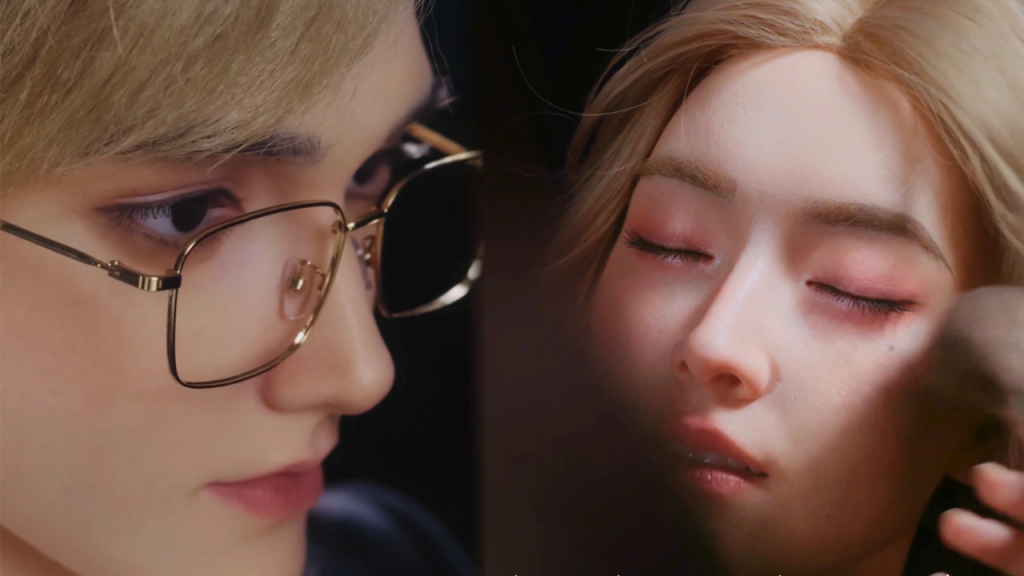
According to UBTECH, their artificial intelligence can recognize moods, personalize conversations, and supports local encryption for privacy.
UBTECH has ben exploring ultra realistic humanoids since at least 2025. The company showcased an ultra-realistic humanoid robot named Una in 2025 for service applications. They also demonstrated a male variant. At the time, UBTECH said the robot excelled at nonverbal communications.
The robotics firm, founded in 2014, initially focused on consumer-grade robots for STEM before expanding into industrial automation in recent years. The company has been pushing bipedal robots to market since at least 2018, when it launched its first Walker prototype at the Consumer Electronics Show in Las Vegas. A full humanoid version debuted the following year.
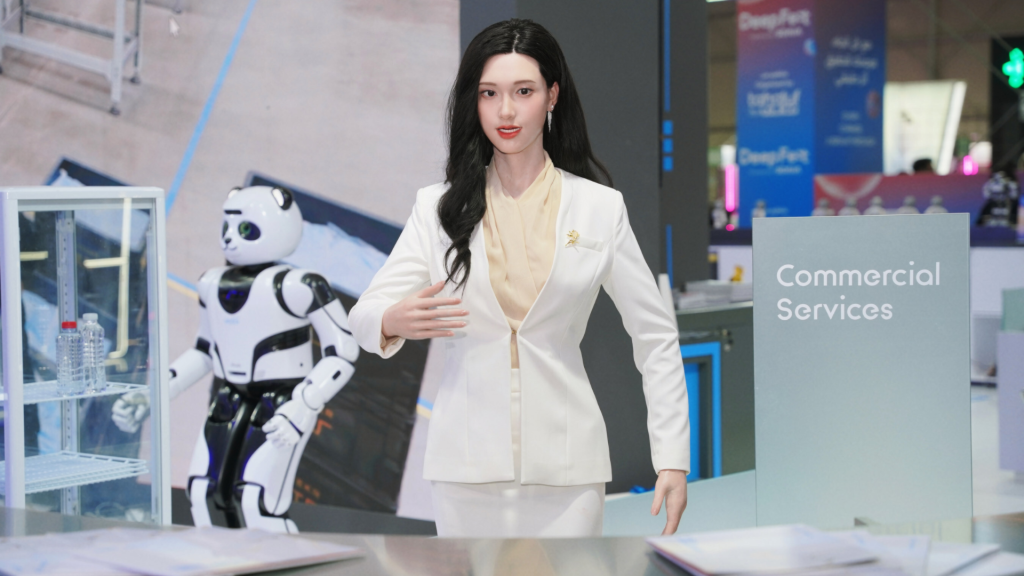
UBTECH was China’s pioneering humanoid company for several years and the first to go public, when it became listed on the Hong Kong Stock Exchange in December 2023. They initially targeted consumer applications but shifted toward industrial automation in recent years.
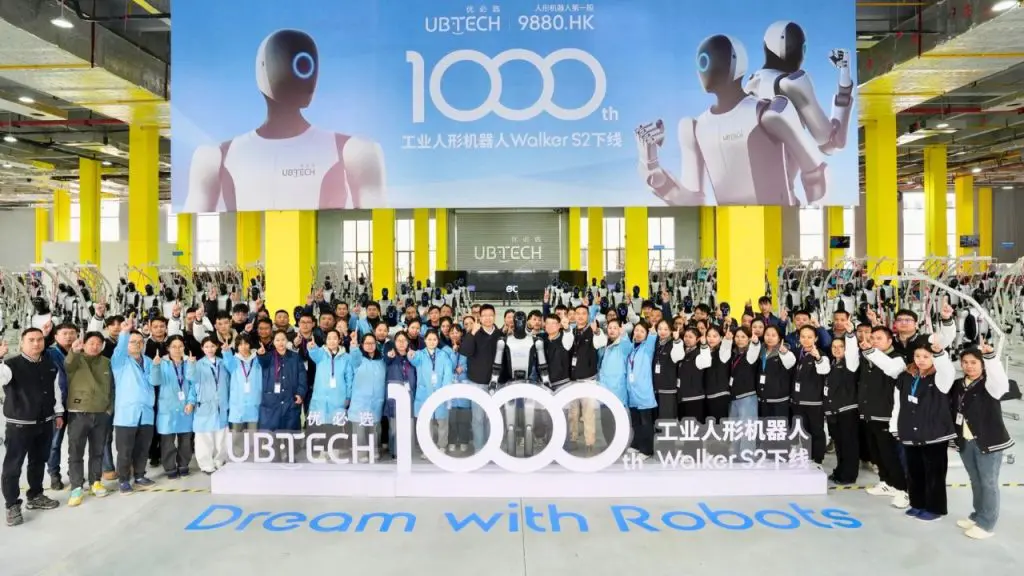
In 2025, the company reported shipping more than 1,000 humanoids, a massive scale up from just three the prior year. Today, UBTECH is one of the world’s most well-funded humanoid companies, but it faces stiffening competition in the mainland and abroad.
In the ultra-realistic humanoid niche, one of its biggest competitors is NOETIX Robotics, which was founded in Beijing just three years ago. Its female presenting bionic robot head, called Xiaoyue, recently sold at auction on JD dot com for over $15,000. It’s built on the firm’s Hobbs platform, the same technology used to create a replica of the veteran Chinese actress Ming Cai for a skit during the 2026 Spring Festival Gala.
The lifelike robotic head weighs 7.5 kg (16 lbs), which is roughly 50 percent heavier than the average human head. It boasts a reported 24 DoF for eerily humanlike expressions. Its main use cases include home companionship, front desk reception, customer service, and exhibition guidance at events and museums.

A wheeled version, the Hobbs W1, stands about a hundred and 70 cm (5 feet 7 inches), and features arms with 5 DoF and hands with six moving joints each for basic manipulation tasks. It’s currently available for purchase for around $73,000.
NOETIX is scaling production of its Hobbs platform as well as its compact budget humanoids after securing more than a hundred and $145 million in new funding earlier in 2026.
Another Chinese company that’s gaining international attention is Shanghai-based Aheadform, which was launched in 2024 by Yuhang Hu while he was earning his PhD from Columbia University.

Aheadform’s flagship products include the Origin F1, which features dozens of mini facial actuators for lifelike blinking, micro expressions, eye movements, and real time emotional responses. Aheadform has raised close to $30 million to scale its multimodal embodied interaction AI and biomimetic facial technology.
Also in Shanghai, DroidUp is preparing the commercial launch of its viral lifelike humanoid named Moya. The startup, launched in 2021, calls it the world’s most biomimetic humanoid robot.

DroidUp claims the android has a walking gait that’s 92 percent similar to a human’s motions. Standing 165 cm (5 feet 5 inches), Moya reportedly weighs just 32 kg (71 lbs). According to DroidUp, it has silicone skin with internal heating, so it feels warm to the touch like a real human body. Pricing is expected to start around a $165,000.
Other notable players in China’s synthetic human niche include:
- Hefei-based Anywit Robotics, which developed a robotic pop singer named Annie by mounting one of its expressive head modules onto the body of a Unitree G1.
- Shenzhen’s DIGIT Robotics, which is commercializing its hyper-realistic humanoid named Xialan for use in places like corporate offices and exhibitions.
- The Chery subsidiary AiMOGA Robotics, whose female presenting humanoids are being deployed at auto dealerships and as traffic officers.
- and the Dalian firm EX Robot, which is scaling production of its service-oriented humanoids that are priced starting around $150,000.

In the West, one of the main players in the lifelike humanoid niche is Las Vegas-based Realbotix. The company, which was born out of the decades-old lifelike doll maker Abyss Creations, is reporting inroads as it pushes its humanoids into the working world. It’s working with the telecommunications provider Ericsson on deploying its flagship humanoid Aria in service roles across Texas, Spain, and Portugal. Its products range in price from $20,000 for an android bust to more than $125,000 for a full-bodied variant.
And in Japan, the legendary roboticist Hiroshi Ishiguro is working with the leading Chinese robotics firm Unitree to commercialize his long running android research. Read all about his vision for a robot-run future right here.