
A year ago, Tesla’s Optimus was widely seen as the clear frontrunner in the humanoid robotics race.
Elon Musk’s ambitions of producing millions of units and reshaping the labor market generated excitement from investors and tech enthusiasts. Few other companies had full-scale robotic humanoid prototypes that looked commercially viable, and none of them possessed Tesla’s track record in artificial intelligence and manufacturing.
Investors and the media assumed others would be playing catch up for years.
Fast forward to today and that’s not so clear. Companies like Boston Dynamics, Agility Robotics, Apptronik, Figure AI, and 1X Technologies have gained traction as they move their AI-powered humanoids into real-world operations.
And China has unleashed a slew of humanoid robots that are getting hard to ignore, as perceived leaders like Unitree Robotics, EngineAI, UBTECH Robotics, and AgiBot move to mass produce their AI robots. XPeng Motors, a rising Tesla competitor, is currently showcasing its next-generation humanoid robot at the Auto Shanghai 2025 exhibition.
Elon Musk’s deepening involvement in politics has significantly altered public perception of Tesla and its robotics ambitions. Once celebrated for innovation and environmental stewardship, Tesla now faces criticism and declining support from sizeable segments of its traditional customer base.

During Tesla’s first-quarter 2025 earnings call, Musk addressed the company’s financial downturn and the impact of his political involvement on Tesla’s brand and performance. The manufacturer reported a 71 percent drop in income, a 9 percent decline in revenue, and a 13 percent decrease in vehicle deliveries.
Acknowledging that his unofficial role with the Department of Government Efficiency (DOGE) has caused a turbulence, Musk said he intends to significantly reduce his time with DOGE starting in May. But investors worry it might be too late to reverse course as Tesla’s brand is no longer perceived as invincible.
Tesla still expects to build thousands of Optimus humanoid robots by the end of 2025, but most of that production will occur later in the year.
Musk said the Tesla Bot faces a typical new-product production ramp. It’s constrained by the slowest component in a large list of around 10,000 unique parts. The production volume depends on how fast Tesla can solve bottlenecks, which has been made more challenging with the Trump administration’s trade war with China.
Musk had broken with the president on tariffs and the White House’s trade policy toward the People’s Republic. He reportedly made personal appeals to Trump to reverse sweeping tariffs, highlighting the negative impact on Tesla and other manufacturers. He also bashed Trump’s trade advisor, Peter Navarro, calling him a “moron” and questioning his qualifications.
Tesla has acknowledged that evolving trade policies and rising tariffs are creating uncertainty and affecting its global supply chain. The company reported a 20 percent year-over-year decline in automotive revenue, attributing part of the downturn to the adverse effects of tariffs.
The trade war has also affected Optimus.
The humanoid robot needs rare Earth magnets from China to work properly. The magnets are used inside small electric motors within the Tesla Bot’s arms. They help make its arms strong but still lightweight and compact.
The Chinese government enacted new rules for exporting the magnets in 2024 that require special licenses, especially for anything that might be used in the military. The policy has also hit US-based drone manufacturers, which maintain limited inventories of the materials.
Tesla ran into problems because Chinese officials were concerned that Optimus could become weaponized. Musk said he’s working to clear things up, explaining that the Tesla Bot is not intended for military applications. It’s being developed for factories, homes, and other everyday uses.

Delays and higher costs are possible if the rules slow down shipments or if Tesla has to source the magnets from somewhere else.
Musk said Tesla plans to scale Optimus faster than any product in history, targeting 1 million units by 2030 or sooner. The company aims to build at least 5,000 of the robots by the end of the year, which will be put to work in Tesla’s factories.
Tesla plans to broaden their availability in 2026, with the automaker’s employees getting first access. Musk predicts that the humanoid robot will be Tesla’s most impactful and profitable product by far.
Tesla is positioning Optimus as a general-purpose robot that can do everything from household chores to social companionship. It uses the company’s real-world AI to understand and react to its surroundings.
Tesla first announced its humanoid robot concept during the company’s 2021 AI Day event. A dancing imposter in a costume joined Musk on stage during the announcement.
The first Optimus prototype emerged the following year and in 2023 the manufacturer unveiled a second-generation iteration with a slimmer design, improved hands, and more human-like movements. Tesla is developing the next-generation version which will be designed for high-rate manufacturing.
Meanwhile in China fellow EV maker Xpeng’s humanoid robot named IRON is emerging as a potential top competitor to the Optimus. Xpeng is showcasing the robot’s improved walking capabilities at Auto Shanghai 2025.
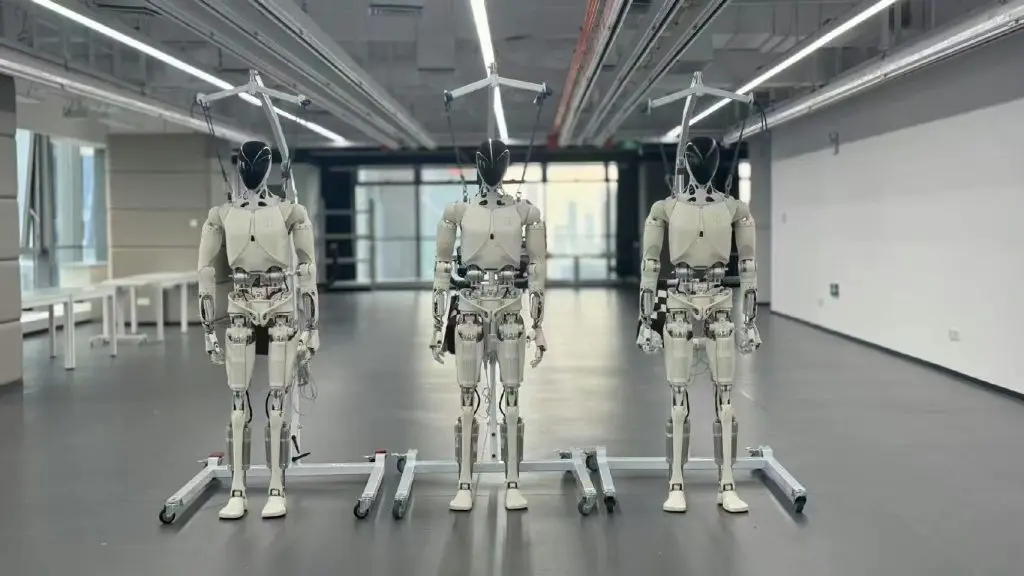
Like the next-generation Tesla Bot, Iron has a reported 22 degrees of freedom (DoF) in its hands, which nearly match the dexterity of human hands which typically have 27 DoF.
At the show, the robot also demonstrated its conversational abilities powered by Xpeng’s smart cockpit AI. IRON runs on Xpeng’s proprietary Turing AI chip , a 40-core processor that can handle up to 30 billion parameters. The automaker is training the robots in its factory, where they help assemble EV components and autonomously navigate the production floor.
The robot boasts 60 articulating joints, 200 DoF, and a 720-degree AI vision system adapted from the carmaker’s self-driving technology.
Like Tesla, Xpeng plans to begin mass production of IRON in 2026, positioning it as a general-purpose robot for factories, offices, retail stores, and homes. XPeng is reportedly considering investing nearly $14 billion into its humanoid robotics program over the next two decades.