
Skyborne Technologies’ killer robodog just moved closer to the frontline in a new US military testing program.
Skyborne says its CODIAQ armed quadruped has received a limited safety release from the Department of War. That means the Pentagon has reviewed the robotic dog enough to allow controlled military testing.

The defense tech company, which has headquarters in Australia and Virginia, has secured $6.5 million to supply the US military with 14 quadrupeds and 28 weapon attachments. Add-ons they’ve demonstrated so far include a CHAOS 10-shot 12GA shotgun and a HAVOC 5-shot 40mm grenade launcher. They’ve also committed to 24 months of sustainment, including hardware support, maintenance, and services.
According to Skyborne, delivery is planned as a total package fielding event in 2026 to support evaluations requested by multiple USSOCOM tactical units.
CODIAQ stands for Controller Operated Direct Action Quadruped. The modular armed ground robot is built on Ghost Robotics’ Vision 60 platform, with payloads that can be swapped in under 90 seconds and Skyborne’s Exitus AI targeting software.
Militaries around the world are training robotic dogs for the future of war.
In China, Hangzhou-based Wuba Intelligent Tech is accelerating the production of its RoboWolf quadrupeds showcased during the People’s Liberation Army’s 2025 Victory Day parade after recently securing around $69 million in funding. WuBa is backed by NORINCO Group, a state-owned defense conglomerate.

Elsewhere in Asia, the South Korean government reportedly wants Hyundai to supply its army with AI-powered robots, including the world-famous Spot from its subsidiary Boston Dynamics. They’re wanted for frontline surveillance, logistics, and support due to severe troop shortages.
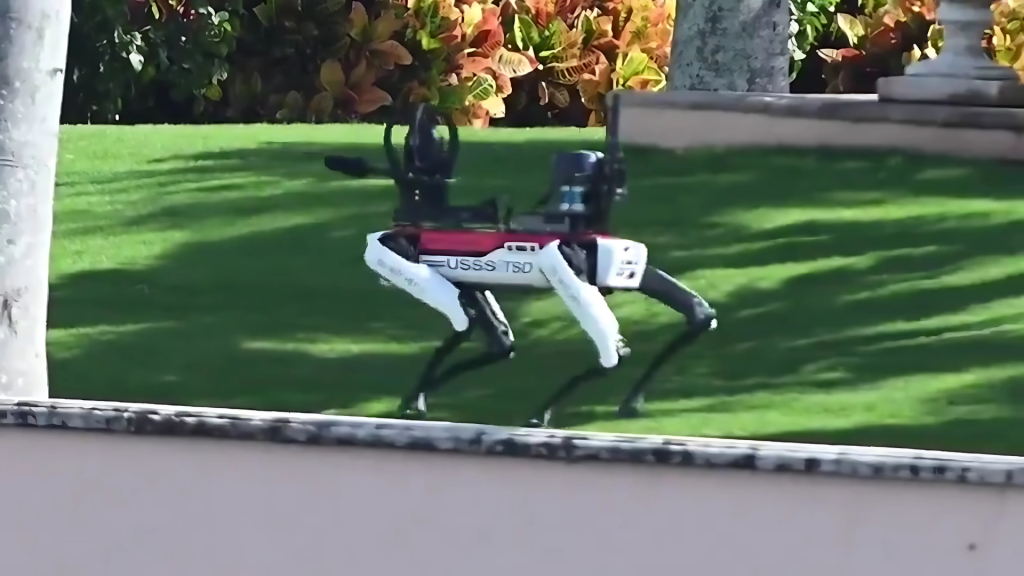
Boston Dynamics originated as a DARPA-funded lab but has moved away from defense and toward industrial applications. The Massachusetts robotics leader signed an open letter in 2022 alongside Unitree Robotics, Agility Robotics, ANYbotics, and others pledging to not support lethal use case. Unitree’s four-legged robots have been seen in military training for the People’s Liberation Army, Ukraine, and the US Marines but the Hangzhou-based firm insists the modifications are unauthorized.
The deal with the Korean army, if it materializes, could fit into BD’s 2022 pledge if the robots are unarmed. South Korea is rapidly expanding its fleet of UGVs with mobile platforms that integrate with machine guns, autocannons, missiles, and anti-drone systems. BD has also been lobbying the Trump Administration to incense federal support for the US robotics sector as it struggles to keep pace with Chinese rivals like Unitree, UBTECH, and Agibot. It’s really hard to imagine them turning down a request from the DoW if it’s framed as imperative for national security.