
Smartphones just got legs.
Researchers from UCLA’s Robotics and Mechanisms Lab (RoMeLa) developed PhoneBot as an open-source platform that uses ordinary smartphones as robot brains. Their goal was to prove that smartphones contain most of the tech required to control a walking robot with their embedded cameras, motion sensors, wireless connectivity, and powerful processors. They propose PhoneBot as a cost-effective entry point into humanoid research.
“The adoption of humanoid robots in education and research remains limited by high hardware costs, complex sensing systems, and substantial computational requirements,” they wrote in their paper, PhoneBot: A Low-Cost Open Humanoid Robot Platform Reusing Smartphones. “By using a smartphone’s integrated measurement unit (IMU), camera, wireless connectivity, and onboard processing capabilities, PhoneBot reduces hardware costs and simplifies the system architecture.”
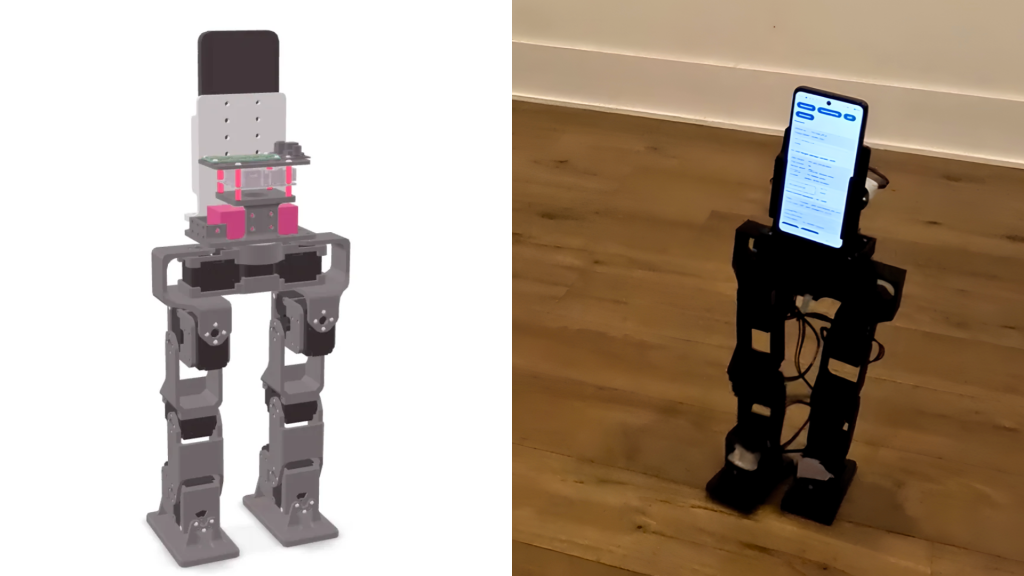
They tested the robotic legs with four Android phones, including a Chinese Honor 9 from 2017, to show that even older devices can power bipedal simple robots. The other devices they used were a 2024 Motorola Moto G, a 2025 Motorola Moto G, and 2024 a Samsung Galaxy A16 5G.
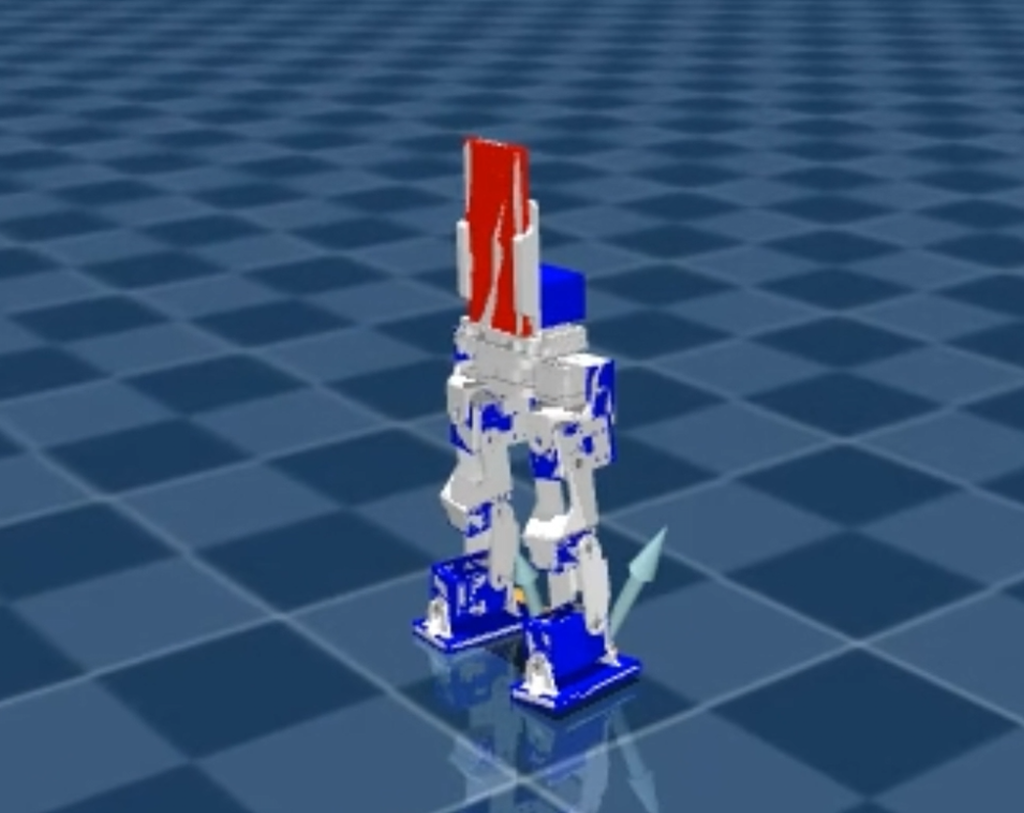
The research team trained PhoneBot in simulation using Google’s MujoCo physical simulator. The robot’s digital twins experimented with techniques for natural walking and getting onto its feet using reinforcement learning. The learned behaviors were then transferred to the real robot through a process called Sim2Real, short for Simulation to Reality, and refined.
In physical reality, 12 ROBOTIS DYNAMIXEL servos power its legs, while a 13th rotates its waist. The actuators are the same kind of motors that Hugging Face and Pollen Robotics use for their popular Microduck, which went mega viral during NVIDIA CEO Jensen Huang’s keynote address during GTC 2026 Berlin.
PhoneBot stands 48 cm (1 foot 7), weighs 1.8 kg (4 lbs), and costs about $400 to build excluding the phone. The phone’s camera, motion sensors, and processor handle perception and AI powered movement. Commands are sent over Wi-Fi.
The researchers released the robot’s mechanical designs, 3D-printable components, BOM list, and assembly instructions under a noncommercial Creative Commons license.
RoMeLa is led by Professor Dennis Hong, one of the creators of the pioneering DARwin-OP platform, one of the first widely adopted open-source humanoid research platforms.