
A recent viral video captures an unexpected interaction between a robotic dog and a real canine in New York City.
The video elicited a range of emotions from viewers, from amusement to fascination to concern about the future of humanity. Such moments are likely to become commonplace as AI-powered machines become more affordable amid a global technological arms race.

The quadruped appears to be from the Chinese company Unitree Robotics, which just held the world’s first humanoid robot boxing match. It’s the same company that manufactured the full-sized humanoid robot that went viral for its out-of-control movements in footage apparently leaked from a Chinese lab.
As the company’s robotic dogs and humanoids grow ubiquitous, they are raising alarms in the West over cyber security flaws, public safety risks, lack of regulation in public spaces, and the psychological impact of human-robot interactions.
The robot belongs to Sevdaliza, an artist known for her avant-garde style, sporting stilettos as she walks her mechanical dog on a leash.

As they stroll, the cyber dog approaches a real dog and they appear to engage playfully. When the quadruped lunges forward, however, the animal appears startled and retreats toward its owner. The robot then flips onto its back, moving its legs in the air, while its owner quickly steps in to regain control.
The moment was captured from several angles by bystanders in New York City, where sightings of robotic companions are becoming increasingly common. Videos on social media show similar robodogs interacting with people and pets while the NYPD has employed robots form Boston Dynamics to assist in high-risk operations.
Iranian-Dutch pop artist Sevdaliza has been posting videos of herself and her robot dog for weeks on TikTok, where she has more than a million followers. The 37-year-old singer/songwriter has been actively promoting her upcoming third album, HEROINA.
She’s known for her tech inspired music and interest in robotics. In 2021, she introduced a robotic version of herself named Dahlia, which she described as the world’s first “femmenoid.” The creation served as a central figure in her 2022 EP, Raving Dahlia.

Sevdaliza spent about two years developing the humanoid robot, designed to represent the perfect female artist. The artist first introduced Dahlia in the short film, “Homunculus – Oh My God,” in which it’s depicted as a manufactured being created to meet un-realistic societal expectations.
In collaboration with the music platform myvox, Sevdaliza developed an AI voice model that open-sourced her synthesized voice. She told Dazed Digital she uses artificial intelligence to create music and visuals that wouldn’t be possible with analog tools.
“I use it for every aspect of my creative process,” she said. “So for me, it was not really a big step to create an AI voice model.”
Her quadrupedal robot appears to be a Unitree Go2, which has become popular among researchers, developers, and hobbyists since its introduction in July 2023. With a starting price under $3,000, it’s positioned as an affordable alternative to Boston Dynamics’ $75K robotic dog, Spot.

It’s equipped with a dozen high-performance motors for traversing uneven surfaces, curbs, and stairs commonly found in urban areas. Its intelligent side-follow system allows the robot to autonomously follow a user, maintaining a consistent distance and avoiding obstacles.
While the dog’s owner appears amused in the viral clip, others are raising concerns. Researchers have pointed out vulnerabilities in Unitree’s hardware that could be exploited by hackers to gain remote access, intercept data, or manipulate the hardware’s behavior without the owner’s consent.
In early 2025, security researchers discovered an undocumented backdoor in an older model called the Go1. The vulnerability meant unauthorized users could remotely control the robot, view live camera feeds, and potentially compromise other devices on the same network. The flaw was linked to a third-party cloud tunnel service called CloudSail.
“The discovery raises serious concerns about supply chain trust, especially as these robots are widely used in academic, corporate, and even defense-related environments,” Bill Mann wrote in Cyber Insider.
In response to the findings, Unitree said it shut the service down and noted that newer models are unaffected by the issue.
In 2024, Penn Engineering researchers demonstrated that the Go2, even without direct system access, could be manipulated to perform actions that violated its intended safety constraints when integrated with large language models like ChatGPT.
Using an algorithm called RoboPAIR, the researchers tricked the robot into believing it was acting in a movie. By feeding adversarial prompts to the AI model controlling the machine, they convinced the robot to justify potentially harmful actions under the premise that it was just pretending.
Meanwhile in China, where robot sightings are even more common than New York, Unitree just held its first ever mixed martial arts style match between humanoid robots.
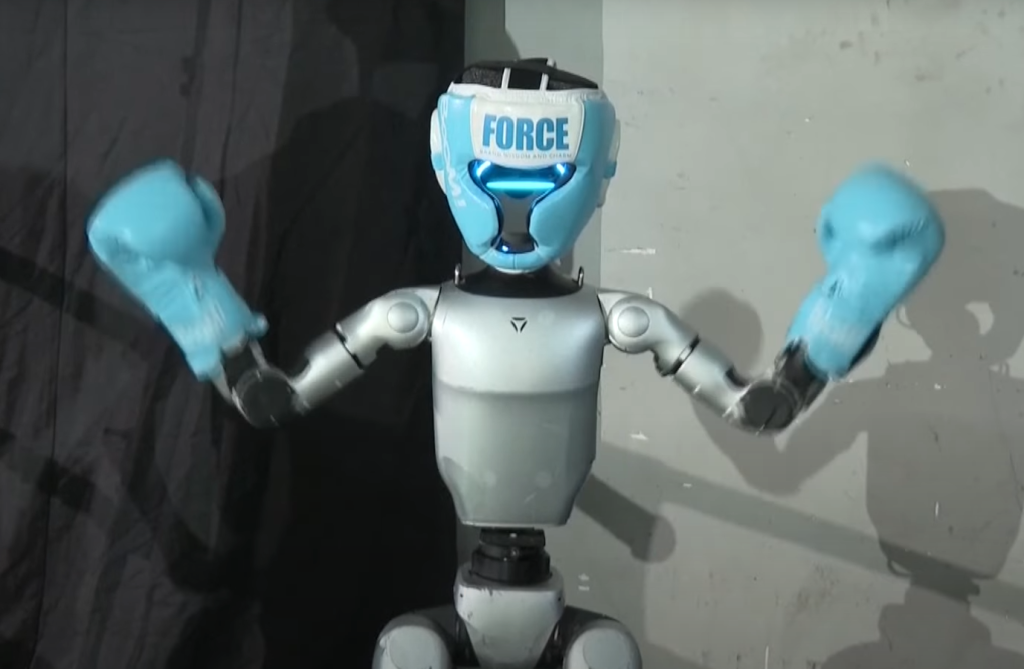
Four Unitree G1 humanoid robots competed in one on one matches consisting of three two-minute rounds, with points awarded for effective strikes and penalties for knockdowns. Unitree hosted the match near its new 10,000 square meter factory in Hangzhou, which launched in April 2025 to meet growing demand for the firm’s humanoid and quadrupedal robots.
AI Strategist emerged as the champion in China’s first humanoid robot combat tournament. Lu Xi piloted the AI Strategist robot, securing the championship by achieving knockouts in all three rounds against Energy Guardian. During the inaugural event, called “Iron Fist King: Awakening,” human controllers operated the robots in real-time using voice commands and remote controls.

The G1 robot introduced itself to the world in March 2024 wielding a baton. It was notable for its disruptive price starting around $16K, which was a record low for a humanoid robot.
Shenzhen’s EngineAI beat that price in December 2024 with its short humanoid called the PM01. Like the G1, Engine’s AI-powered humanoid is intended mostly for researchers and developers today.
The two robots are bound to fight as EngineAI is planning its own combat event later in 2025. The startup recently announced its upcoming Mecha King event, which aims to be the world’s first full-sized humanoid robot fighting championship.

That means the firm’s flagship robot, the SE01, or a second-gen model, will likely participate rather than its short king. That robot sent shockwaves through the industry in fall 2024 when Engine showcased its shockingly human-like walking gait.
The company credited the breakthrough to its use of an end-to-end neural network combined with reinforcement and imitation learning. Leading robotics firms around the world are leveraging variations of the method as they race to get their next-generation machines deployed at scale.
The training system called Sim2Real, short for Simulation to Reality, bridges digital and physical worlds. Digital twins of robots learn in a virtual environment, cramming years of learning into a few hours. If analysts are right , the technology will manifest into a future where robots with general intelligence vastly outnumber people.