
People want useful robots in their homes, and there’s no shortage of companies around the world dying to take their money.
For decades, AI geniuses have been trying to make household robots like Rosie from the Jetsons a reality but even today’s most advanced robots still get stumped by a laundry basket or slightly open drawer.
Homes are particularly problematic environments for AI-powered robots because no two are alike and they’re constantly changing. Robots generally struggle with vague commands and tasks that require multiple steps, which most home chores do. Still, analysts see a market potentially worth trillions, which is why there’s a global arms race to build the first truly useful home robot.
One of the most well-funded ventures attempting to solve this challenge, Silicon Valley-based Physical Intelligence, says its new AI model is a big step toward robots that can actually understand instructions, adapt to unfamiliar homes and get real work done. The startup says its new π0.5 model empowers robots to enter unfamiliar homes and start working right away.
Researchers tested the new π0.5 framework at three rental homes in San Francisco, where robots used the artificial intelligence to complete basic domestic tasks. Physical Intelligence calls the smart robot brain a “vision-language-action model with open-world generalization,” meaning it can see, understand instructions, and act in homes and situations it’s never seen before.

The robot follows simple commands like, “put the dishes in the sink.” It then figures out what steps to take and does them.
The startup stressed there’s a long way to go before models like π0.5 reach human-level adaptability, but it’s a major step toward truly general-purpose home robots.
“Our experiments show that this kind of knowledge transfer is essential for effective generalization, and we demonstrate for the first time that an end-to-end learning-enabled robotic system can perform long-horizon and dexterous manipulation skills, such as cleaning a kitchen or bedrooms, in entirely new homes,” the researchers wrote in their paper.
The AI is trained on a massive mix of real-world robot data, web images, language instructions, and high-level task sequences. The hundreds of hours of diverse training data give the robots the flexibility to understand natural instructions, adapt to new environments, and finish chores without needing retraining.
The robot brain works in two steps, similar to how humans think and then act. It uses its high-level thinking to plan actions. Its low-level thinking uses action tokens, which are short pieces of information that tell the robot exactly how to move its arms, hands, and base, step by step. The tokens are like building blocks for motion, helping the robot move smoothly and accurately in real-time.

According to Physical Intelligence researchers, robots using the model succeeded in the three real homes, completing multi-step chores like putting dishes in the sink, placing clothes in a laundry basket and organizing drawers. They reported high task completion rates across all homes. Even without training in those homes, the model scored similarly to a control model that had seen those environments before, suggesting strong generalization.
The robots performed 10-to-15-minute cleaning routines from single commands. Tasks like “clean the bedroom” triggered multi-stage behaviors such as pulling out drawers, picking up objects, and placing them correctly, all inferred on the fly. They turned vague commands into smart step-by-step actions. From prompts like “put the items in the drawer,” they generated accurate high-level subtasks.
The researchers also noted improvements as training grew from 3 to 104 homes, showing that the diversity of environments is key to learning general skills. The system outperformed both the original π0 model and a GPT-4 powered planner in completing high-level tasks, especially in messy or cluttered households.
Physical Intelligence emerged in 2024 and quickly gained attention for its AI-driven robotics approach. The startup’s valuation jumped to $2.4 billion after it secured $400 million in funding from the likes of Jeff Bezos, OpenAI, Lux Capital, and Thrive Capital.
Its mission is to empower robots in all settings to autonomously navigate the real-world and interact naturally with humans. Physical Intelligence plans to build on its foundational model as a growing array of companies race to get their AI-powered robots to consumers.
Another well-funded startup, 1X Technologies, plans to deploy its NEO Gamma humanoid robots in a limited number of homes in 2025. Their strategy centers on real-world testing, as founder Bernt Bornich believes robots learn best by doing.

The earliest testers are 1X employees who’ve shared clips of the robots performing chores on social media. By placing NEO Gamma into actual homes, the robots encounter the unpredictability of daily life, with cluttered rooms, weird requests, varying lighting conditions, and interactions with people.
1X plans to scale production of its humanoids in 2026, with a goal of manufacturing 100,000 units by 2028 and scale into the millions from there.
For early adopters, human teleoperators will likely stand in as a backup for full autonomy until the robots learn enough to operate on their own. They’re exploring using call centers where workers would remotely guide the robots in real-time, especially during complex or unfamiliar tasks. With this approach, the robots would learn from human demonstrators and gradually become more independent over time.
1X, which is headquartered in Sunnyvale and was founded in Norway, is also developing a generative world model trained on extensive sensor data collected from their robots. According to 1X, the model enhances decision-making by predicting outcomes of actions.
1X is competing with another Silicon Valley startup, Figure AI, which plans to start testing its humanoid robots in real homes this year. Figure initially focused on industrial applications, but founder Brett Adcock accelerated its timeline for home deployments by two years thanks to what he called rapid advancements in its self-developed AI model, Helix. The company unveiled Helix after parting ways with OpenAI.

Using the model, Figure says its robots can process visual data and natural language inputs simultaneously. This means the robots can adapt quickly to new actions without task-specific fine-tuning. Through reinforcement learning, Figure’s robots have also achieved more human-like walking capabilities, enhancing their adaptability in home settings.
In China, Shanghai-based startup AgiBot is also developing a general-purpose AI model for robots to understand and perform useful tasks with minimal training. The startup’s GO-1 model, short for Genie Operator-1, integrates a vision language model and a mixture-of-experts (MoE) system. The system is trained on AgiBot World, a large-scale dataset containing over a million real-world robot demonstrations across 217 tasks in five domains.
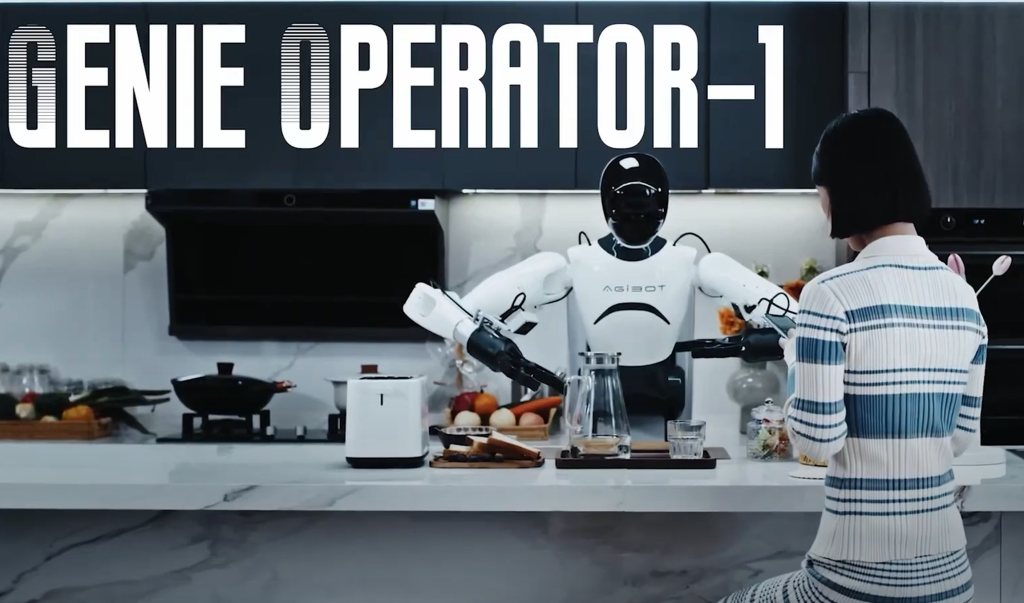
Founded in 2023 by former Huawei engineer Peng Zhihui, AgiBot plans to manufacture up to 5,000 humanoid robots in 2025. That’s the same number of robots Tesla aims to produce this year.