
Open-source robots are having a moment.
A $400 duck is selling like crazy as Chinese robotic crabs scuttle into the mainstream and a wave of relatively low-cost humanoids shakes up the robotics sector. As prices collapse and AI becomes more powerful, the first robots to get into the hands of ordinary people look nothing like what the industry expected.
KingKong’s Jumper Crab
In China, a decade-old company that makes components for advanced robots is clawing its way into the global spotlight with its viral robotic crab.
Beijing-based KingKong Technology is best known for its magnetic encoders, which are tiny sensors that tell a robot how far its joints have moved to help it walk, balance, and handle objects accurately. Liang Zheng founded the firm in 2017 after setting up shop in Beijing’s Changping District the prior year. He initially set out to build complete robots but pivoted after learning how expensive and difficult sensors that control their joints were to obtain.

KingKong says its proprietary sensing tech, called Patterned Magnetic Encoder Technology, uses extremely compact, high-precision position sensors that resist dust, vibration, oil, and other environmental interference. Magnetic encoders are widely used in industrial robotics, electric vehicles, medical equipment, semiconductor manufacturing equipment, and increasingly humanoids.
KingKong has experienced rapid growth amid China’s physical AI boom as a truly staggering number of companies require the sensors needed to bring their humanlike machines to life. The startup’s annual encoder production reportedly rose from 40,000 units in 2024 to 300,000 the following year, a 650 percent increase. Its workforce also expanded from about 40 to 200 employees. KingKong is now targeted an annual production capacity of 2 million encoders after securing $14 million in Series A funding earlier in 2026.

According to the company, it serves more than 2,000 customers globally and is a supplier to over 80 percent of China’s humanoid robot makers. Its reported customers include Unitree Robotics in Hangzhou, XPeng in Guangzhou, Fourier in Shanghai, the Shenzhen companies UBTECH Robotics and Astribot, and Tesla. KingKong has also expanded into miniature robotic motors for hardware requiring precise movement.
The company got its first shot of virality in July 2026 when it introduced its open-source crab-inspired robot Jumper during the World Artificial Intelligence Conference (WAIC) in Shanghai. The robot, which is also known as Tiaotiao, is geared toward researchers, developers, students, and hobbyists,
It measures about 40 cm (15.7 inches) long and wide, stands 20 cm (8 inches) tall, and weighs just 1.8 kg (4 lbs). Its 3D-printed frame houses 22 movable joints with servos that make it walk on four legs, turn, jump, and dance. Its two front claws can pick up objects weighing 1 kg (2.2 lbs).

Each servo has two magnetic sensors that track movement and detect resistance. The 44 sensors help it control its joints more precisely as it moves at speeds of at least 0.5 m/s (1.1 mph) and jumps as high as 40 cm (15.7 inches). Its battery lasts about 2 hours per charge. Jumper uses a 5-megapixel camera and a depth sensor to perceive its surroundings and recognize objects. They feed its onboard AI, which runs on an 8-core Rockchip RK3576 processor that’s made in China.
KingKong released its development software on Github in late September so people around the world can experiment with a virtual replica of Jumper using the physics simulator program MuJoCo. The robot’s software is also compatible with AI coding assistants so developers can use simple written instructions to create new walking patterns, dance routines, virtual environments, and custom appearances.
In a recent discussion on Reddit, an account representing Jumper’s developers said they’re moving as fast as possible to offer the robot commercially. Though it looks like a toy now, KingKong envisions uses in indusial inspection, environmental monitoring, and search and rescue. For now, the company is offering 100 Jumper engineering prototypes to select developers interested in creating new movements.
KingKong plans to develop an entire family of small robots including cats, dogs, and miniature humanoids.
MicroDuck Explodes
There’s clear consumer demand for open-source robots. Case in point: the runaway success of Hugging Face’s $400 robotic duck.
As of late October, the MicroDuck has surpassed 20,000 preorders after a viral appearance with NVIDIA CEO Jensen Huang during GTC Berlin 2026. Brooklyn-based Hugging Face, often described as the GitHub of open-source AI models, launched the MicroDuck in four colorways in August shortly after news broke that NVIDIA planned to buy the firm for nearly $13 billion.

The robot, developed in collaboration with Hugging Face’s French subsidiary Pollen Robotics, was an instant hit. The companies reported more than 10,000 first-week preorders, but the latest surge exceeded that in 24 hours, putting revenue generated to more than $8 million.
To accommodate the unexpected demand, Pollen has struck a deal with the South Korean company ROBOTIS for 750,000 actuators to build 50,000 MicroDucks. The robotic duck’s mechanical design uses the company’s Dynamixel XL Series smart servos that are priced around $27 apiece. They now require a two-month lead time for online orders, likely due to the MicroDuck deal. Even with factory pricing, they’re likely selling the MicroDuck at near cost as a way to get thousands of new users into Hugging Face’s ecosystem.

The MicroDuck stands 25 cm (9 feet 8 inches), weighs under 800 grams (1.8 lbs), and has 15 degrees of freedom (DoF) in its legs, head, and neck. Its beak can pick up small objects and optional wheels make it faster.
The MicroDuck perceives its surroundings with a front camera and a small lidar depth sensor. Two motion sensors help it stay balanced and react to its environment. Its onboard AI runs on a Chinese Rockchip processor that delivers 8 TOPS of compute. According to its developers, the MicroDuck can do basic moves out the box while users can teach it new tricks in simulation.
Hugging Face and Pollen are working with the Chinese company Seeed Studio to ramp up production.
Reachy Mini Level Up
The Shenzhen-based firm is also the official manufacturing partner for Pollen’s Reachy Mini, a desktop robot that just got a major upgrade. The new edition, called Reachy Mini Level Up, adds a $149 hoverboard to the wireless version for a total price of $650. The lower-end Reachy Mini, which requires a wired computer connection, is $399.

The human-inspired companion stands 28 cm (11 inches) and weighs 1.2 kg (3.3 lbs). It uses a 6-DoF head, full-body rotation, and two animated antennas to communicate through movement. The Reachy Mini comes equipped with a wide-angle camera, four microphones, and a 5-watt speaker so it can see, hear, and respond to users.
Within a year of its debut, the Reachy Mini had reached about 10,000 units in the wild.
RoMeLa’s PhoneBot
There are also open-source designs that users can build themselves with 3D-printed parts.
At UCLA’s Robotics and Mechanisms Lab (RoMeLa), researchers built PhoneBot, whose AI runs on an ordinary smartphone. The lab is led by professor Dennis Hong, one of the creators of the pioneering DARwin-OP platform, one of the first widely adopted open-source humanoid research platforms.
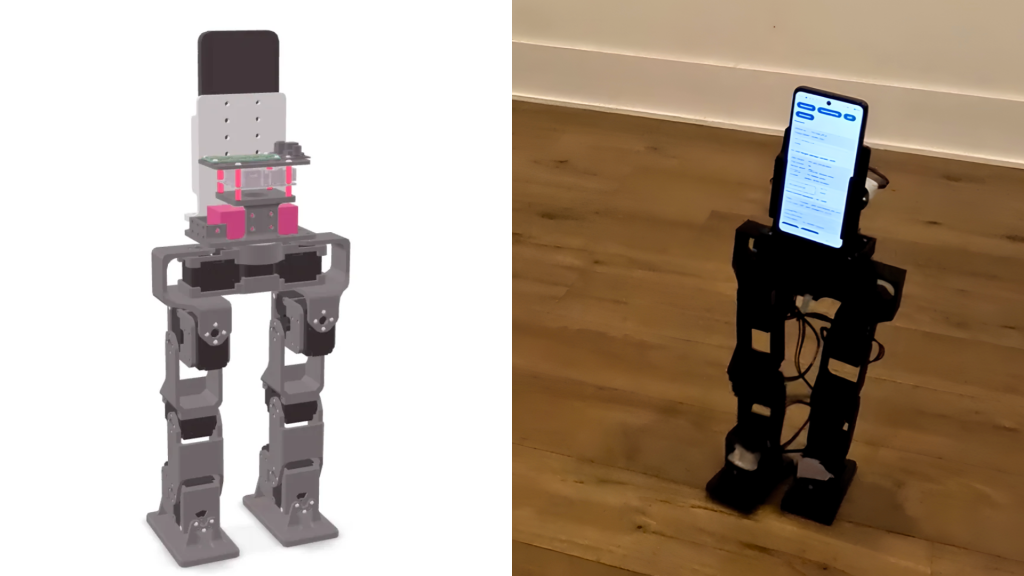
The team’s goal was to prove that smartphones contain most of the components required to control a walking robot with their embedded cameras, motion sensors, wireless connectivity, and powerful processors. They propose PhoneBot as a cost-effective entry into humanoid research with its bill of materials (BOM) around $400, excluding the smartphone.
They tested their robotic legs with four Android phones, including a Chinese Honor 9 from 2017 to show that even older devices can power simple bipeds. The other devices they used were a 2024 and 2025 Motorola Moto G and a Samsung Galaxy A16 5G from 2025.
The researchers trained PhoneBot in simulation using Google’s MuJoCo physics simulator. In physical reality, 12 Dynamixel sesrvos power its legs while a thirteenth rotates its waist.
Asimov Turns 1
A pricier option is Asimov from the Singaporean company Menlo Research. It’s named after Isaac Asimov, the legendary science fiction writer who came up with the Three Laws of Robotics. At $20,000, the robot is expensive by consumer standards, but it’s a fraction of what research-grade humanoids cost just a few years ago.
The team behind Asimov just celebrated the first anniversary of its development, which Menlo says began as a sketch on a napkin. Today, the open-source walking robot is available as a kit that’s shipping to customers in more than 20 countries. Menlo says it sold out of its initial 100-unit run.

Standing 1.2 meters (3 feet 11 inches), Asimov weighs 35 kg (77 lbs) and has 25 DoF. Asimov uses a Rasberry Pi5 and a Chinese Raxda CM5 for onboard computing.
It’s slightly shorter than Unitree’s G1, but about the same weight. The difference is that Unitree’s standard model does not support secondary development. Asimov costs less than half as much as Unitree’s higher-end EDU model for researchers and developers, but it comes as a DIY kit that takes about 20 hours to assemble.
Menlo has open-sourced Asimov’s designs, schematics, assembly instructions, and parts list. Developers can source the parts and build Asimov independently, though this requires technical expertise, access to custom-built components, and additional work to integrate the hardware and software.
Looking ahead, Menlo plans to outfit Asimov with more advanced robotic hands and better AI so it can handle tasks autonomously. Its long-term goal is to make it a modular platform that can be tailored for a broad range of real-world jobs.
RoboParty’s RP1
Another option is the RP1 from the Shanghai startup RoboParty.
It stands 135 cm (4 feet 5 inches), weighs around 40 kg (90 lbs), and has between 24 and 30 DoF depending on the configuration. According to RoboParty, it can run at speeds of up to 4 m/s (9 mph), climb slopes as steep as 30 degrees, and operate for 3 hours per battery charge. It’s stronger than open-source humanoids in its class with its custom joints that can generate up to 160 Nm of torque.

During IROS 2026 in Pittsburgh, RoboParty invited attendees to kick and shove the robot to show how it can maintain balance during disturbances.
The platform has four head configurations that prioritize locomotion, human interaction, data capture, and perception. It also integrates with popular five-fingered hands from Inspire Robot and Linkerbot as well as RoboParty’s self-developed end effector.
The startup, launched in February 2025, is working toward commercial production of the RP1, which will reportedly be priced around $16,000.
Meanwhile in the US, Tesla says it’s officially begun scaling production of its Optimus humanoid robot. Read all about Elon Musk’s ambitious plans for the general-purpose helper right here.