
Norinco Group, the Chinese defense manufacturing giant, is training humanoid robots to become next-generation riot control officers as Beijing tightens its grip on public dissent.
As the Chinese government pushes to integrate humanoids into its military, Norinco appears to be leading the race to develop humanlike machines to serve alongside and eventually replace human soldiers.

Headquartered in Beijing, the state-owned conglomerate builds tanks, armored vehicles, artillery, ammunition, unmanned aerial vehicles (UAVs), missiles, and other military equipment as well as civilian products for use across industrial sectors. Although Norinco was formally established in 1980, its roots stretch back to the earliest years of Communist China in the 1950s, when the government built out a network of weapons factories to supply its army.
Norinco emerged from the industrial system as China reorganized its defense sector and began expanding its international weapons exports. The eight-year war between Iran and Iraq helped fuel Norinco’s early global expansion as the manufacturer became a major supplier for both sides.
Today, Norinco stands among the world’s largest defense manufacturers as is China’s leading producer of military land systems. Its international customers include countries across Asia, Africa, and the Middle East, with documented customers including Pakistan, Myanmar, Thailand, Bangladesh, Nigeria, Mali, Burkina Faso, and Niger. According to the Stockholm International Peace Research Institute (SIPRI), it ranked 11th worldwide in 2024 with about $14 billion in arms revenue.
It is the only manufacturer on the list with a known active humanoid robotics program. Norinco’s robotics research is spread across several subsidiaries and research institutes.

One of its most well-known programs is the Machine Wolf, more commonly known as RoboWolf, which was the only legged robot showcased during China’s Victory Day Parade in September 2025. Norinco’s Hangzhou-based subsidiary, WuBa Intelligent Tech, developed the underlying technology and is now scaling production for military and civilian applications.
WuBa launched in February 2022 with around $42 million in registered capital. It’s led by founder Cheng Peng, a Zhejiang University-trained engineer who previously worked in defense and aerospace research.

In March 2026, Chinese military media released footage of the WuBa Q20A robotic wolves conducting simulated urban combat. The robots’ developers created three specialized variants:
- Shadow handles reconnaissance, scouting ahead, identifying threats, and sharing info it finds with other units.
- Blood is an armed robodog for engaging targets and providing supporting fire.
- Pole transports equipment and supplies.
The newest variants reportedly reach speeds up to 15 km/h (9.3 mph), can carry up to 25 kg (55 lbs), and can be equipped with firearms, grenade launchers, and even miniature missile systems, depending on their assignments. According to China’s Military of National Defense, the robots can coordinate their movements together, identify targets, and aim autonomously, while human operators remain responsible for authorizing attacks.

WuBa, also known as 58 Intelligent Technology, is also developing a humanoid robot named Dasheng that’s geared toward industrial jobs. Its name translates to “Great Sage Equal to Heaven,” the title belonging to Sun Wukong, the Monkey King from the classic Chinese tale, Journey to the West. Public reports indicate it’s been under development since 2023, which is when the Chinese government set a national goal to mass manufacture humanoids by 2025 and to own the market by 2027.
The country already builds an estimated 95 percent of the world’s humanoids and expects to ship at least 100,000 by the end of 2026. About 10,000 of those are headed into the workforce, while the rest train for jobs, collect data, and act as high-end RC toys.
Many experts believe humanoids are still years, or even decades, away from matching human reliability in demanding environments like factories and battlefields. But one of the industry’s more cautious leaders, Unitree founder Wang Xingxing, says he now believes a major breakthrough could arrive sooner than he originally expected. Speaking at the 2026 China International Industry Fair in Shanghai, Wang said recent advances like OpenAI’s ChatGPT 6 (Astra) have him convinced that the so-called ChatGPT moment for general-purpose robotics could be just a year or two away.

In physical AI, that would be the equivalent of reaching artificial general intelligence (AGI), which would mean a robot could be put into a random scenario and figure out what to do just like a human.
If the accelerated timeline pans out, we could see humanoid robots serving alongside PLA soldiers sooner than later. The Chinese government is reportedly stepping up efforts to prepare humanoids for military use, though there have been no confirmed deployments or public demonstrations.
When it does happen, the robots probably won’t come from Unitree, which has publicly pledged to not support lethal use cases. The decade-old robotics firm’s quadrupeds have been tested by militaries from China, the US, and Ukraine, but Unitree insists the modifications were unauthorized.

Companies like Shanghai’s Agibot and Shenzhen’s EngineAI, the maker of the Terminator-inspired T800, are also unlikely candidates. Though their robots have appeared alongside police for limited public service and traffic control work, supplying combat-ready machines to the PLA would jeopardize their expansion into Western markets, which Beijing is eager to support.
A state-owned entity like Norinco is much more likely, especially since it’s already developing its flagship humanoid for military reconnaissance, security patrols, and other dangerous missions. Norinco first introduced its humanoid named Fuxi in November 2025 at the China International Import Expo (CIIE) in Shanghai alongside a smaller version called Fuxi Lite.

It got even more attention during the 2026 World Robot Conference (WRC) in Beijing, where a small fleet of the humanoids demonstrated riot control capabilities. Controlled by teleoperation, they wielded batons and shields marked with the words, “Fang Bao,” the Mandarin term for riot control. The robots could play a role in Beijing’s efforts to crack down on domestic protests, which have surged in recent years due to unpaid wages, housing disputes, and frustration with municipal authorities.
Hong Kong is another potential deployment area. The Chinese government has dramatically tightened its control over the city since the massive pro-democracy demonstrations of 2019. Hong Kong maintains its own police force, but the local government is accountable to Beijing within China’s constitutional system. City officials have reportedly allocated an additional $638 million to its 2026 national security budget, bringing its total funding to $2.3 billion.

The riot-control humanoids could also attract interest from foreign governments. Norinco already supplies police and security equipment to countries like Venezuela, Kenya, Bolivia, and Sri Lanka, which have been documented as using its gear for protest suppression.
Norinco showcased Fuxi at WRC as China’s state-run People’s Daily reported that it was named the lead organization of the new Central State-Owned Enterprise Robotics Innovation Consortium. The initiative unites more than 100 organizations to advance robotics research, development, and deployments.
Developed Norinco’s Beijing-based Zhongbing Intelligent Innovation Research Institute, the full-sized Fuxi stands 180 cm (5 feet 11 inches) and weighs about 85 kg (187 lbs). Its five-fingered hands reportedly have 6 degrees of freedom (DoF) each.
Norinco says Fuxi can recognize people, detect unusual situations, issue alerts, and coordinate with other robots similar to its RoboWolf quadrupeds. Its onboard AI has a higher-level system that interprets instructions and a lower-level system that controls its movements.
One of its standout features is called Shenwai Huashen, which translates to External Avatar. It allows a human operator to control the humanoid from a different location by copying movements in real time. Thanks to the low-latency system, the robot could enter service with limited autonomy and improve over time with real-world interaction data.
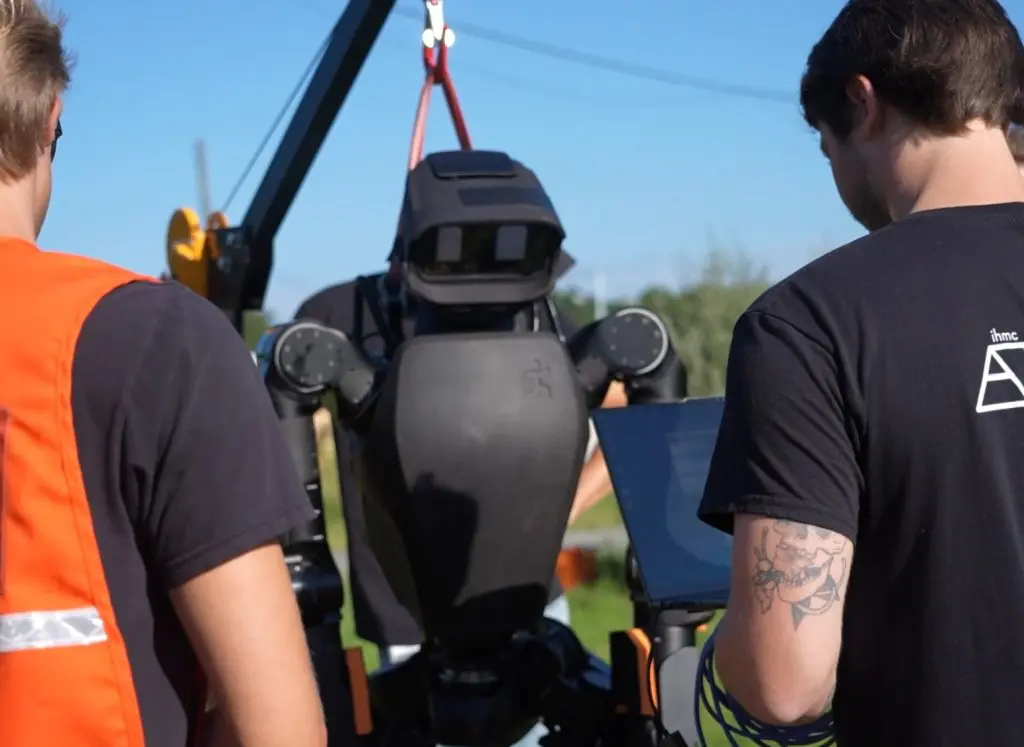
China’s aggressive moves to lead the world in humanoids is accelerating development in the United States, where the Trump Administration has effectively banned next-gen Chinese robots from being imported. The US military has begun field-testing a humanoid robot that’s backed by decades of DARPA research and tens of millions of dollars in funding. Read all about the humanoid named Alex right here.