
It could be the first major acquisition of the global humanoid frenzy.
During CES 2026, the Israeli autonomous driving tech firm Mobileye announced its intent to buy the relatively small startup Mentee Robotics for around $900 million. The move could mark the beginning of a wave of consolidation as hundreds of robotics firms fiercely compete to secure their spot in the next generation of embodied artificial intelligence.
The Israeli tech billionaire, Amnon Shashua, is at the center of the deal. Like many of his peers, he’s bullish on the future of humanoids, envisioning them taking over manual labor at factories, warehouses, and eventually housesholds.
“I’m very optimistic on humanoids,” Shashua said during a CES presser. “I believe that, 10 years from now, there will be millions of robots working alongside humans.”
The computer scientist and entrepreneur founded Mobileye in 1999, aiming to develop technologies to dramatically reduce traffic collisions. He was commercializing academic research he conducted as a professor at the Hebrew University of Jerusalem after earning his doctorate from MIT. It began as a classic university spin out: small, research driven, and focused on a central theory rather than a product roadmap.

The idea that low-cost cameras and rigorous vision algorithms could reliably read the road defied industry consensus. In the Y2K era, the prevailing belief among researchers was that advanced driving assistance required expensive sensors and infrastructure. Mobileye spent the early aughts winning over automakers, demonstrating that camera-based systems could detect lanes, vehicles, pedestrians, and traffic signs with automotive-grade reliability.
As the tech matured, the firm grew into a Tier 1 automotive supplier. It developed a specialized computer chip, called EyeQ, to run its software directly inside vehicles. Because it was purpose-built for vision workloads, the so-called system-on-a-chip could process camera images, detect lanes and objects, track motion, and make decisions more efficiently than off the shelf processors.
By the early 2010s, the technology had become foundational to modern advanced driver assistance system features. Basically every major global car manufacturer relied on it in some come capacity for now-standard features like automatic emergency braking and lane keeping. During this era is when the company shifted its focus toward autonomous driving.

Tesla used its chips and vision software for Autopilot vehicles beginning in 2014. The partnership ended two years later after a fatal crash involving Autopilot. Mobileye blamed Tesla for pushing the system beyond its intended safety envelope, while Tesla chose to move faster toward full autonomy with its inhouse stack.
Mobileye went public in 2014 and was acquired by Intel in 2017 for $15.3 billion. Shashua stayed on as president and CEO. He founded Mentee Robotics in 2022 as a distinct company to pursue humanoid development. Though Israel has advanced robotics for defense and security, Mentee is the primary company focused on the humanoid form factor.
The market was starting to heat up but was largely outside the mainstream. Tesla had unveiled its first Optimus prototype, and Xiaomi revealed China’s answer to it in the CyberOne. Oregon-based Agility Robotics was one of the first firms making meaningful commercial progress. Otherwise, media coverage on humanoids mostly focused on character-driven social robots like Sophia from Hong Kong-based Hanson Robotics and Ameca from the British firm Engineered Arts.

Shashua and Elon Musk were among the few tech leaders at the time banking on a robot run future. Mentee’s approach is much different, however.
The Israeli businessman co-founded the robotics firm with Shai Shalev-Shwartz and Lior Wolf, both noted technology researchers. Wolf serves as CEO.
Mentee Robotics introduced its first humanoid prototype by mid 2024. One of its first demos shows the humanoid, named MenteeBot, interpreting a spoken command and converting it into action. The robot’s onboard AI breaks the process into clear steps that happen seamlessly in the background.
The request is then translated into a plan. As the robot’s AI brain decides what steps are needed and in what order. MenteeBot uses its internal 3D map of the environment and live sensor data to navigate autonomously to the correct spot, avoiding obstacles and positioning itself correctly. It then uses its vision and object recognition to find the right items, control its hands and arms to grasp them safely, and complete the task, all while continuously checking its surroundings and adjusting its actions as conditions change.

Another demo shows the bipedal robot following an engineer through an office to build a 3D map. It turns in place to keep the woman centered in its view. This gets to the heart of Mentee’s value proposition: Its robots are engineered to learn directly from human mentors.
Mentee’s humanoid is now on its third iteration, which is geared toward industrial and logistics use cases. MenteeBot V3 stands 175 cm (5 feet 9 inches) and weighs 70 kg (154 lbs). It uses custom-built actuators that are reportedly up to 3x more powerful and precise than typical off the shelf motors. Its reported payload capacity is up to 25 kg (55 lbs) while maintaining balance and motion.

The robot boasts 360-degree sensing capabilities through multiple cameras, including fisheye and rearview lenses. Two NVIDIA Jetson Orin AGX chips power its perception, decision making, and control. Its battery supports up to 3 hours of operation with quick swaps.
In a recent demo, Mentee showcases its robot learning to change a fellow machine’s battery from a single human demonstration. The 3-minute video shows the humanoid observing a person performing the battery-replacement task from its own POV. The demo is captured as raw video and converted into structured representations of full body motion data, object interactions, and task sequencing.
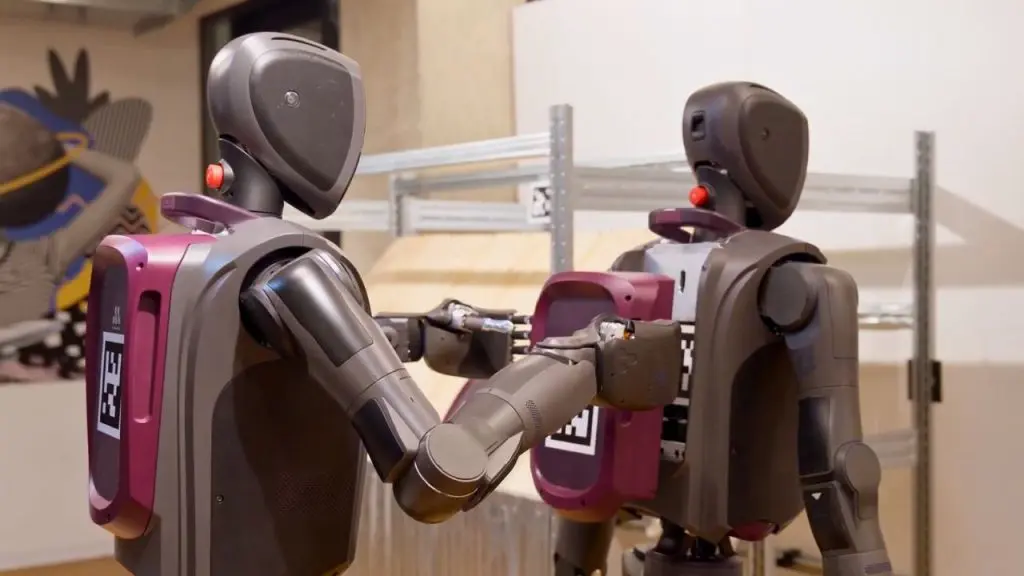
The AI reconstructs the tasks inside a simulation, where the humanoid’s digital twin trains across thousands of variations to account for real-world uncertainty and edge cases. Once training is complete, the learned behaviors are transferred to the hardware through a process called Sim2Real, short for Simulation to Reality. The result is a robot that can pull off the task independently and potentially teach it to other robots just like a human apprentice.
Another recent demo features two Gen 3 MenteeBots executing a full end-to-end workflow while navigating a cluttered warehouse environment. Without teleoperation, the robots lift 32 boxes from eight uneven piles and distribute them across four flow racks. The two machines operate in close proximity for the duration, acting on a continuous sequence of decisions based on real objects in real space.

Mentee Robotics is scaling production of its third-generation bot as it transitions from startup to a subsidiary. Mobileye says it’s entered a definitive agreement to acquire Mentee for about $612 million in cash and up to 26.2 million shares of its common stock. The deal is structured to close in the first quarter of 2026, subject to customary conditions. Mobileye board and its largest shareholder, Intel, approved the agreement, with Shashua recusing himself because of the conflict of interest. The total cash value is reported at around $900 million.
By bringing Mentee’s humanoids into its ecosystem, Mobileye says it aims to accelerate both the technical development and commercial deployment of the robots into the workforce. The company expects proof of concept pilots with customers in 2026 as fully autonomous assistants. Home deployments are planned for around 2030.
“I am immensely proud of what Mentee’s multidisciplinary team has accomplished in just 4 years,” Mentee CEO Wolf said in a press release. “We set out to build a platform that combines cutting-edge AI with deeply integrated hardware to make humanoid robots truly useful in real-world environments. Joining forces with Mobileye gives us access to unparalleled AI infrastructure and commercialization expertise, accelerating our mission to bring scalable, safe, and cost-effective humanoid solutions to market.”