
Just a year after its launch, Palo Alto-based K-Scale Labs is already ruffling feathers in the robotics world.
Founder Benjamin Bolte, an engineer who’s worked on robotics for Tesla and Meta, came out swinging like 50 Cent in early 2025, causing tension in Silicon Valley with public shots at unicorn rivals. He insists that making robots open and affordable is the only way to get billions of them into the real world.
“Highly capable robots are poised to take over large amounts of labor in our homes and businesses, and in a democratic society, the only way to make rapid forward progress is if the benefits from such changes are wide shared,” he wrote in a May 2025 blog post. “In other words, we expect that the only way for humanoid robots to achieve mass adoption is by being open-source, auditable, and broadly accessible.”
When he criticized Figure AI‘s approach to doing everything in-house and questioned its transparency, founder Brett Adcock called him an “idiot.”

During a recent webinar, Bolte said with a smirk: “Personally, I am very excited about the world’s best humanoid robot being open source and shared by everyone and built for developers by developers and not some other companies.”
K-Scale’s name is a likely reference to the Kardashev Scale, a highly influential concept in astrophysics that measures a civilization’s technological advancement based on energy consumption. Soviet astrophysicist Nikolai Kardashev introduced the framework in 1964, categorizing civilizations as follows:
- A Type 1 civilization harnesses all the energy available on its planet, including renewable sources like solar, wind, and geothermal, and can control natural processes like weather and volcanos.
- A Type 2 civilization captures the full amount of energy output of its star, possibly using structures like Dyson spheres.
- A Type 3 civilization harnesses the energy of an entire galaxy, manipulating stars and black holes.
- Type 4 and 5 civilizations are speculative, with godlike abilities like countering universe-scale events and multiverse energy control.

Carl Sagan placed Earth’s civilization at 0.7 in 1973 when he proposed a refined version of the scale based on real-world energy use. Experts today generally agree humanity is slowly approaching Type 1 status, with the possibility of progressing in the next century or two with breakthroughs in fusion energy, space-based solar, and global electrification.
The Kardashev scale became popular among science fiction fans and futurists in the 70s and 80s and today it’s frequently cited in discussions about AI advancements. K-Scale sights it heavily in its messaging.
“We’re building the infrastructure to make humanity into a Type I Kardashev civilization, and we’re making it open source and available for everyone,” Bolte said in another recent video.

Bolte founded K-Scale Labs in 2024 after leaving Meta, where he worked on the AI research team teaching robots and computer systems to learn from the world around them. He previously worked at Tesla as a senior Autopilot engineer, writing the CUDA code behind a 3D vision system called the voxel occupancy network. The system served as the first perception model for Tesla’s Optimus humanoid robot.
Joining Bolte launching the startup was Matthew Freed, who developed advanced robotics for Lockheed Martin and General Dynamics, and Pawel Budzianowsk, a well-known machine learning researcher with a PhD in dialogue systems from the University of Cambridge.
The team secured $500K in seed funding after the startup incubator, YCombinator, added it to its Winter 2024 batch. K-Scale has secured additional funding, but its war chest is small compared to other US startups racing to deploy their humanoids at scale like Figure AI, 1X Technologies, and Agility Robotics.
K-Scale introduced its early humanoid robot prototype named Stompy in February 2024. Standing about 122 centimeters, the robot was built with materials costing under $10K. Its training was accelerated in simulation, where it learned on its own through trial and error.

The learned behaviors are then transferred to the physical hardware via a process called Sim2Real, short for Simulation to Reality. The technique has become standard among the perceived leaders in the humanoid robotics race. It’s been credited with quickly enabling humanlike walking, dancing, and martial arts moves.
K-Scale has open sourced its simulation to reality pipeline as it takes pre orders for two budget humanoid robots.
Zeroth Bot, or Z-Bot, is priced just under a thousand dollars. Standing about 46 centimeters, Z-Bot is geared toward students and developers.
K-Scale’s higher end model is called the K-Bot. Standing 1.4 meters, the robot is priced just under $9K for developers, researchers, and hobbyists who want to build and test real-world aI and robotics. The humanoid robot possesses actuators that deliver 120 Nm of torque and supports swappable attachments for different tasks.
K-Scale is also developing a model called M-Bot that’s about 70 centimeters tall and priced under $3K for early buyers.
Z-Bot’s pricing is notable for under cutting short humanoids from Chinese firms like Unitree Robotics and EngineAI. Short humanoids like Unitree’s G1, EngineAI’s PM01, AgiBot’s Lingxi X2 and the T1 by Booster Robotics are growing in popularity among researchers and developers as China aims to deploy robotic humanoids at scale in 2025 and lead the industry by 2027.


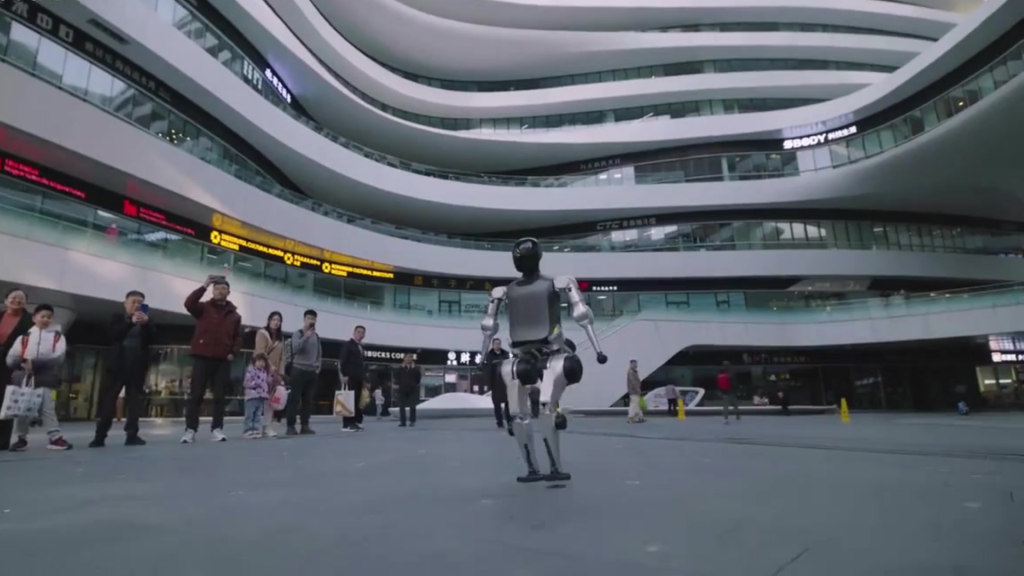
While Z-Bot isn’t as sturdy as high-performing models from Unitree and EngineAI, it fills a gap in the United States by offering a relatively affordable, developer friendly humanoid platform. Researchers from UC Berkeley have a similar goal with their new lightweight humanoid robot that can be built with 3D printed parts for under $5K.
The K-Bot could be seen as the West’s answer to China’s open-source general-purpose humanoid robot, Tiangong, developed by the government-backed Beijing innovation hub, X-Humanoid. Tiangong has been upgraded considerably since its 2024 introduction and recently made headlines for its first-place finish in the first ever humanoid robot half marathon.
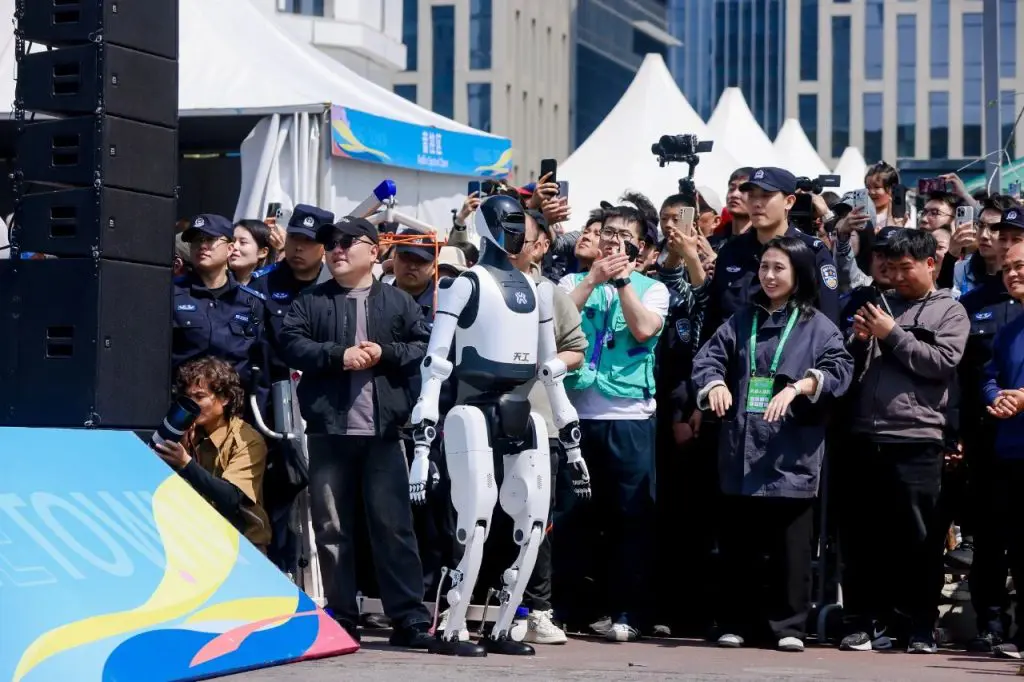
Choices are much more limited for researchers and developers interested in full-sized humanoid robots at this point. One of the most popular options is Unitree’s H1, which is available starting around $90K. Other full-sized humanoids are beginning to hit the market that are priced around $30K from Chinese firms like UBTECH Robotics, and US based upstarts like Westwood Robotics have recently introduced new research platforms.