
Kawasaki was one of the first players in robotics, entering the field when it barely existed more than 50 years ago.
Founded all the way back in 1896, the global conglomerate played a key role in turning Japan into an industrial automation leader. It introduced industrial robots to the Japanese industrial workforce in the 1960s and, by the 70s, became one of the first manufacturers to mass produce them.
Kawasaki has no intent to slow down as it seeks to lead the robot-run future that experts call inevitable. The following are the next generation machines the company is pushing to market that could fundamentally change the future of work, manufacturing, transportation, and sustainability.
Kaleido 9
Kawasaki Heavy Industry says it’s pushing its flagship humanoid robot into the real world after a decade of research and development. The Japanese industrial giant unveiled the ninth generation iteration of its Kaleido humanoid at the 2025 International Robot Exhibition (IREX) in Tokyo alongside its futuristic robotic horse, CORLEO.

The Kaleido 9 inherits decades of robotics research from Kawasaki, which built Japan’s first domestically produced industrial robot in 1969 in collaboration with Unimation. Robots have been a core part of its portfolio ever since.
Kawasaki has been exploring humanoid robotics for well over 20 years. In the early 2000s, the manufacturer contributed to Japan’s National Humanoid Robotics Project (HRP), developing tech for remote control and teleoperation. Its researchers demonstrated how a humanoid robot could one day stand in for people in dangerous settings with a widely cited 2002 demo featuring a humanoid driving a backhoe.
Kawasaki started developing the Kaleido platform in 2015 and introduced the first-generation prototype in 2017. The OG Kaleido stood about 178 cm (5 feet 10 inches), weighed 85 kg (187 lbs), and boasted 32 degrees of freedom (DoF). It demonstrated bipedal locomotion, basic object recognition, and two-handed grasping. The Kaleido 1 could handle up to 60 kg (132 lbs) with its industrial upper body strength.
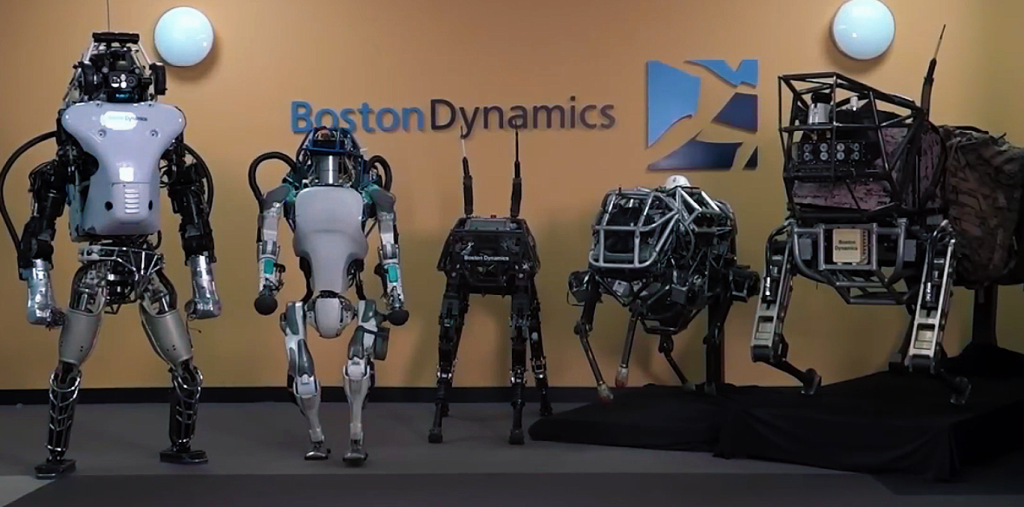
The first Kaleido emerged as Boston Dynamics was dominating public attention in the humanoid sphere with Atlas. Though the Massachusetts robotics leaders hydraulic-powered humanoid became a pop culture icon, Kido was structurally ahead with its fully electric design. Boston Dynamics introduced its all-electric atlas in 2024. Hydraulics have largely become a historical artifact in humanoid development. Considered useful for extreme demos and disaster research, but unscalable in industry.
Kawasaki is also developing a slimmer derivative of Kaleido designed to work collaboratively with people in more everyday settings.
Mech Superhumanoid
One of its future collaborators could be Mech, a so-called superhumanoid Kawasaki is developing with the California-based unicorn startup Dexterity Robotics.
Mech is a large dual arm industrial robot with a rover base for navigating across warehouses and industrial sites. Kawasaki supplies custom multiaxis industrial robotic arms for mech that are engineered for a wider range of motion than standard six-axis designs. The added degrees of freedom mean the robot can reach deep into trailers and maneuver in constrained spaces with industrial-grade reliability.

Redwood City based dexterity engineered the robotic system for physically demanding warehouse tasks that remain difficult to automate like loading and unloading trucks, palletizing and depalitizing boxes and order picking.
Dexterity says combining humanlike adaptability with superhuman strength and sophisticated artificial intelligence will fundamentally transform logistics operations.
Mech two arms have a combined span of 5 1/2 m or nearly 18 ft and can lift up to 60 kilos or 132 lb. With its extended reach, the robot can load items at the top of box trucks and manage multiple tall stacks of boxes simultaneously.
According to its developers, the robot’s AI-driven sense of touch equips it to perform tasks requiring a human like dextrous manipulation. Its agile rover base can spin and climb ramps. It houses dual vacuum pumps, a supercomput, a battery pack, and up to 16 cameras.
Up to 10 mech superhumanoids can reportedly be managed and monitored simultaneously by a single individual. The systems capabilities can be enhanced with new apps that teach it to perform new jobs.
Hydrogen-Powered Nyokkey
Kawasaki is advancing in new class of hydrogen-powered machines starting with its COVID era mobile service robot. The company recently shared demo footage of its Nyokkey wheeled robot using a hydrogen fuel cell system.
Kawasaki collaborated with Toyota Bosoku which developed the compact fuel cell and Daido University.
Nyokkey generates its own electricity through its fuel cell which converts hydrogen and oxygen into electrical power. Hydrogen is supplied from a low-pressure onboard tank and fed into a fuel cell. Its interaction with oxygen from the air creates energy, generating water and heat as byproducts. The robot has swappable low pressure hydrogen tanks for quick refueling.

Engineers have been experimenting with hydrogen-powered robots for years, mostly for academic research and proof of concept systems. But Kawasaki is keen to push the tech into the real world to help Japan achieve its goal of leading the global transition to hydrogen-based low emission power within the next 25 years.
The Japanese government wants hydrogen and ammonia-based systems to account for 10 percent of its total energy mix by 2050. Officials plan to build a comprehensive supply chain with a thousand fueling stations before 2030. They want Japan to produce 12 million metric tons of low-carbon hydrogen annually by 2040.
Kawasaki has developed and publicly demonstrated hydrogen-powered vehicles, but they are not yet commercially available. The manufacturer held the world’s first public demo of a hydrogen internal combustion engine motorcycle at Japan’s Suzuka circuit in July 2024. Availability is targeted by the early 2030s.

Standing 150 cm (4 feet 11 inches), Nyokkey navigates autonomously using LiDAR for mapping. Kawasaki introduced the autonomous dual arm mobile service robot in 2022. Its development began in 2021 to address patrol and monitoring needs during the COVID-19 pandemic.
Nurabot
The design is the foundation for Nurabot, an autonomous nursing assistant Kawasaki is developing with Foxconn. According to its developers, the robot reduces nurse workloads by up to 30 percent, delivering medicine, carrying samples, and retrieving supplies.

It began real-world testing in April 2025 at the Taichung Veterans General Hospital, one of Taiwan’s leading national healthcare facilities.
CORLEO
Looking even further ahead, Kawasaki says it’s moving forward with its viral CORLEO quadruped concept first introduced at Expo 2025 in Osaka.

The robotic horse has adaptive rubber hooves that help it grip uneven ground and absorb shocks for off-road stability. Its weight shift control is similar to horseback riding with the rers’s center of gravity determining direction.
Kawasaki says it’s officially started development of the hydrogen-powered coro toward productization. They’re targeting 2035 for launch, but that’s dependent on several technological breakthroughs and regulatory approvals. Still, the target is 15 years closer than Kawasaki’s original stated 2050 time frame.
The Future of Robotics
To stay up to date in the age of physical AI, make sure to subscribe.