
A wave of hyper-dexterous robotic hands is flooding the market as investors pour billions into next-gen machines built to outperform humans.
In the race toward general-purpose robotics, AI-powered designs are pushing robotic dexterity, strength, and sensitivity to human-like levels. With mass production underway, the synthetic human hands are dropping in price and becoming accessible to a rapidly expanding market. For now, the market is still B2B-focused, with advanced end effectors being sold as plug-and-play modules to integrate with larger platforms.
The rapid progress brings the world closer to full lifecycle automation, with robots that can build, maintain, and destruct products without human touch. Though often hyped alongside humanoids, mechanical manipulators aren’t limited to any form factor. They integrate with industrial robotic arms, mobile service bots, quadrupeds and other autonomous platforms.
Startups developing humanoids, cobots, and service bots to handle tasks requiring human-level precision. Manufactures are buying them as modular components to upgrade existing hardware and build out next-gen smart factories. As research institutions and universities drive demand, the tech is also becoming within reach for much younger aspiring builders.
Industrial giants hope they unlock production breakthroughs as they anticipate worsening labor shortages. Factories once limited by human through put could run 24/7, self-optimizing themselves without breaks or even lights.

DexRobot’s 021
In China, the Shanghai-based startup DexRobot says its new mass-production-ready mechanical hand nearly matches human dexterity.
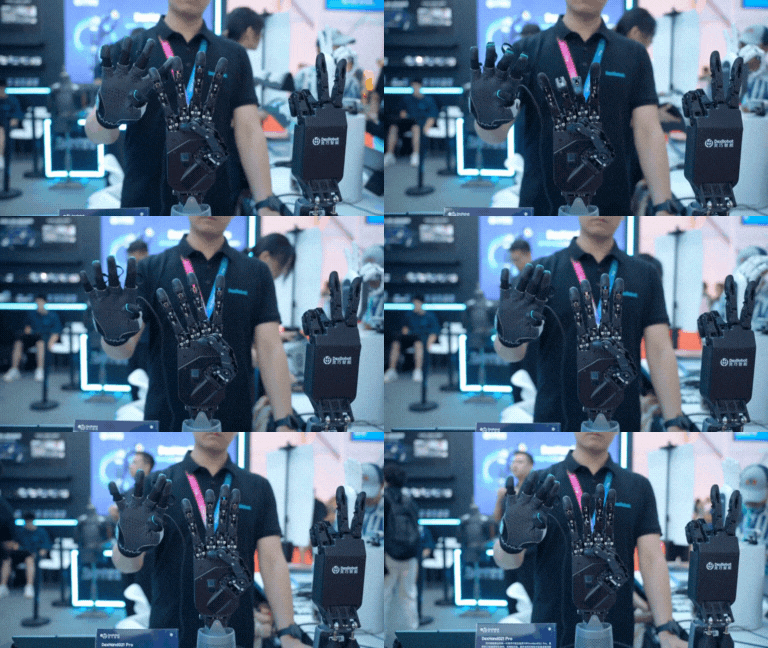
The DexHand 021 has a reported 19 degrees of freedom (DoF), 12 of which are actively controlled by motors. The seven other passive joints move when other parts of the hand are in motion, which DexRobot says unlocks uncanny fluidity.
The robo-hand uses a dual-tendon system that’s similar to human anatomy. It retails for around $9,500, while a higher-end variant with 22 DoF requires contacting the company for pricing.
AgiBot OmniHand
Another Shanghai firm, AgiBot (AKA Zhiyuan Robotics), is bringing dexterous manipulation tech to the mass market.

The unicorn startup, which has already begun mass producing humanoids, offers its OmniHand end effector on JD.com and its own ecommerce shop starting around $2,000. AgiBot, which also sells quadrupeds and mobile cleaning bots, is already teasing a second-generation OmniHand.
The OmniHand is the latest in a wave of AI-driven robotic hands from China to hit the market nearly two years after the Chinese government made the mass production of humanoids a national priority.
More Chinese Robot Hands
The OmniHand is the latest in a wave of AI-driven robotic hands from China to hit the market nearly two years after the Chinese government made the mass production of humanoids a national priority.
At the 2025 World Artificial Intelligence Conference (WAIC) in Shanghai, Beijing’s Linkerbot unveiled its latest creation, the LinkerHand L7. It has 12 DoF, six of which are active. According to Linkerbot, it’s withstood more than a million operation cycles during testing, demonstrating 2x or 3x longer service life than competitors.
Linker’s industrial robotic hands start at around $6,800. Research variants boast up to 42 DoF and require custom pricing.
Other recent launches include:
- Wuxi-based MagicLabs’ MagicHand S01 built for industrial applications.
- Beijing-based Inspire Robot’s F1, which is priced around $5,000 and is geared toward researchers and developers.
- Unitree Robotics’ Dex5 hand, which features 20 DoF, 16 active and 4 passive.
PSYONIC’s Ability Hand
During Comic-Con 2025, San Diego-based PSYONIC showed the latest iteration of its Ability Hand, which can be used as a prosthetic for humans and a dexterous manipulator for robots. The Shark Tank success story can be seen on humanoids like Apollo from Google-backed Apptronik and AEON from Hexagon AB.

At 490 grams, it’s lighter than the average adult’s hand. It closes in just 0.2 seconds, which PSYONIC says it’s twice as fast as any other bionic hand on the market. Each finger can withstand blunt impacts and the water is resistant.
Its pricing reportedly starts between $15K and $25K.
Daxo Muscle V0
The Muscle V0 by the Philadelphia startup Daxo Robotics possesses 3x the actuators of human hands with its 108 artificial muscles.
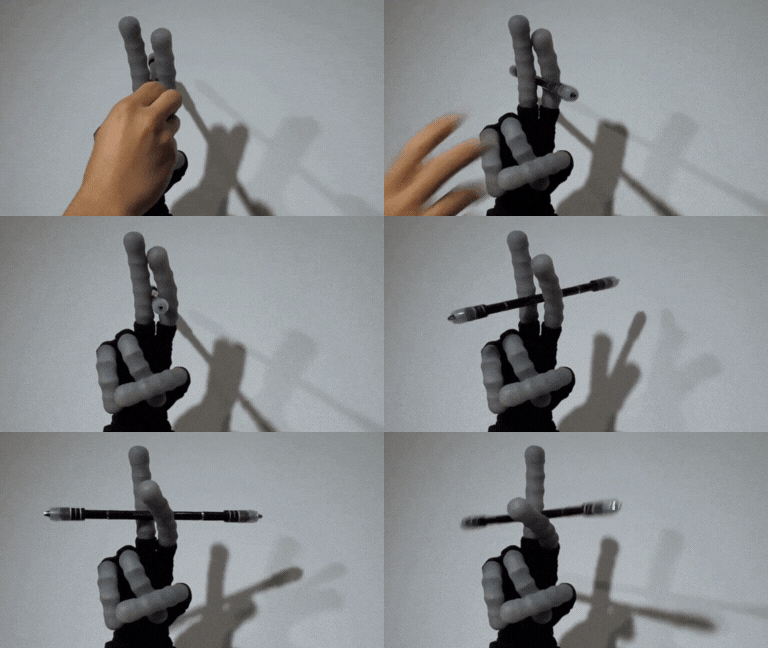
It’s inspired by human anatomy but not bound to it. The design allows for countless movement combinations, giving the hand strength, precision, and flexibility far beyond human abilities.
Its base structure is a semi rigid bone with attached spokes that anchor tendons. The prototype’s skin is made from off-the-shelf silicone gel sleeves from Amazon, the same kind used for burn recovery and scar treatment. The gel is cheap and fast to prototype, but future production models will switch to custom synthetic rubber.
Daxo says it’s collaborating with manufacturing partners to create optimized molds and rubber mixes to withstand tens of thousands of repetitions.
Launched in 2023 by Penn Engineering PhD Tom Zhang, Daxo’s stated mission is to make manual labor optional. According to Daxo, the prototype cost about $1,200 to build and will soon be tested in industrial automation, agriculture, and logistics.
ALLEX’s Hands
In South Korea, WiRobotics is generating buzz with its newly unveiled mechanical hand that boasts 15 DoF for its flagship humanoid, ALLEX.

Weighing just 700 grams (1.5 lb), it delivers up to 40 N of fingertip force, which is enough to operate tools with delicate precision and safely interact with people. It can sense tiny weight changes of around 100 grams and perform delicate actions like interlacing fingers and picking up a single grain of rice.
WiRobotics, which develops exoskeletons and wearable robotics, is developing ALLEX as a modular humanoid platform. The startup plans to deliver a full-sized general-purpose humanoid robot by 2030.
Next-Gen Robot Hands
Looking to the future, a wave of next-generation robotic hands promise to transform industry and homelife.
Tesla Bot Gen 3
Tesla’s Gen 3 Optimus hand boasts a reported 22 Dof, doubling the joints of the second gen humanoid design. An additional 3 DoF are in each wrist. According to reports, Tesla plans to scale production of Optimus after a redesign to address performance issues.

The Hand of Clone
Meanwhile, Clone Robotics says its synthetic human hand beats Tesla’s hand at a fraction of the cost. The startup, which operates out of the US and Poland, says the Hand of Clone has 27 DoF, which matches the actuators of humans.

To keep up with tomorrow’s Skynet-inspired tech, subscribe to my YouTube channel for first updates.