
Fourier is bidding farewell to its first-generation humanoid robot.
The Shanghai based robotics firm just released specs for its second-generation robot, the GR-2. It’s notable for its high torque rating and 53 degrees of freedom.
Its 380 Nm of torque is enough to lift patients into wheelchairs, move furniture, and operate industrial tools. In video posted on Fourier’s website, the robot is seen performing tasks at an SAIC-GM automotive facility in China.In comparison, the GR-1 had 300 Nm of torque, which was sufficient for lifting nearly its own weight but offered much less power than the GR-2.
Fourier says the GR-2 has 12 degrees of freedom in its hand. That’s the same as NASA’s Robonaut R2, which is designed for precise tasks in space.

Fourier’s advanced actuation system provides precise control of the robot. Each joint in the GR-2 is powered by a flexible series actuator unit specifically tuned to meet its unique torque demands.
According to Fourier, the system’s dual-encoder system doubles control accuracy so the robot can perform high-precision tasks even in challenging environments. Compared to the GR-1, Fourier’s latest robot actually has one less degree of freedom.
Humanoid robot designs strike a balance between complexity and practicality. With the reduction, the Gen 2 robot may have gained enhancements in strength, stability, or battery efficiency.
The GR-2’s integrated cable design hides its wiring so it’s more compact and tidier than the original. Its joint assembly makes maintenance simpler and reduces the cost to build. Fourier says the configuration accelerates the transition from computer simulations to real-life interactions.
The robot also has a modular design so parts can be changed out quickly. It also has a swappable battery that runs for up to two hours.
At 1.75 m, the GR-2 stands 10 cm taller than the first-generation robot. It’s also 8 kg heavier, weighing in at 63 kg.
Its Software Development Kit (SDK) provides developers with a suite of tools to program and customize the robot’s functionality. It supports popular robotics frameworks like ROS and NVIDIA’s Isaac Lab. The SDK offers access to pre-optimized modules for tasks like machine vision, path planning, and force feedback control so developers can build apps quickly.
Until July 2024, Fourier was known as Fourier Intelligence. The company rebranded, splitting into two units: Fourier and Fourier Rehab. The latter focuses on rehabilitation specific innovations while Fourier specializes in general-purpose robotics. The company says the rebranding streamlines its efforts to provide full-stack robotics solutions across over 40 countries.
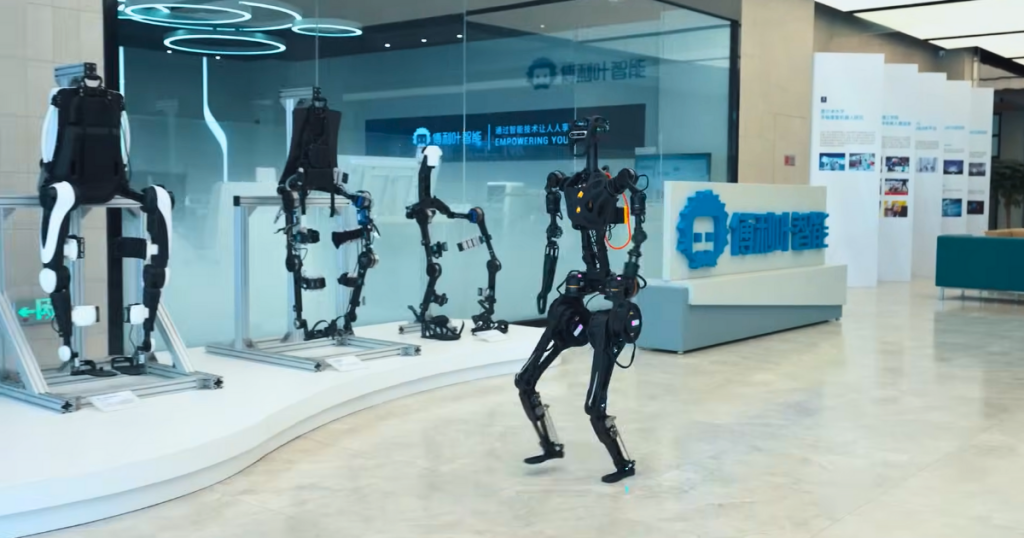
The rehab division’s offerings include RehabHub, a platform that integrates physical therapy devices that help users walk, stand, and improve balance; and MetaMotus Galileo, a device that rehabs the lower body. The exoskeleton system is part of the company’s assistive robotics line for supporting patients in regaining mobility and strength.
Founded in 2015, Fourier initially focused on rehab technology. After gaining a reputation, the company expanded its scope to include humanoid robotics with the GR1.
The release comes amid nonstop humanoid robotic product announcements from a growing array of Chinese firms.
China’s government is prioritizing the mass production and deployment of humanoid robots. The country aims to mass produce the AI robots by 2025 and conquer the market by 2027.
Just last week, Chinese tech giant Tencent unveiled its new hybrid robot called The Five or Xiao Wu. The fifth-generation robot. intended to work near humans in places like homes and healthcare facilities, uses its legs to walk and its wheels for faster mobility as needed.
Other recent entries include:
- The PUDU D7 by Pudu Robotics, a so-called semi humanoid robot that can ride elevators on its own. With its human-like upper body, the AI robot moves in all directions with its omnidirectional chassis. It’s designed for places like hotels and hospitals to deliver items across floors using elevators autonomously.
- The VersaBot V-B-1 by Lanxin Robotics mimics human vision to achieve high-level spatial awareness. Lanxin calls the robot the first pure-vision humanoid robot. It uses cameras to create three dimensional maps of its surroundings. With its advanced AI, the robot decides in real-time whether to stop or move around obstacles. The VersaBot is intended for industrial settings.
- PNDbotics says its offering, Adam, is the first high-biometric humanoid robot. That means it closely imitates the biological structure and movements of a real human. Adam’s pelvis is designed to move like a person’s, using joints and actuators that mimic natural motion. .
- EV maker XPENG is expected to showcase its new humanoid robot called the PX5 at its upcoming tech day. XPENG is positioning the robot as its answer to the Tesla Optimus.
- Astribot S1 is an advanced AI robot assistant that uses imitation learning to perform tasks with precision and autonomy.
- Robotics startup Agibot says it’s also coming for the Tesla Bot with its flagship robot called Yuanzheng A2.
- LimX Dynamics recently shared a 3-minute video of its CL-1 robot doing heavy loading tasks continuously. The robot uses sensors to find objects and automatically adjusts to handle different tasks. The humanoid ignores unexpected disruptions, re-locates target objects, re-plans tasks on its own, and adjusts to place objects accurately. The robot uses sensors to find objects and automatically adjusts to handle different tasks.
- And social media has been flooded with encounters with Unitree’s G1 AI robot. Standing 1.3 m, the G1 is a compact version of Unitree’s full-sized, general-purpose humanoid, the H1. Unitree recently unveiled the production-ready iteration of the robot, which retails for sixteen thousand dollars.
And that’s just some of the humanoid robots that have emerged recently in China. For up-to-the-minute updates as the market evolves rapidly, make sure to subscribe to my YouTube channel.