
A Chinese T800 robot lost its head during what was billed as the world’s first autonomous humanoid fighting event. It kept going like nothing happened, as its head dangled by wires.
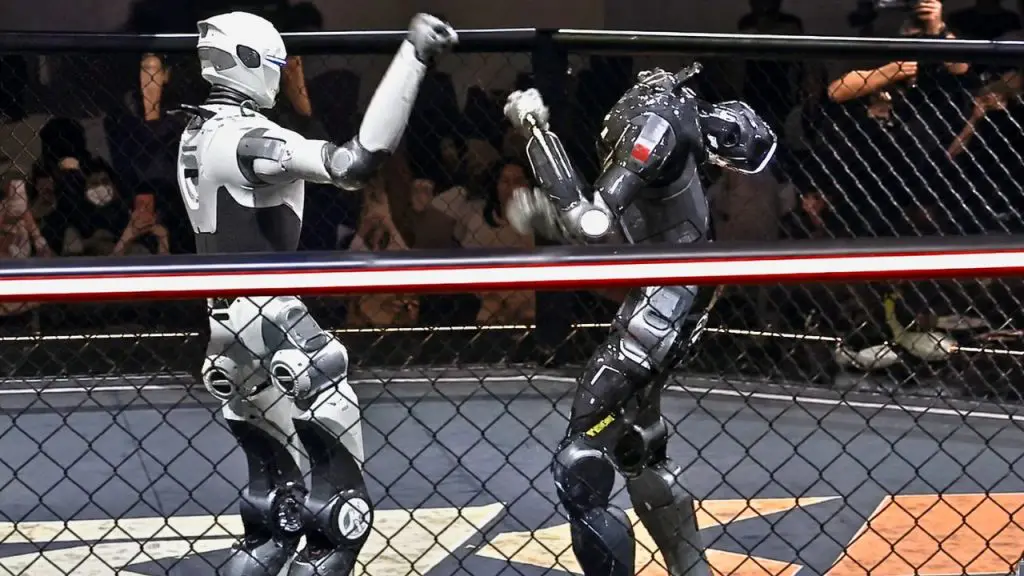
The wild moment stole the spotlight as the fast-rising startup EngineAI kicked off the first of many scheduled robot cage matches. It could be a glimpse of what’s to come as the Terminator-inspired machine prepares for combat on US soil.
EngineAI transformed the area around Shenzhen’s Nanshan Culture and Sports Center into a cyberpunk district in preparation for its inaugural Ultimate Robot Knockout League (URKL) event. The 3-year-old startup opened a dedicated theme park and experience zone that included a giant T800 replica as a public attraction. The public attraction featured robot parades, interactive experiences, robot ring demos, performances from local dangers and singers, limited edition giveaways, and photo ops.

In a surreal scene, Engine AI’s flagship full-sized humanoid robot made a dramatic entrance at the launch of the combat league. The robot arrived via a low-altitude flight aboard a standing personal evTOL aircraft from the Hangzhou-based company CoolFly. The aerial vehicle, called the Urban, is priced starting at $100,000 and is planned for release in 2027.

In the lead up to the event, EngineAI shared cinematic footage of the T800 sharpening its mixed martial arts skills. The series of promos pay clear homage to classic Hong Kong cinema. They build on EngineAI’s 2025 tribute to Kung Fu Hustle, which recreated the two thousand four Stephen Chow film’s iconic Axe Gang dance scene with the startup’s smaller PM1 humanoid.
The mini films up the ante with what can be described as a mix of Bruce Lee’s raw intensity and philosophical depth, Jackie Chan’s acrobatic humor and stunts, and the Shaw Brothers’ grand wuxia epics. The conclusion features a cameo from actor Donnie Yen, known for Hong Kong action films like Ip Man (2008) as well as Western hits like John Wick (2014).

EngineAI is spending heavily on marketing after raising at least $350 million to date. Launched in 2023 by serial entrepreneur Zhao Tongyang, the company is reportedly heading toward an IPO on the Hong Kong Stock Exchange (HKEX). If approved, it will join fellow Shenzhen-based humanoid robot makers UBTECH Robotics and Dobot.
It’s one of several startups from the booming Chinese tech hub seeking a public listing alongside Pudu Robotics, Leju Robot, and LimX Dynamics, which just announced raising $200 million in pre-IPO funding. Known for its multi-for-factor Tron robots and its humanoids Oli and Luna, LimX has raised at least $400 million so far in 2026.
According to Bloomberg, EngineAI is seeking a valuation of at least $1.5 billion. Its war-chest has powered rapid scaling. The company recently began mass producing its humanoid and quadruped robots at its new intelligent manufacturing base in Shenzhen. The factory covers more than 12,000 square meters (130,000 square feet) and can reportedly churn out a humanoid every 15 minutes. Engine is planning a much larger manufacturing headquarters more inland in Zhengzhou to scale to 10 thousand units annually.

Compared to many Western peers burning cash more quietly, EngineAI is betting big on visibility. URKL is likely its largest marketing expense. The costs include a championship belt valued at nearly $1.5 million, smaller cash prizes for other finalists, and dozens of T800 humanoids with plenty of spare parts.
EngineAI is banking on the stunt delivering several returns at once. First, it gives the company a highly visible way to promote its technology and to establish itself as a global humanoid brand. Secondly, the fights act as an extreme testing environment for balance, fall recovery, motion control, perception, power systems, structural durability and heat management.
The league has 32 finalist teams selected from more than 60 applicants worldwide. According to organizers, they’re connected to elite institutions like Tsinghua University, Zhejiang University, the University of Hong Kong, Stanford University, and UC Berkeley. They’re all using the T800 as the standard platform, programming the robots’ combat behavior and equipping them with protective gear.

EngineAI’s website lists the T800’s height as 173 cm (5 feet 8 inches) but final production versions are reportedly closer to 1.8 meters (6 feet). Its weight is reported as 85 kg (187 lbs). The robot has a reported 29 degrees of freedom (DoF) and comes equipped with three-fingered hands with seven moving joints each.
It boasts significantly higher torque than most modern humanoids at four hundred and fifty newton meters, which on paper surpasses 90 percent of men in their prime. However, its payload capacity is lighter than rivals like Atlas from Boston Dynamics at around 5 kg (11 lbs) per hand.
It launched in late 2025 with pricing starting around $25,000 but the entry point is now listed as $40,000. Higher-end configurations use stereo vision and LiDAR for perception and NVIDIA AGX Orin for computing.

In January 2026, EngineAI filed a US trademark application for T800 to cover robots for education, security/surveillance, AI research, household use, entertainment, cleaning, etc. The T800 from the Terminator is not trademarked. The machining company Kennametal previously trademarked T-800 for industrial products.
The Ultimate Robot Knockout League bouts could accelerate the T800’s development similar to how motorsports improves automotive technology, though critics worry it will inevitably lead to actual Terminators like in the movies that inspired the T800’s name.

Donnie Yen served as a mentor during the inaugural show that kicked off a series of events that will run into the end of 2026. The first fights were at times awkward, as the robots struggled to track each other and often attacked empty space. The fighting is expected to improve as engineers refine the robots’ vision, movement, and combat software.
The headline match pitted robots named White Eagle and Matador against each other in the octagonal cage. The five-round fight featured punches, spinning kicks, flying kicks, takedowns, defensive movements, and deliberate taunts. Valid strikes earned one point, while knocking an opponent down earned three points.
The teams could decide how much control came from a human operator and how much came from the robot’s software. The robots appear to have executed preprogrammed combat skills and managed balance automatically, while humans may have selected actions or issued higher-level commands. Though likely not fully autonomous, reports indicate the robots were not remotely controlled move-for-move like Unitree’s televised match in 2026.

The most dramatic moment of the night came when White Eagle landed repeated flying kicks that apparently knocked Matador’s head off. Matador kept going because its primary control and power systems were housed in its torso. Despite losing its head, Matodor still won the overall match three rounds to two, having built an earlier lead.

Meanwhile in San Francisco, the startup REK (Robot Entertainment Kombat) is planning a smaller scale event featuring T800 humanoids. The robots will be controlled through VR at REK’s Nob Hill storefront that serves as a hub for humanoid robot sales, repairs, and special events. REK has been running humanoid fighting events in the Bay Area for over a year, starting with smaller Unitree G1 robots.