
Robots are getting smarter and more capable every day. In Japan, they’re also getting cuter.
The concept of kawaii is deeply embedded in Japanese culture, influencing everything from fashion to pop music to consumer and industrial robotics and even space exploration. The cultural inclination has manifested into robots that are not only functional but also endearing and approachable.
Shintoism, the country’s indigenous religion, does not draw strict boundaries between people and machines. Robots are viewed more as companions than lifeless tools.
Japan’s aging population and declining birth rate are creating demand for robotic assistance across sectors. As artificial intelligence and robotics advance rapidly, mechanical concepts that were once confined to popular anime like Astro Boy are entering the real world.
Sony AIBO
Sony introduced AIBO in 1999, pitching it as an autonomous robotic dog capable of forming an emotional bond with its owners. Its name stands for Artificial Intelligence Robot and also resembles the Japanese word aibō, meaning partner or companion.
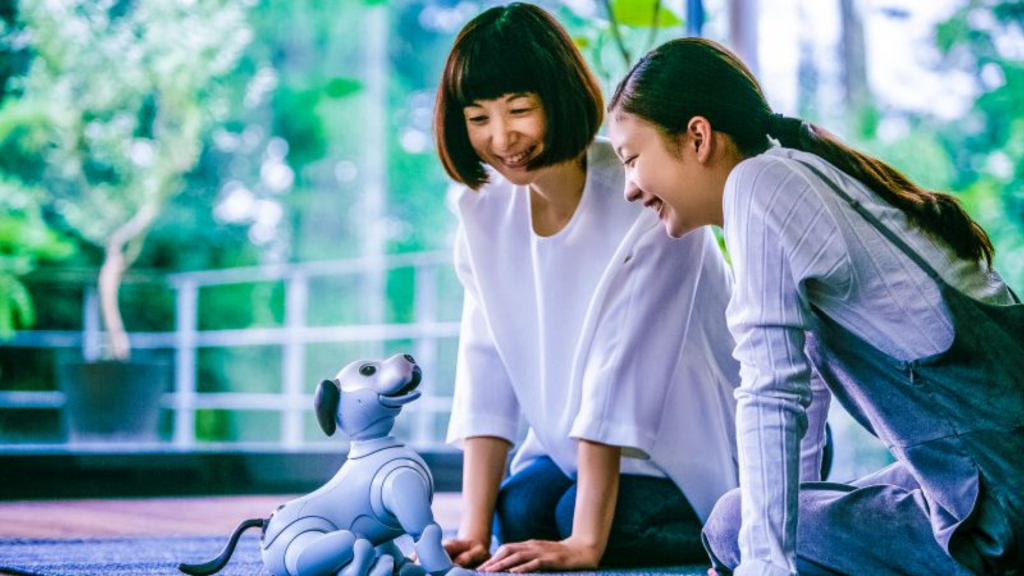
The concept emerged in Sony’s Computer Science Laboratory, where Toshitada Doi and Masahiro Fujita spearheaded the project aiming to develop a robot that could learn and express emotions. The electronics manufacturing giant released the first consumer model, the ERS-110, in June 1999. Priced around $2.5K, the initial production run sold out rapidly.
The robodog used its multiple sensors, cameras, and microphones to interact with its surroundings and recognize voice commands. It could learn and adapt its behaviors, developing a unique personality over time.
AIBO could chase balls, recognize its owners, and exhibit other lifelike behaviors. Sony discontinued the AIBO line in 2006 as part of a corporate restructuring only to revive it 12 years later.
The 2018 AIBO featured artificial intelligence, cloud connectivity, and a more lifelike appearance. It could recognize up to 100 faces and respond to more than 50 voice commands.
AIBO is a cultural phenomenon in Japan that’s served as a significant platform for advancing AI-powered robotics. Its popularity has given researchers and developers a unique opportunity to explore autonomous behavior and human-robot interaction.
AIBO robots were widely adopted in academic settings. Sony’s OPEN/R architecture for AIBO encouraged a global community of developers to create and share applications. Colleges like Carnegie Mellon have offered courses centered on the platform, covering models of perception, cognition, and action for problem-solving.
The quadruped’s capabilities continue to evolve, with newer models incorporating advanced facial recognition, voice command processing, and adaptive learning.

Recently, researchers from Sony and ETH Zurich unveiled an AI system to enable quieter walking. They developed a reinforcement learning-based model to teach AIBO to walk more softly in a virtual environment. Within Nvidia’s Isaac Simulator, the robot’s digital twin taught itself to reduce footstep noise through trial and error. The researchers launched the study in response to common complaints about quadruped robots being too noisy for home use.
Sony QRIO
The development of AIBO laid the groundwork for more complex humanoid behavior.

Sony showed off a prototype of a humanoid robot in Tokyo in 1999 and unveiled QRIO in 2003. Promoted as the world’s first running humanoid robot, QRIO could recognize speech, dance in sync with music, and express emotions. Sony shut down the QRIO project in 2006, alongside AIBO but, unlike the quadruped, it wasn’t resurrected.
Honda’s ASIMO
Another game changing robot from the Y2K era, Honda’s ASIMO, featured intentionally cartoonish aesthetics.
Standing 1.2 meters, the humanoid robot was designed to appear approachable. ASIMO walked with a slight bouncy step, using gentle gestures that appeared less robotic than prior humanoids. The robot was so cute that DisneyLand showcased it for years as part of its Tomorrow land Innoventions exhibit.
Honda wanted ASIMO, short for Advanced Step in Innovative Mobility, to be seen as a futuristic helper or friend rather than just a machine.

The robot’s backpack-like structure housed its batteries and computing systems, which delivered cutting-edge capabilities. ASIMO recognized simple voice commands and could respond with preprogrammed actions. Its camera vision recognized faces, gestures, and objects in its environment.
Advanced gyroscopic sensors managed its balance. Its multi-fingered hands could perform basic tasks like carrying items and opening doors.

ASIMO was initially intended for R&D and promotional purposes, but Honda envisioned a future where robots like it would be normalized in daily life. With Japan’s aging population, robots like ASIMO were seen as potential household helpers for the elderly to maximize independent living.
While ASIMO was an impressive technological advancement, it was expensive to build, operate, and maintain.
The robot made its last public appearance in 2022, but its essence lives on. ASIMO is returning to Honda in the form of an operating system for its upcoming electric vehicles.
Kirobo
Japan’s Kirobo is the first robot to have a conversation in space.
Japan sent the AI-powered bot to the International Space Station via the Kounotori 4 spacecraft in 2013. It served as a companion for astronaut Koichi Wakata, the first Japanese commander of the ISS. The mission made Kirobo the second humanoid robot to space travel after NASA’s Robonaut 2 was tested aboard the ISS in 2011.

Renowned Japanese roboticist Tomotaka Takahashi, the founder of Robo Garage, designed the robot in collaboration with Japan’s Aerospace Exploration Agency (JAXA), Toyota, and Dentsu. Takahashi is also known for the humanoids Robi and RoBoHoN.
Kirobo stood 34 centimeters tall, about the size of a small teddy bear or large water bottle. It could float in zero gravity for easy movement around the ISS.
It was built to test how robots could help astronauts with social interaction during long, isolated space missions. It was part of a broader Japanese initiative exploring how robots could support people in lonely or stressful situations.
Kirobo spoke Japanese, recognized facial expressions, and responded to voice commands. It interacted in real-time with its camera sensors and speech recognition software.
Kirobo spent about 18 months in space. It returned to Earth in February 2015 aboard the Space X Dragon cargo spacecraft. While Kirobo was designed to assist astronauts aboard the ISS, Mirata remained on Earth, serving as a backup and facilitating parallel experiments to ensure the success of the mission.
Since then it’s been displayed at exhibitions and museums in Japan. It was such a hit with the public, it’s since been commercialized.

A miniature version of the robot, called Kirobo Mini, was made available to consumers in 2017. Designed for everyday use, the robot stood about 10 centimeters. It was marketed in Japan as a personal interactive companion, selling for around $400.
LOVOT
LOVOT is a robot designed just to be loved.
Groove X, a Japanese startup founded by former SoftBank engineer Kaname Hayashi, started selling the $3,000 robot in 2020. Marketed as a robot for the lonely, LOVOT became popular during the COVID-19 pandemic as a source of comfort during lockdowns.

LOVOT looks like a mix between a penguin, a baby seal, and a plush toy. Its big, round anime-style eyes move expressively. Covered in soft, cuddly fabric, the robot has tiny arms and wheels under its body for smooth movement. The lovable robot returns to its charging nest when its battery is low.
LOVOT can simulate more than 50 emotional states, including curiosity, shyness, jealousy, and joy. It recognizes people, makes eye contact, and follows its owner around like a pet. The robot acts warmly when it’s picked up or petted, which it detects with its thermal sensors.
Like other popular Japanese robots geared toward consumers, LOVOT remembers how it’s treated and adapts its personality over time. It communicates with coos, chirps, and hums like a baby or a small animal.
Panasonic’s Nicobo
Nicobo is another robot whose primary purpose is to provide emotional support and companionship.
Developed by Panasonic in collaboration with Professor Michio Okada from the Toyohashi University of Technology, Nicobo embodies the concept of a weak robot. That means it’s intentionally designed with limitations to facilitate a nurturing relationship with its owner. The approach encourages users to engage. with the robot as they would a pet or a child.

Nicobo resembles a soft, cat-like creature with its knit fabric exterior. It wiggles, wags its tail, and emits gentle sounds, including occasional flatulence, which is gross.
It interacts with people with its microphone, cameras, and touch sensors. Over time, the robot learns and responds to simple Japanese words.
Initially released through a limited crowdfunding campaign, Nicobo was priced at $360 with a monthly subscription fee starting at around $10 for software updates and maintenance.
Moflin
Another AI powered robotic pet, Moflin, is notable for its ability to develop unique emotional responses to match the personalities of users.

Vanguard Industries introduced the robot in November 2019. The project gained significant steam on Kickstarter and, by late 2024, Casio started manufacturing and distributing the Moflin robots in Japan.
Pricing starts at around $400.
OryLab’s Telepresence Robots
OriHime robots by Tokyo-based OryLab are designed to help people who are disabled or sick participate in social and professional activities. The humanoid robots are controllable remotely using a smartphone or tablet.

One version, standing 20 centimeters, is meant to enable users to be present in places like classrooms, workplaces, and family gatherings. A larger variant that stands 120 centimeters has movable arms with 14 joints and is mounted on a wheeled base. The larger versions can perform physical tasks like serving customers and carrying objects.
OriHime robots have been used to connect hospitalized children with their classrooms so they can participate in lessons and interact with other students despite their physical absence.
At OrlyLab’s experimental Avatar Robot Cafe in Tokyo, individuals with severe physical disabilities serve customers remotely with the robots. The company is opening another cafe in Denmark in fall 2025.
Torobo
Even Japan’s industrial robots are adorable.
Torobo by Tokyo Robotics, for example, is a research-grade humanoid robot that features a smooth, helmet-like head shape giving a minimalist, friendly vibe similar to characters like Baymax or Pepper.

Its big expressive eyes can display animations, making it seem more personable. Even when doing tough tasks like hammering nails, Torobo moves carefully and deliberately, which comes off as more polite than robotic.
SEER
Another cute humanoid that’s made an international impact is SEER, a robotic head engineered to mimic human emotions and facial expressions.
Takayuki Todo, who’s known for blending art and robotics, created the robot while studying media art and technology at the Institute of Advanced Media Art and Science. He designed, built, and programmed the robot as a solo project.
Short for Simulative Emotional Expression Robot, SEER is a humanoid robot skull with moving eyes, eyebrows, and other facial features.

SEER has tiny motors and sensors to control eye and facial movements. It reacts to people’s emotions just like a real human might, which makes some feel emotionally connected with a machine.
SEER gained significant attention debuting at conferences in 2018 and continued as a popular display for years after. Todo’s goal was to explore how people react to robots that reciprocate human-like emotions.
His latest creation, however, is anything but cute. With his viral exhibit entitled Dynamics of a Dog on a Chain, Todo continues his exploration of human-machine interactions but in a much more confrontational manner.
Looking Ahead
To stay up to date as Japan’s AI-powered robots evolve rapidly, subscribe to my YouTube channel for first updates.