
In the past two years, the fastest humanoid robots have more than tripled their speed.
The founder of Chinese robotics leader Unitree, Wang Xingxing, expects them to outpace the most elite runners imminently. Now the focus is shifting to endurance as more than humanlike machines are put through the ringer for the second annual Beijing Humanoid Robot Half Marathon.

The difference in capabilities compared to just a year ago is already staggering. It’s hard to imagine what the following year will look like. How did we get to this point, and what comes next?
The Slow Walk to 2026
Though they’re rapidly making progress today, humanoid robots have advanced gradually over nearly a century to reach this point.
At the 1939 New York World’s Fair, Westinghouse held one of its first public demonstrations of a two-legged machine that could walk. The humanoid named Elektro took slow, deliberate steps in response to voice commands. Elektro’s motion was entirely preprogrammed and lacked any sense of balance or adaptation, but it established the mechanical foundation on which every humanoid system to follow would build upon.

In the 1970s, Japan’s Waseda University developed the WABOT-1, widely considered the first full-scale biped. Unlike earlier machines, the humanoid walked using sensor feedback rather than following fixed motions. It was painfully slow and far from ready for track and field but proved that achieving humanlike locomotion required constant sensing and small corrections.
Japanese humanoids like Honda’s ASIMO carried the torch into the new millennium. The world-famous robot reached speeds of up to 6 km/h (3.7 mph). It maintained balance even when both its feet briefly left the ground during movement, a crucial early step toward running.

The rise of Atlas by Boston Dynamics in the 2010s was another big turning point for the human-inspired form factor. It stayed balanced while jogging over challenging terrain thanks to its advanced software and sensor suite. What really differentiated Atlas was its ability to react in real time, which is essential for any competitive runner.

Another major breakthrough came in 2022 when a robot named Cassie became the first biped to run a 100-meter dash, setting a Guiness World Record with a finish time of under 25 seconds. Developed by Agility Robotics as a spinout of Oregon State University, Cassie had ostrich-like legs that were more efficient than designs mimicking human anatomy. The following year, researchers at UCLA introduced Artemis. The humanoid, developed by the university’s renowned Robotics and Mechanisms Laboratory (RoMeLa), maxed out at 9 km/h (5.6 mph).
Unitree’s Fixation on Speed
A plethora of breakthroughs soon followed after the Chinese government set a national goal to mass manufacture humanoids by 2025 and to own the global market by 2027. Hundreds of startups popped up throughout the mainland to capture the sea of new funding.
Hangzhou-based Unitree, which was already known for its agile quadrupeds, established itself as a leader in humanoids early on. Its first adult-sized biped, the H1, set a world record in March 2024 when it reached a recorded speed of nearly 12 km/h (7.5 mph). The velocity crossed into true running dynamics with its continuous forward momentum and reduced ground contact time. ‘

The achievement was especially notable given the robot’s human-like structure, which is inherently less stable than earlier bipeds like Cassie. Thanks to its advanced AI, the robot could move almost as fast as a human while recovering from mistakes on the fly.
Unitree’s Challengers
Unitree’s H1 remained the fastest humanoid for just six months until Beijing’s RobotEra ran away with the title at 3.6 m/s (8 mph).
The fast-rising startup shared footage of a pair of its Star1 robots running in the Gobi Desert’s Hexi Corridor. Engineers tested whether the robot ran faster with sneakers or barefoot. The sneakered humanoid started late but still beat out the competing Star1. They both maintained a pace that would get them to the finish line in a 5K race in under 25 minutes. That’s above average compared to human runners who typically take between 26 and 35 minutes.

Several other Chinese firms have since declared faster speeds, including the Shanghai-based MirrorMe, which reported that its first humanoid named Bolt hit 10 m/s (22 mph) in February 2026. Unitree reclaimed the title two months later with a vide of the H1 hitting the same speed. Though the benchmark is the same, the H1 likely takes the edge as its top speed was achieved in real-world conditions while Bolt used a treadmill.
Pros and Cons
Though there are far fewer humanoids in the West, leading firms like Tesla, Figure AI, and Boston Dynamics are also aggressively training their robots on increasingly dynamic behaviors like running.
They say teaching a robot to run pushes it to the limit, forcing it into a constant state of controlled failing. Engineers describe it as similar to a stress test for the entire stack. They say if a robot can run, it can usually handle simpler tasks that will be far more useful for early adopters.
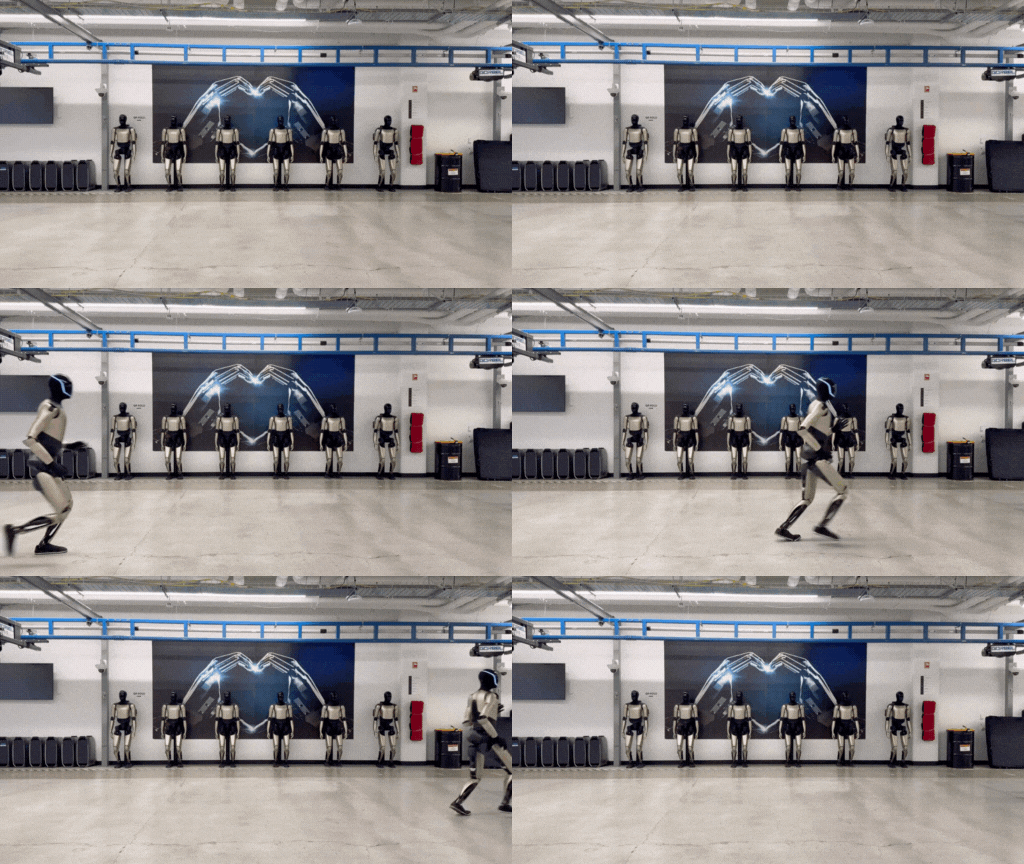
Others worry about what the capability could manifest into.
Projections about the humanoid market vary widely, though analysts generally expect a massive scale up over the next few decades. Numbers range from hundreds of millions to several billion. If even a fraction of those robots are fully autonomous and can run better than humans, they fear it that the dystopian future the movies warned of could become real life.
There’s little doubt that humanoid robots are on a trajectory to likely surpass elite human sprint speeds in the near future. The top humanoids already are already approaching the top end velocity of Usain Bolt, who holds the world record at 12 m/s.
However, there are reasons for anyone scared of a Terminator-run future to feel at ease. Most humanoids can only operate for an hour or two while under load, as high-speed movement drains power faster than anything. Autonomy is also limited. the most impressive demos typically rely on controlled environments, predefined tasks, and a human-in-the-loop to at least some degree. Achieving all-day operation in everyday life remains an unsolved problem industry-wide.
Beijing’s 2nd Humanoid Robot Half Marathon
China’s robot makers are also improving the endurance of their machines with competitions that seemed out of the question just a few years ago. Footage of robots training for Beijing’s second annual Humanoid Robot Half Marathon has been going viral across social media.
The first event featured more than 20 bipedal humanoids and about 12,000 human runners tackling the course in Beijing’s E-Town spanning 21.1 km (13 miles). The global spectacle turned into a revealing stress test that showed the limitations of modern-day humanoid technology. Most of the robotic participants struggled to maintain stability and endurance for the whole distance.

The standout performer was Tiangong (Tien Kung) Ultra, developed by the Beijing Humanoid Robot Innovation Center. The government-backed innovation hub, also known as X-Humanoid, engineered the robot specifically for the race. It completed the trek in just 2 hours and 40 minutes.
While it’s a significant technical achievement, it’s still quite slow compared to human runners. Elite long-distance runners can finish a half marathon in about an hour, and a typical recreational runner takes about two hours. Following Tien Kung was N2 from the Beijing startup NOETIX Robotics, which demonstrated relatively stable pacing compared to most of the bigger machines on the track.
Participation has surged nearly fivefold for the 2026 half marathon with more than 100 teams expected. The competition has been revamped to prioritize autonomy over teleoperation. Nearly 40 percent of the participants are using completely autonomous systems due to the new rules that penalize remote operation. The technical expectations are also much higher this year.
Meanwhile in Shenzhen, the maker of China’s Terminator is preparing for its first Ultimate Robot Knockout League (URKL) later in 2026. It’s described as the world’s first professional competition for humanoid fighting. Read all about it right here.