
People are going crazy about Boston Dynamics’ Atlas humanoid robot’s newly unveiled abilities. Let’s get into what the fuss is all about and what it means as the leading robotics firm accelerates Atlas’ development.
The Massachusetts-based robotics company just released a new demo of its world-famous AI robot autonomously moving engine covers between supplier containers and a mobile sequencing dolly. The Verge says the video proves that the humanoid robot doesn’t need a human. Basically, Atlas has the potential to work in a factory on its own.
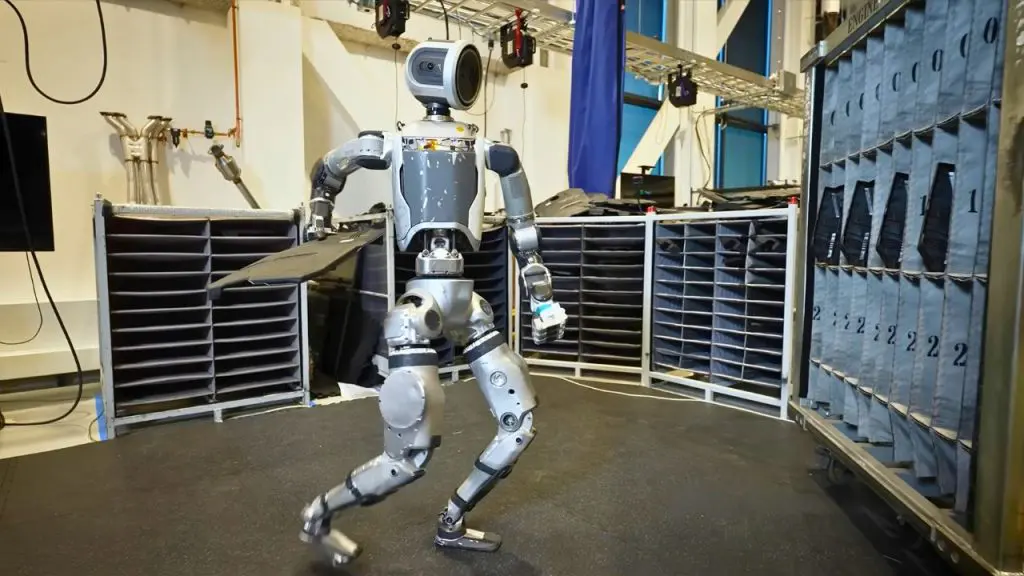
In the nearly 3-minute video, the fully electric Atlas moves with agility, adapts to obstacles on the fly, and recovers from errors on its own. All without human guidance.
Atlas moves engine covers between bins and a cart all by itself, using only a list of bin locations to guide it. It uses machine learning to find and recognize bins and fixtures around it, so it knows where everything is. That means Atlas can see and understand its surroundings instead of just following a fixed path. It can quickly adjust to changes, making it better suited for unpredictable tasks.
According to Boston Dynamics, a specialized grasping policy equips Atlas to handle and move objects without dropping or mishandling them. Its AI keeps track of each item’s position to handle it smoothly and securely.
Atlas reacts to changes around it like moving objects and unexpected obstacles. It does this by using sensors for vision, touch, and body awareness, which help it see and feel what’s happening around it. If it drops something or bumps into an object, Atlas corrects itself in real time.
Boston Dynamics says the robot’s moves are entirely generated on the spot, with no teleoperation or pre-set motions. The company boasted about Atlas’ high level of independence and real-time problem-solving abilities.
Boston Dynamics has been quietly making big moves as it seeks to commercialize Atlas. The company recently announced it’s joining forces with the Toyota Research Institute (TRI) to supercharge the advancement of humanoid robots. Their shared goal is to create smarter robots capable of solving real-world problems quickly and efficiently.
With this partnership, TRI will gain access to Boston Dynamics’ cutting-edge humanoid robot, Atlas. TRI will test its advanced AI models on this highly capable platform, focusing on enhancing the robot’s ability to handle multiple tasks and perform complex manipulations.

The data collected from these tests will help TRI further refine its AI models, allowing for faster problem-solving and more efficient robot performance. In return, Boston Dynamics will benefit from Toyota’s expertise in AI development. Toyota’s Large Behavior Models (LBMs) will improve Atlas’ dexterity and decision-making, enabling the robot to perform a wider range of tasks. Boston Dynamics, which is owned by Hyundai, plans to use Toyota’s AI to explore new innovations in robotics and ensure that Atlas can adapt to various real-world environments.
Atlas has been in development since 2013, when it was introduced as part of the DARPA Robotics Challenge seeking innovations in disaster response.