
China’s answer to Ameca, often called the world’s “most advanced humanoid robot,” has emerged with technical specs that outdo it on paper.
AnyWit Robotics was spun out of the University of Science and Technology of China (USTC) in Heifi in December 2023, shortly after President Xi called for the mass production of humanoids. The startup’s core founders include Cao Rongyun and Liang Cong, both alumni of USTC’s elite honors program. They say their mission is to create humanlike robots capable of rich emotional interaction through embodied intelligence.

The group began research and development into emotionally interactive humanoid robots as early as 2021, when they built a bionic robotic panda named Xiao Chuan as a special project for the Chengdu Giant Panda Museum. With realistic fur, the robot panda served as a guide to attract visitors and deliver educational content about pandas.
AnyWit’s first product was an interactive plush toy called Academic Cat, a robotics-infused smart doll. The AI-powered cat-like figure can understand the intent behind users’ questions and go in-depth discussing complex topics like quantum physics. Academic Cat was showcased at the Anhui Innovation Center as a highlight exhibit.

The team sees interactive robotic toys as an entry point into embodied intelligence. They’re not alone. OpenAI recently announced a deal with Mattel to bring its artificial intelligence into physical toys, which already has people fretting about M3GAN-like scenarios.
AnyWit introduced its flagship humanoid, Anni, in late 2024. The female-presenting robotic head features a highly expressive animatronic face with a reported 34 degrees of freedom (DoF). As documented, the android’s facial expressiveness surpasses the famous humanoid from Engineered Arts, which has 27 degrees of facial freedom.

Anni is capable of gaze tracking, recognizing a user’s identity, perceiving human emotions and behaviors, and autonomously generating appropriate emotional responses. Its LLM-backed dialogue system supports multilingual speech interaction with voice recognition, semantic understanding, and voice-lip synchronization for realistic talking.
The robotic platform integrates with a multimodal interaction suite by iFlytek, China’s leading speech recognition and AI technology provider. The state-of-the-art speech capabilities include noise-robust voice recognition and cloud-based Q&A generation. The technology is tightly integrated with AnyWit’s expressive face and gesture control systems so facial movements match dialogue context.

AnyWit is apparently in the early stages of commercializing its technology. The startup calls Anni its first-generation humanoid robot with standardized mass-production capability. The founders have secured angel-round financing from Yunxiu Capital, though the funding amount was not disclosed.
Anni bears a striking resemblance to Ameca, which became a viral sensation in 2021 with its human-like behavior and unique aesthetics. At the time, the humanoid robotics market was in a transitional phase, shifting away from research-driven platforms like Honda’s ASIMO.

The most visible social robots were Pepper and Sophia, which symbolized vastly different approaches to going to market. The Japanese tech giant SoftBank aggressively deployed Pepper across banks, retail stores, and hotels, but the strategy failed to deliver long-term value. The push likely contributed to the decline of Aldebaran Robotics, the French startup SoftBank had acquired to develop Pepper.

Meanwhile, Sophia from Hanson Robotics became a viral sensation in the late 2010s as the general public was fascinated with the idea of synthetic humans. However, the company suffered major cash flow problems in the early 2020s as live events and conferences were canceled during the COVID-19 pandemic.
Both Anni and Ameca feature smooth, light grey, hyper-realistic skin and clear skulls that reveal sensors, circuit boards, and servo mechanisms. When unveiling Ameca, Engineered Arts explained that the design team sought to avoid the uncanny valley effect, which is when a machine is almost, but not quite, human in appearance or behavior, unsettling observers.

They developed the robot to be as human-like as possible while reinforcing that Ameca is very much a machine. While Sophia was often positioned as a media personality or goodwill ambassador, Ameca was marketed more as a provocative science fiction character.
Ameca became a symbol of the next generation of robots: One that could stare back, react in real time, and make people question whether it’s possible for machines to become sentient. The timing meant Ameca was the most recognizable humanoid robot in the market just as the general-purpose robotics craze was intensifying.
Today, Engineered Arts and AnyWit are in a sea of competitors racing the embed their humanoid robots into daily life.
Founded in UK in 20024, Engineered Arts restructured as a US entity in late 2024 to expand its footprint and meet growing stateside demand. They raised $10 million in Series A funding, led by Helium 3 Ventures, bringing its total to more than $16 million. As of late, the startup has been emphasizing its desktop androids, like Azi, an Ameca counterpart with 27 actuators for facial expressions and five for neck movements.

There’s a strong case for desktop humanoids as a near-term entry point into the market. Full-sized bipedal humanoid robots still face major hurdles, like balance, energy efficiency, and real-world reliability, meaning their widespread use is likely years away. Desktop humanoids avoid those barriers. They can stay plugged in for power, rely on fewer mechanical parts and won’t injure anyone if they fall over.
If either Ameca or Anni become commercially successful, their desktop approach could give the companies a runway to refine the conversational AI and fund R&D for bipedal variants. It’s a strategy that other companies are apparently following, including Las Vegas-based Realbotix Corp., which is pitching its hyper-realistic humanoids for roles in customer service and event marketing.

While Realbotix and Engineered Arts operate in a niche market with limited institutional backing, Chinese firms like AnyWit get strategic support from local governments and public funding. It’s why interest in lifelike robots has surged in China since late 2023, when the government set out to mass produce humanoids by 2025 and lead the market by 2027.
One of the perceived leaders in industrial humanoids, Shenzhen-based UBTECH Robotics, recently unveiled its first ultrarealistic android named Una (Xiao You). In early 2025, UBTECH announced a partnership with Easyhome New Retail Group, one of China’s largest retail chains, to deploy 500 humanoids, including Una, into its stores this year.
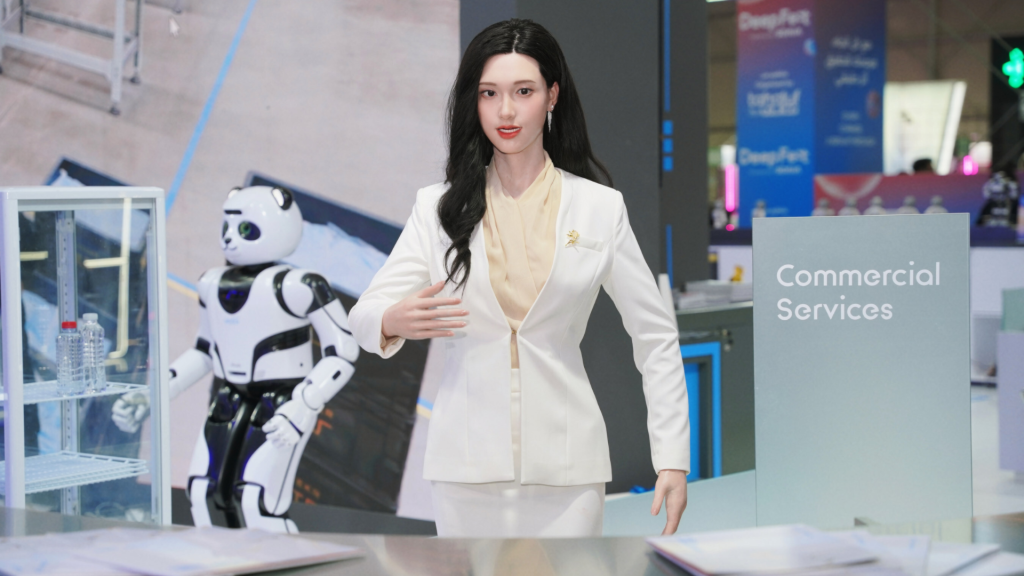
Another Shenzhen firm, DIGIT, recently introduced its flagship hyper-realistic humanoid robot named Xia Lan. The startup, which was founded in 2024, says the robot’s advanced facial actuation system allows for seven categories of human expression and 22 distinct facial actions.
Shanghai-based Zhuoride Robotics has developed a line of ultrarealistic androids, including Cuiha, a life-sized robotic bust that’s gone viral for its level of realism. Its skin features embedded flexible electronic skin sensors for a sense of touch. Its eyes, with dialing pupils, are another highlight.

Another newer startup, AheadForm, has gained attention for its lifelike robotic heads that can predict people’s emotions. Founded by Yuhang Hu, who has a PhD in robotics from Columbia University, the startup recently unveiled its Real Elf series of robots that feature up to 30 artificial muscles for facial expressions and a hyper-realistic Monk android.

The startups emerging are up against EX Robot, which has become synonymous with China’s push for humanlike emotionally intelligent androids in recent years. The Dalian-based firm is executing on a radical growth strategy that it says is already delivering returns. EX Robot is pretty much always going viral for its uncannily human creations that evoke amazement from some and horror from others.